5 Decoders in Action
This chapter pivots from building a semantic search backbone to showing how decoder models—large language models—turn retrieved facts into clear, conversational, and personalized output. It outlines the core mechanics of decoder-only transformers: autoregressive next-token prediction over embedded, position-aware sequences processed through masked self-attention and feed-forward layers. With this foundation, the chapter frames decoding not just as model architecture, but as a set of choices that directly shape tone, coherence, and creativity—preparing the ground for combining search and generation in a full RAG system.
The text then puts “decoders in action,” contrasting decoding strategies and their trade-offs: greedy decoding for speed but limited variety, beam search for broader exploration, and probabilistic methods—temperature, top-k, and top-p sampling—for calibrated creativity. From there it moves to prompting as the practical interface to LLMs: starting with zero-shot instructions, improving reliability with few-shot exemplars, and unlocking reasoning via chain-of-thought prompts (including zero-shot and few-shot CoT). Through hands-on examples—using a hotel-search scenario—the chapter demonstrates how thoughtful decoding and prompting convert raw, relevant results into structured, evidence-backed analyses and tailored recommendations, while underscoring the crucial distinction between generative models and search engines.
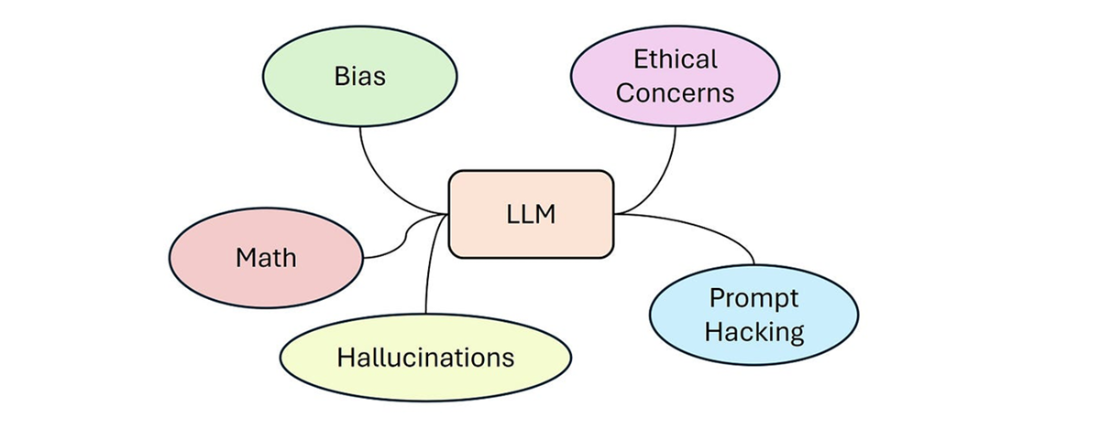
Finally, it surveys the model landscape and operational choices: closed-source leaders (e.g., GPT-4 class) for peak capability versus open-source options (e.g., Llama, Mistral) for control, privacy, customization, and potentially lower long-term cost. Selection hinges on task complexity, latency, budget, deployment constraints, governance, and team expertise, along with monitoring and fallback strategies to manage risk. The chapter closes with a candid look at LLM pitfalls—bias, hallucinations, prompt injection/hacking, and math errors—and argues for safeguards and grounding, setting up the next step: Retrieval-Augmented Generation to blend trustworthy retrieval with fluent, user-centered generation.
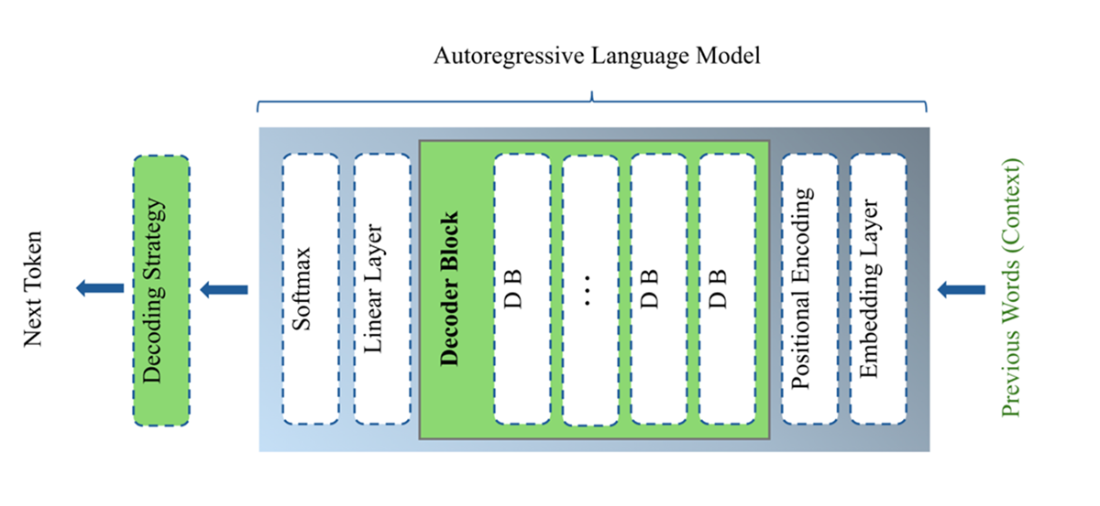
Autoregressive Language Models predict the next word by processing a sequence of previous words. They use embedding, positional encoding, and multiple decoder blocks to generate a probability distribution for the next word.
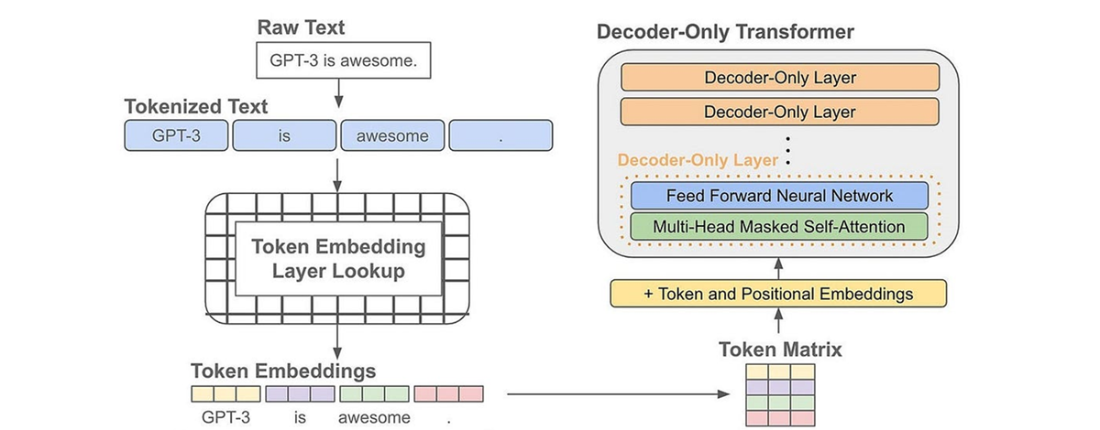
Process of how a Decoder-Only Transformer model, like GPT-3, processes text by converting raw text into tokenized representations, embedding them, and feeding them through multiple layers of self-attention and feed-forward networks to generate an output.
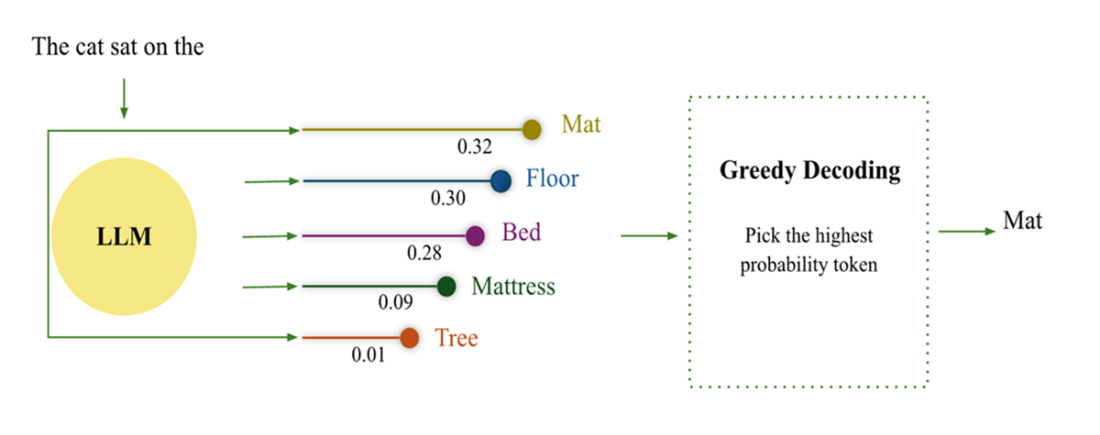
Greedy Decoding method used by Large Language Models. The LLM generates a probability distribution for the next word, and Greedy Decoding selects the word with the highest probability
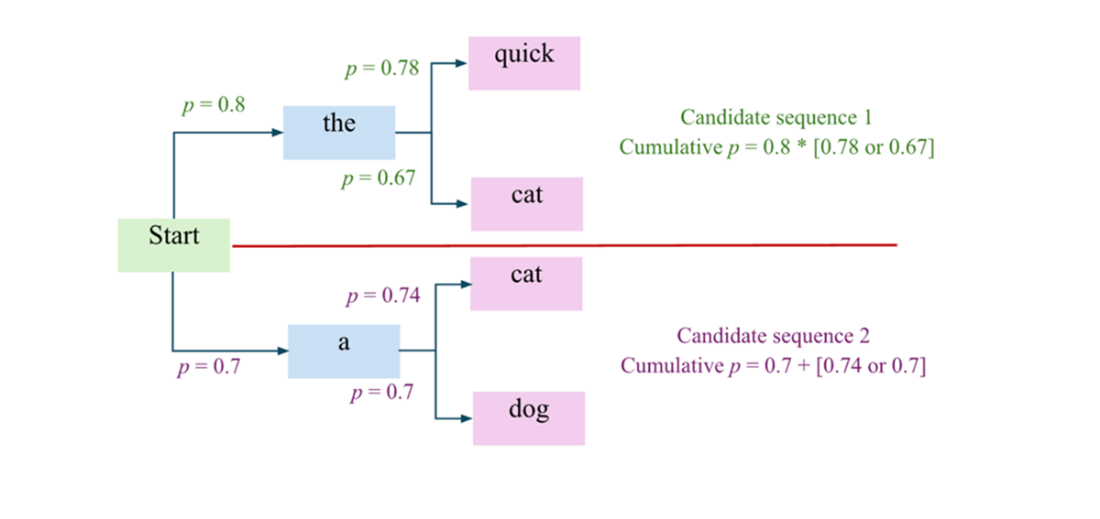
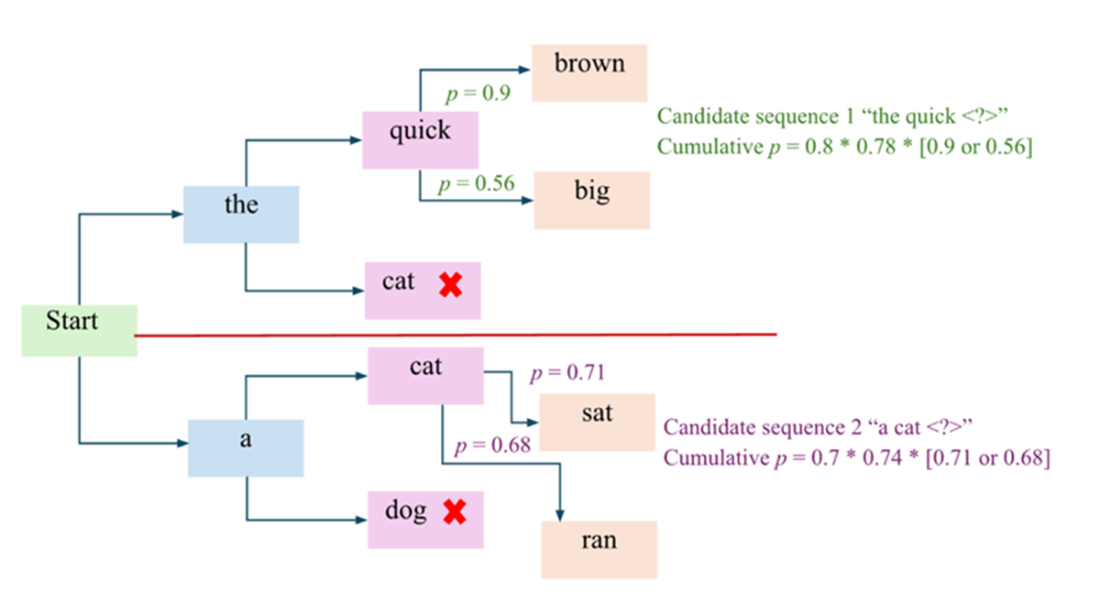
Beam search starting with two candidates, “the” and “a.” Two candidate sequences are highlighted, each with a calculated cumulative probability based on the probabilities of the individual words within the sequence.
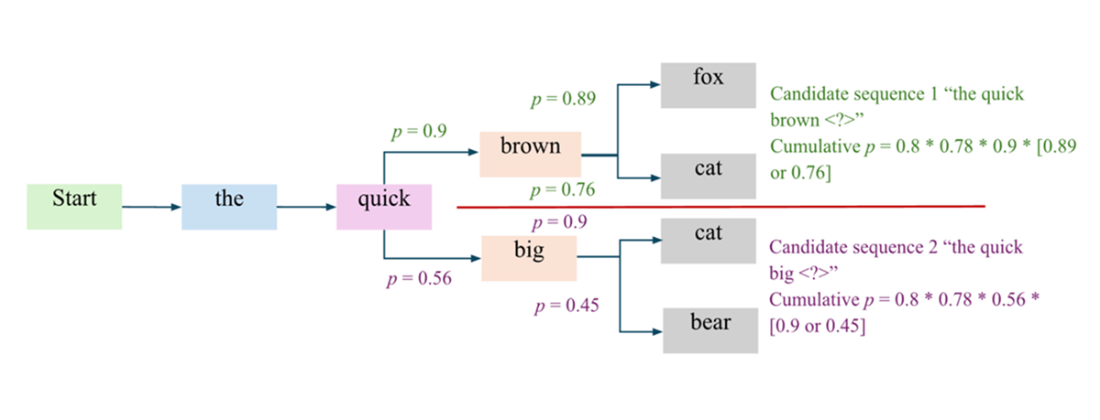
The word network has been expanded, with new words and probabilities added, resulting in updated candidate sequences and cumulative probabilities, while some words have been marked as incorrect
The final image presents the complete word network with updated candidate sequences and their probabilities, along with identified incorrect words.
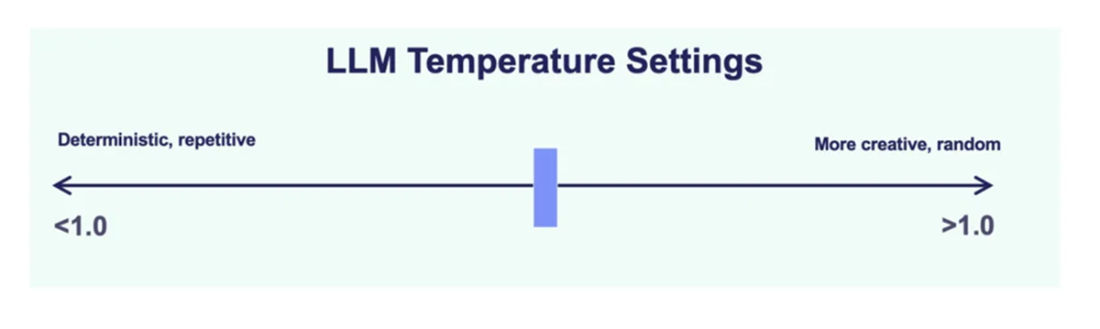
An overview of how temperature settings in LLMs control the balance between deterministic, repetitive output (low temperature) and more creative, random output (high temperature).
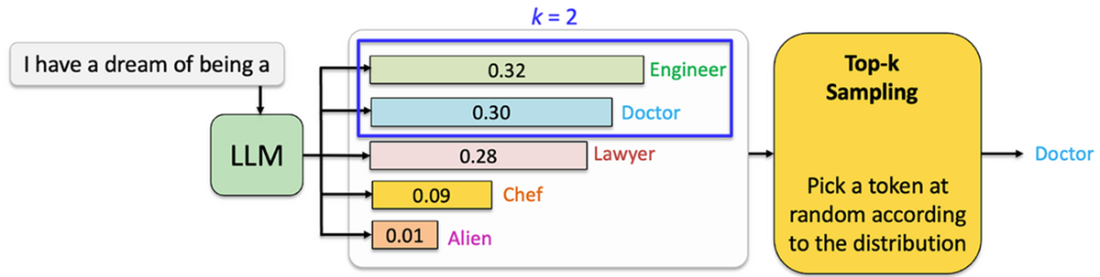
Top-k sampling in LLMs, where the model generates a probability distribution for the next word, and only the top-k most probable words are considered, with the final word chosen randomly based on their probabilities.
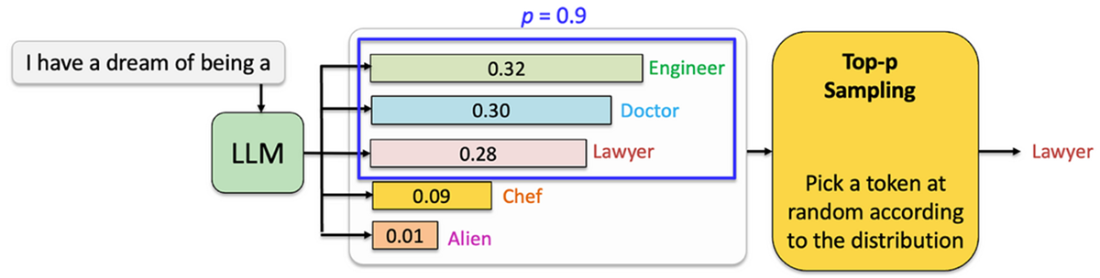
Top-p sampling in LLMs, where the model generates a probability distribution for the next word, and only the subset of words with a cumulative probability up to the threshold (p) are considered, with the final word chosen randomly based on their probabilities.
In this example we explore two approaches to prompting a language model to solve a word problem: reasoning extraction, where the model explains its steps, and answer extraction, where the model directly provides the numerical answer. [Source]
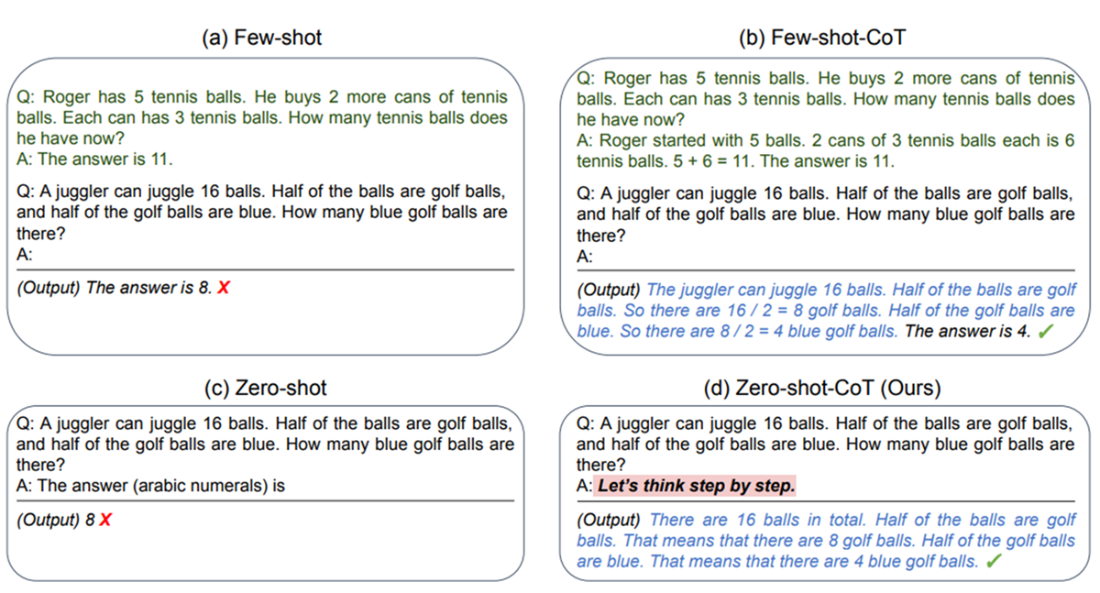
In this example we explore adding a simple "Let's think step by step" instruction to Few-shot prompts can significantly improve a language model's ability to solve word problems by encouraging it to reason through the steps. (image source: https://arxiv.org/pdf/2201.11903)

Hugging Face website, which hosts a large collection of open-source models. The models are organized by text generation (LLM), with the most popular models listed at the top.

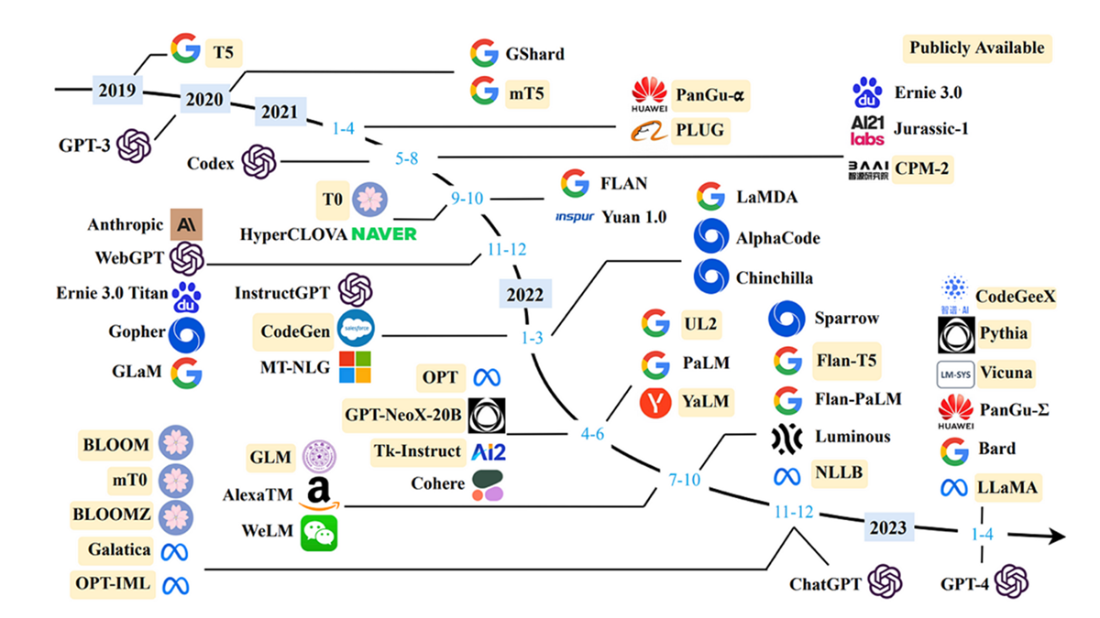
Timeline for existing large language models. Source: http://arxiv.org/abs/2303.18223
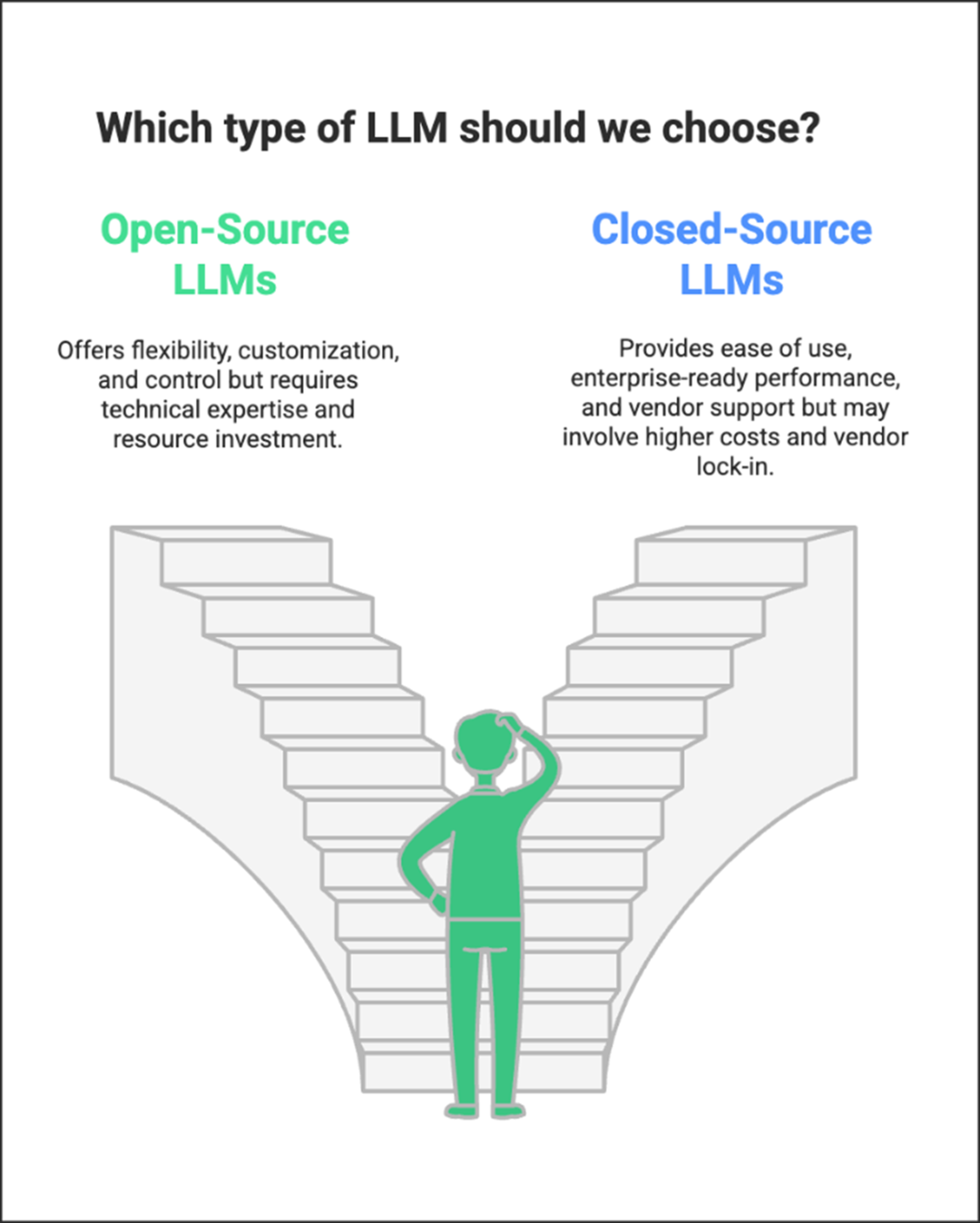
A simplistic overview on choosing Open Source vs. Closed Source LLMs
LLMs are not without challenges, in fact, they have struggled with a myriad number of challenges and limitations
Summary
- Decoder models, in contrast to Encoders, are Auto Regressive in nature, making them well-suited for tasks like content generation, translation, and conversation. Their ability to generate text one token at a time, while considering all previous tokens, enables them to produce coherent and contextually appropriate outputs.
- The foundation of decoder models lies in their sophisticated attention mechanisms and ability to maintain context across long sequences. Through various Decoding Algorithms, these models can process information while ensuring causality in generation, making them particularly effective for tasks requiring sequential understanding and generation.
- Decoding algorithms such as greedy decoding, beam search, and various sampling techniques offer different approaches to generating text from these models. These algorithms balance factors like diversity, coherence, and computational efficiency, allowing users to optimize outputs for specific use cases.
- Prompting techniques play a crucial role in effectively utilizing decoder models. From basic zero-shot prompting to more sophisticated few-shot and chain-of-thought approaches, these techniques enable users to guide the model's behavior and improve output quality. The evolution from simple prompts to engineered instructions has significantly enhanced our ability to control and optimize model outputs.
- The landscape of decoder models spans both open-source and closed-source options, each with distinct advantages. While closed-source models like GPT-4 offer state-of-the-art performance through APIs, open-source alternatives like Llama provide flexibility and customization options. The choice between them depends on factors such as privacy requirements, cost considerations, and technical expertise.
- The practical implementation of decoder models requires careful consideration of deployment strategies, resource requirements, and integration approaches. Whether using API-based services or deploying open-source models, understanding these aspects is crucial for successful implementation in production environments.
- Looking ahead, the field of decoder models continues to evolve with improvements in model architectures, training techniques, and deployment options. The growing ecosystem of tools and frameworks makes these models increasingly accessible while offering more sophisticated options for customization and optimization.

 Build an Advanced RAG Application (From Scratch) ebook for free
