9 Structure-based Drug Design with Active Learning
Structure-based drug design uses the three-dimensional structure of a protein target to guide the search for molecules that can bind and modulate its function. The chapter begins by showing how molecular docking supports this process: a ligand is placed into a defined binding site, many possible poses are sampled, and each pose is scored to estimate how well it may bind. Because proteins are flexible and experimental structures can be incomplete or uncertain, the chapter emphasizes that docking is only as reliable as the structures and preparation steps used to set it up.
The chapter then walks through a practical docking pipeline, from separating a protein-ligand complex into receptor and ligand files to defining a docking box around the known binding site and running AutoDock Vina. It highlights important preparation choices such as protonation, tautomer handling, water and metal retention, and ligand geometry, since these can strongly affect scores and rankings. The resulting poses are validated by comparing them with known crystallographic poses and by inspecting interaction patterns, reinforcing that docking output should be interpreted as an approximation rather than a final answer.
To address the cost of screening massive modern compound libraries, the chapter introduces deep docking and active learning. A surrogate neural network is trained on a small set of docked molecules to predict docking scores for the rest, and acquisition functions are used to choose the next molecules most worth evaluating, balancing exploration and exploitation. The same framework is extended to free energy perturbation for lead optimization, where active learning can help identify better protocols and focus expensive simulations on the most informative cases, reducing computational burden while improving decision-making.
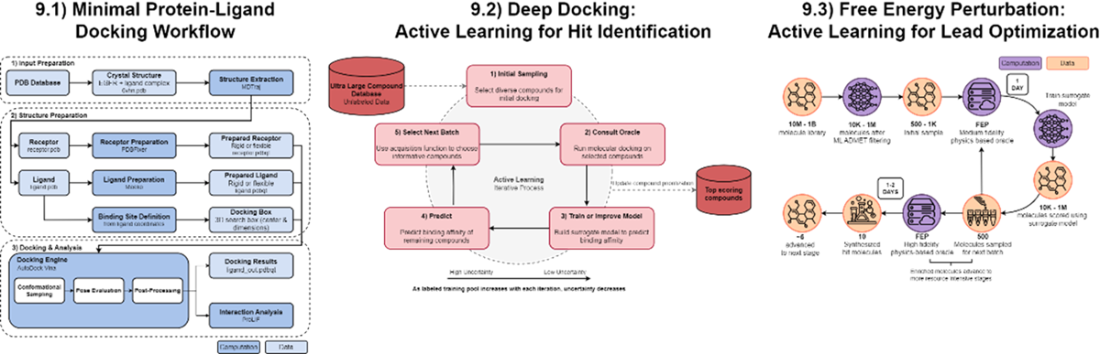
We cover three scenarios. We start with a minimal protein-ligand docking workflow, understanding its value and limitations. These limitations lead us to active learning, which we can facilitate with ML models, including neural networks, to efficiently progress hit identification and lead optimization.
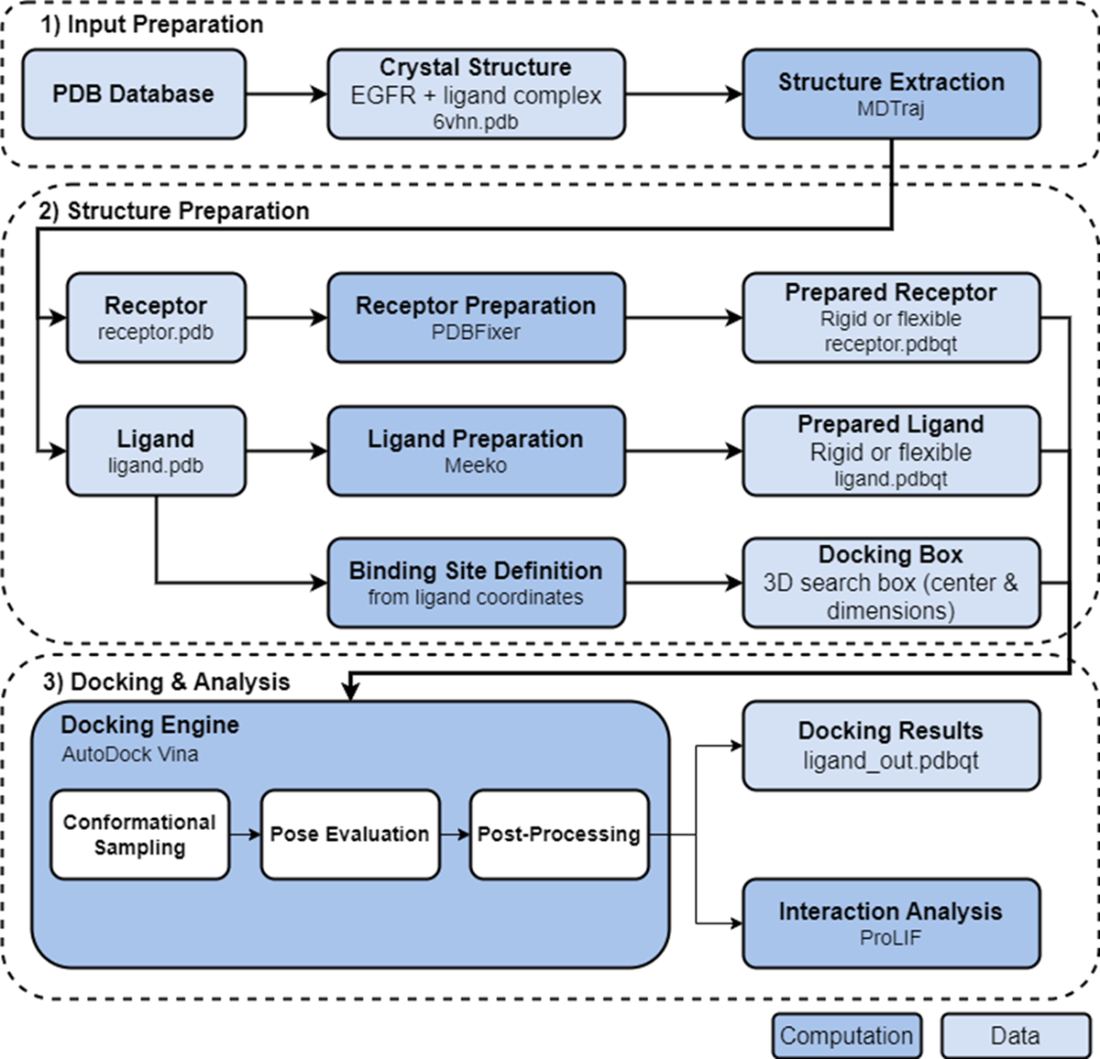
Schematic overview of our protein-ligand docking workflow for structure-based drug design, illustrating a pipeline from obtaining the initial protein-ligand structure to analyzing molecular interactions in the docked complexes. The process consists of three main stages: (1) Input Preparation, where the EGFR-ligand complex structure is obtained from the PDB database and separated using MDTraj; (2) Structure Preparation, involving receptor preparation with PDBFixer, ligand preparation with Meeko, and binding site definition based on ligand coordinates; and (3) Docking & Analysis, where AutoDock Vina performs conformational sampling and pose evaluation, followed by post-processing and interaction analysis using ProLIF. Dark blue rectangles represent computational tools, while rectangles indicate processes within the docking engine, and light blue rectangles represent the data files we reference throughout this chapter’s Python notebook.
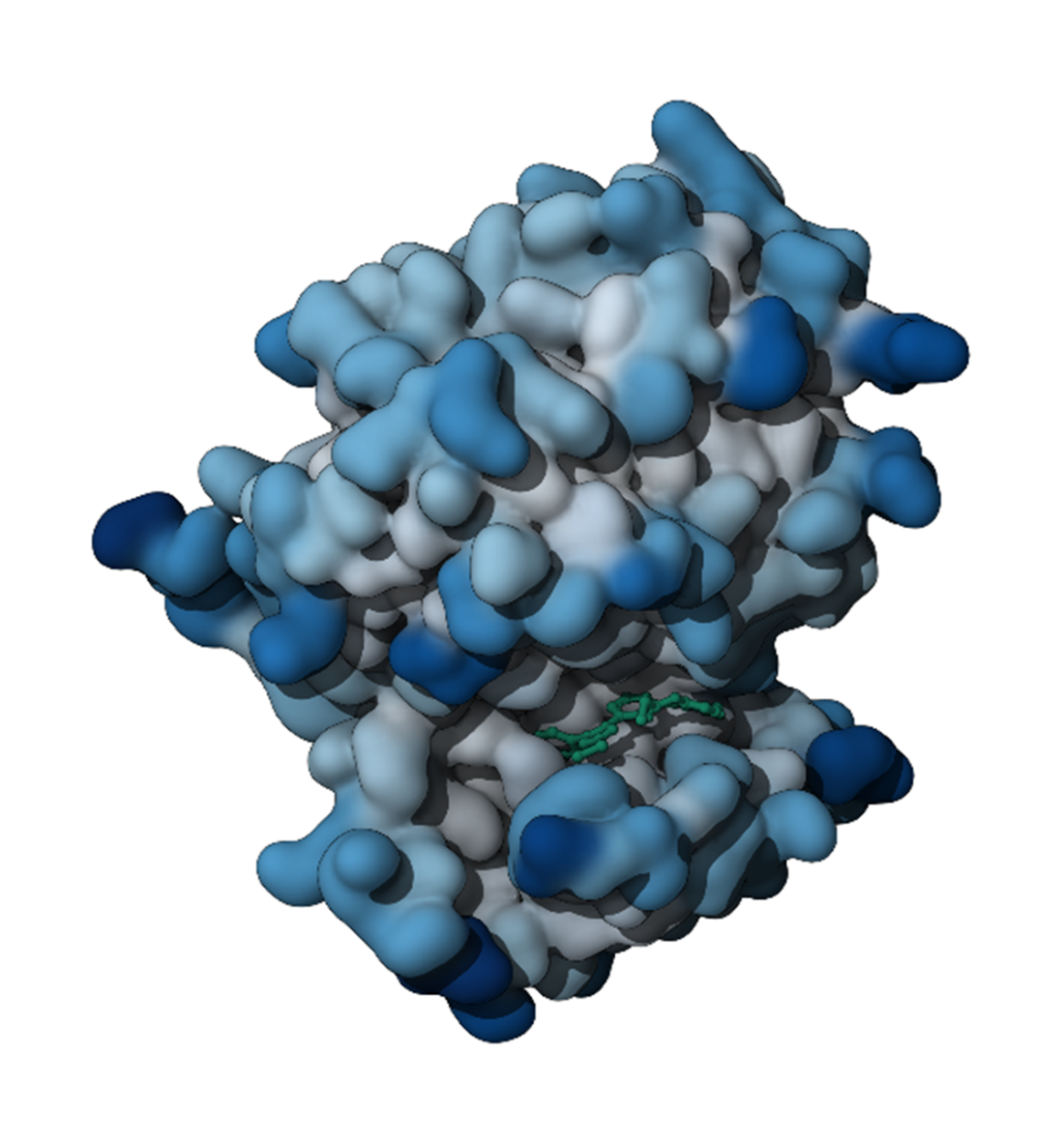
Wild type EGFR in complex with LN2057 obtained by X-ray diffraction (PDB ID: pdb_00006vhn). We represent EGFR as a Gaussian surface, which renders the 3D shape of the protein in a way that emphasizes its overall volume and shape (rather than a detailed atomic structure). We color EGFR by its accessible surface area, which renders the protein surface in colors ranging from white to dark blues. The least accessible (buried) residues are colored white. The darker blues reflect greater exposure of the corresponding residues. Refer to this video on Mol* for a tutorial on visualizing biomolecular structures using Mol* in PDB.
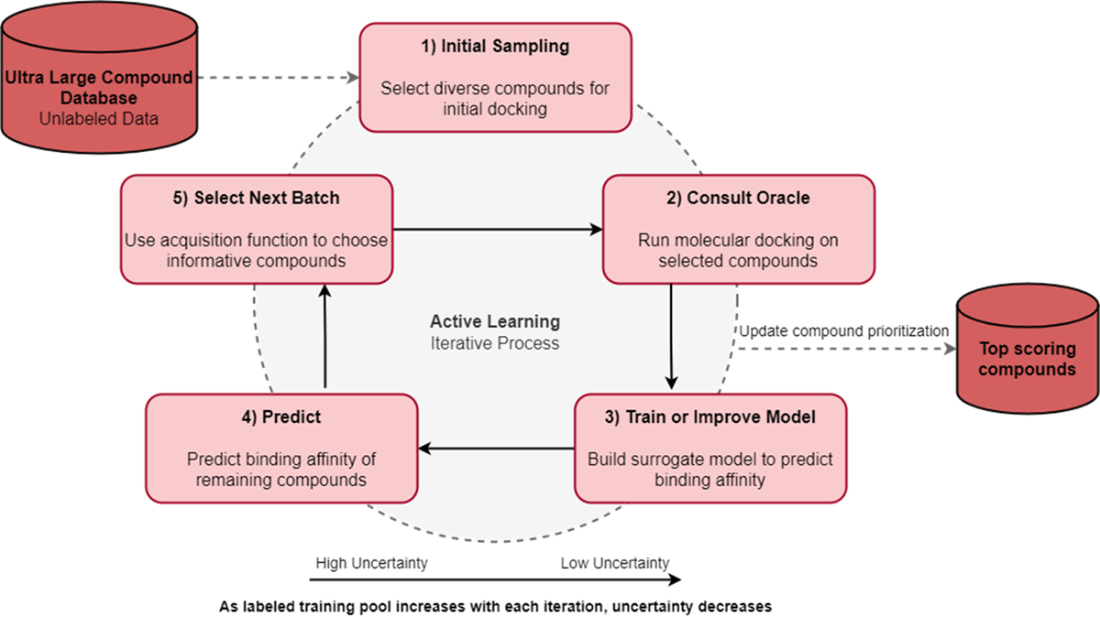
Active learning framework for accelerated hit discovery in structure-based drug design. The iterative workflow begins with (1) initial sampling of diverse compounds from an ultra-large compound database, followed by (2) molecular docking evaluation of the selected compounds to generate binding affinity scores. These results are used to (3) train or improve a surrogate machine learning model, which then (4) predicts binding affinities for the remaining compounds in the database. Based on an acquisition function that balances exploration and exploitation, the system (5) selects the next batch of informative compounds for evaluation. This cycle continues until convergence, with promising candidates transferred to the top-scoring compounds collection. Uncertainty decreases as the labeled training pool expands with each iteration, enabling efficient exploration of vast chemical spaces without exhaustive docking of all compounds.


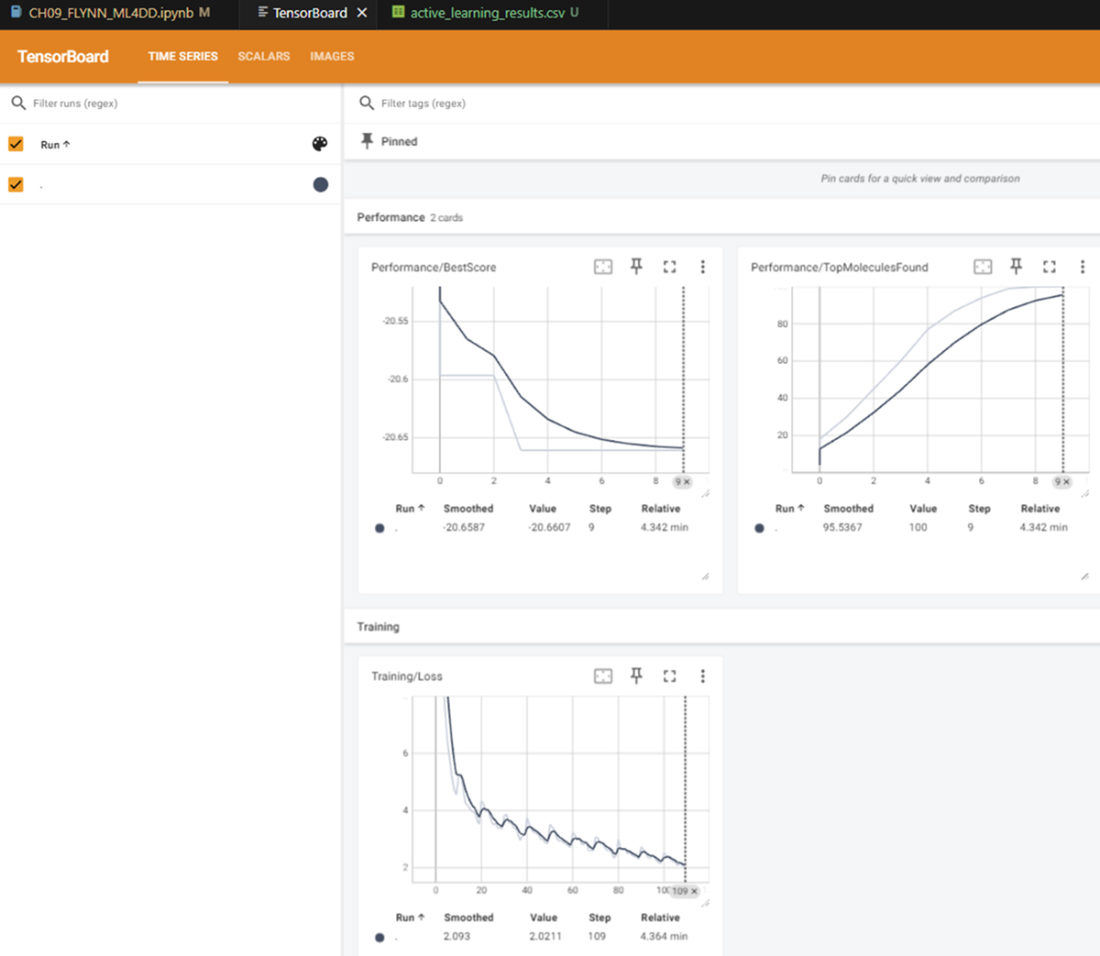
TensorBoard visualization of model training metrics for progressive docking in structure-based drug design. The dashboard displays three key performance metrics: (left) best docking score progression showing a steady decrease to roughly -20.7 kcal/mol (the best score reported in the results table above), indicating improved docking-score predictions; (right) top molecules found increasing to 73 of the top 100 (about 73%), demonstrating the model's growing ability to identify high-scoring compounds; and (bottom) training loss curve exhibiting typical convergence behavior as it decreases from ~6 to ~2 over 100 epochs. The performance metrics reveal the effectiveness of the active learning approach in progressively refining predictions while reducing computational requirements compared to exhaustive docking of the entire compound database.
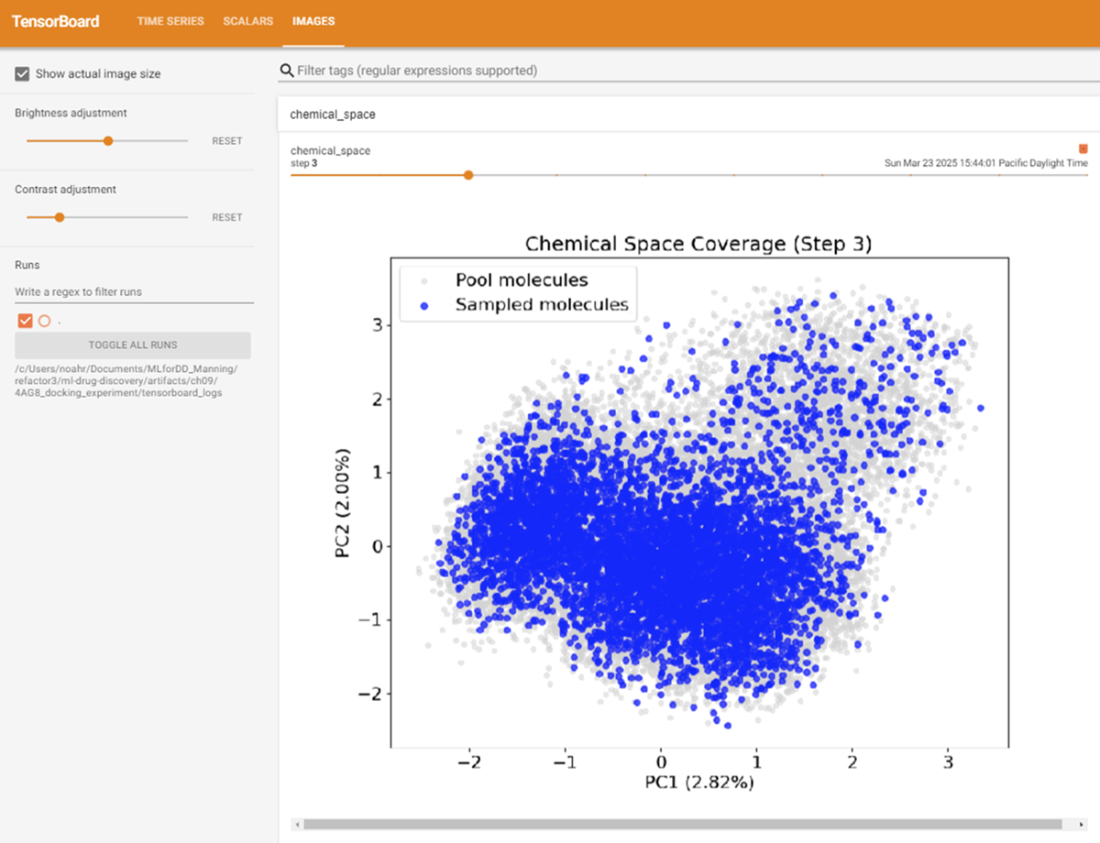
Chemical space coverage visualization at Step 3 of the progressive docking workflow. The scatter plot displays the distribution of compounds in a two-dimensional projection of chemical space using the first two principal components (PC1 and PC2), which capture 2.82% and 2.05% of the total variance, respectively. Blue points represent sampled molecules selected for docking evaluation, while gray points indicate the remaining pool molecules in the database. This representation helps assess the chemical diversity of the compounds being evaluated at this iteration of the active learning process.
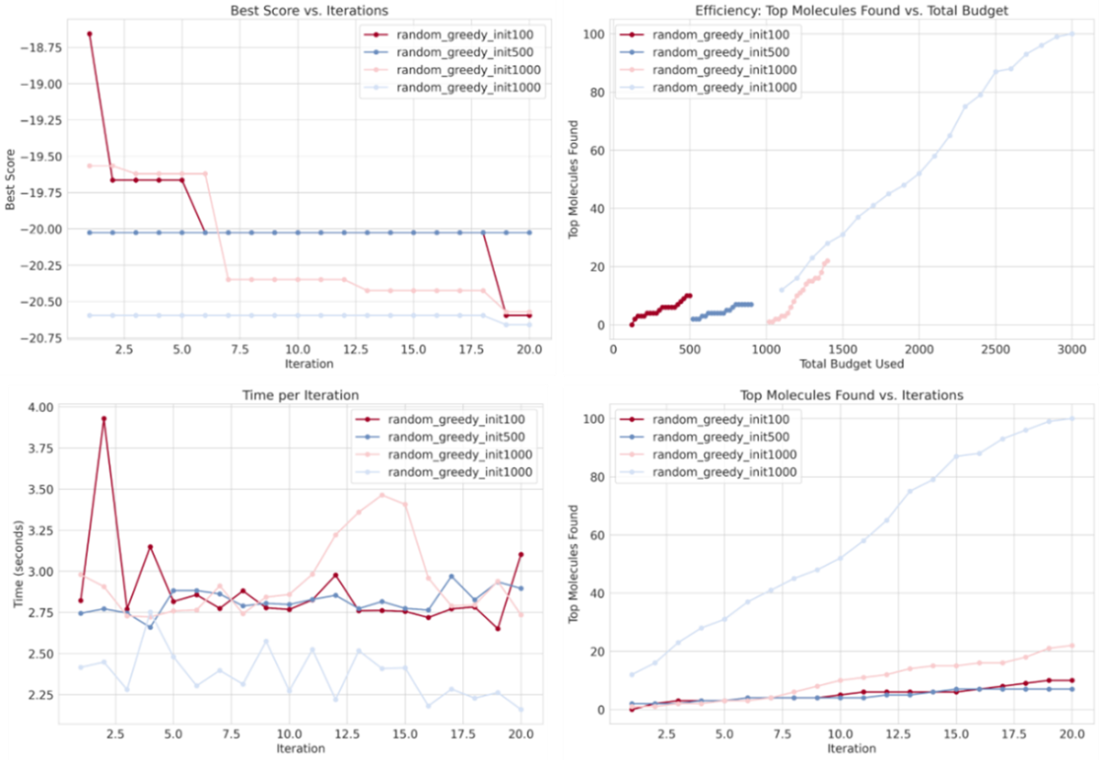
Results from active learning experiments across four different parameter combinations. Each configuration uses random sampling, a greedy acquisition function, and 20 active learning iterations. The dark red line represents an initial sample count of 100 and budget per iteration of 20 molecules. The dark blue line represents an initial sample count of 500 and budget per iteration of 20 molecules. The light red line represents an initial sample count of 1000 and budget per iteration of 20 molecules. The light blue line represents an initial sample count of 1000, and budget per iteration of 100 molecules.
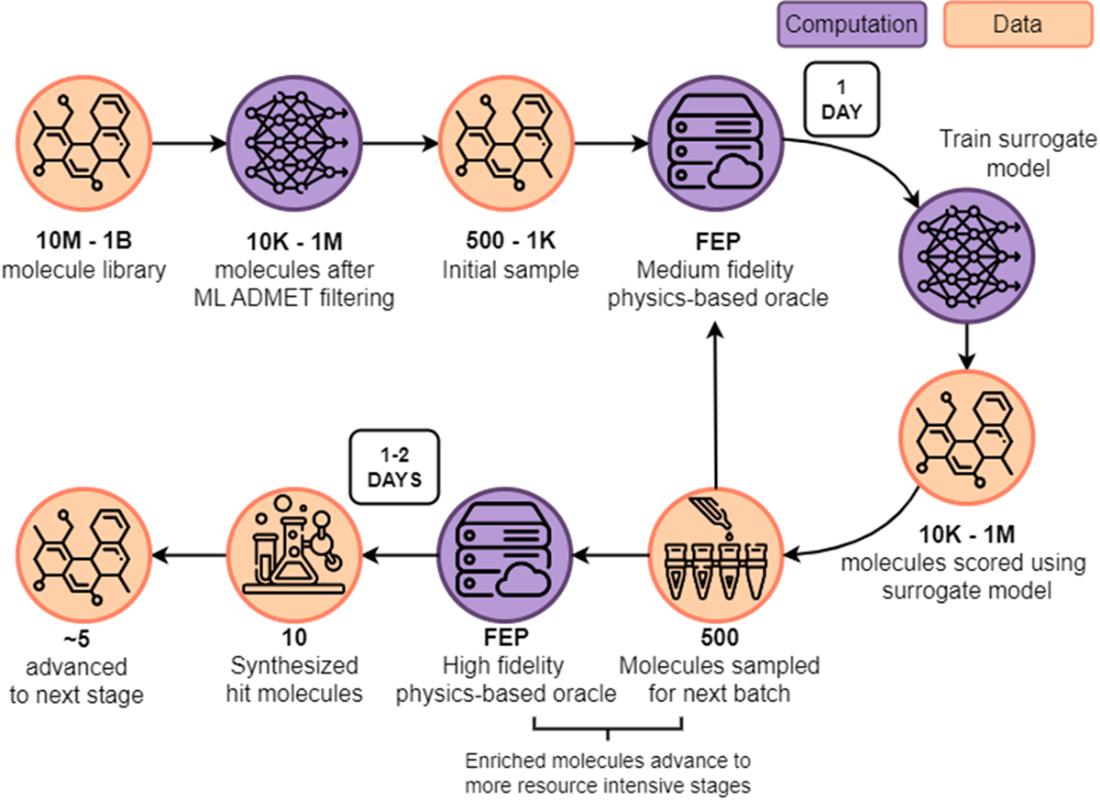
Multi-stage active learning pipeline for structure-based lead optimization using free energy perturbation (FEP) calculations. The workflow begins with a large molecule library (10M-1B compounds) that is filtered down to 10K-1M molecules using machine learning ADMET models. From this filtered set, an initial sample of 500-1K diverse compounds undergoes medium-fidelity FEP evaluation (~1 day of computation). These results train a surrogate model that rapidly scores 10K-1M molecules to identify promising candidates. Based on these predictions, 500 molecules are strategically sampled for high-fidelity FEP analysis (1-2 days), resulting in approximately 10 synthesized hit molecules that advance to subsequent development stages. The diagram illustrates how computational resources (purple) are efficiently allocated to increasingly smaller but higher-quality compound sets (orange), enabling exploration of vast chemical spaces while concentrating expensive physics-based calculations on the most promising candidates.
Summary
- We integrated DL and active learning techniques in SBDD to address the computational challenges of virtual screening in massive chemical spaces. We began by implementing a complete molecular docking workflow to understand the fundamentals of protein-ligand interactions, focusing on an EGFR target. This workflow demonstrated how to prepare protein and ligand structures, define binding sites, conduct docking simulations using AutoDock Vina, and analyze the resulting interaction fingerprints.
- We addressed a critical bottleneck in drug discovery: the prohibitive computational cost of exhaustively docking billions of potential compounds from modern Synthesis on Demand (SoD) libraries. To overcome this challenge, we implemented a deep docking approach using active learning, which strategically selects only the most promising compounds for full docking evaluation while using a surrogate model to estimate binding affinities for the remaining compounds.
- Our active learning implementation included several components: a neural network surrogate model that predicts binding affinities from molecular fingerprints; strategic initial sampling methods to establish a diverse starting point; various acquisition functions (greedy, uncertainty sampling, probability of improvement, and expected improvement) that balance exploration and exploitation; an iterative learning loop that progressively refines the surrogate model with new data; and experiment management tools for analyzing and comparing different active learning strategies.
- The results demonstrated that active learning can dramatically reduce the computational resources required for virtual screening while still identifying the most promising drug candidates. Our experiments with the VEGFR-2 kinase target (PDB ID: 4AG8) showed that only a small fraction of the compound library needed to be docked to recover a large share of the top-scoring molecules—73 of the top 100 after 10 iterations in our run.
- We explored how these active learning principles extend beyond docking to more computationally intensive methods like Free Energy Perturbation (FEP) calculations, which provide more accurate binding affinity predictions during lead optimization. We discussed how active learning can be used not only to prioritize which molecules undergo FEP evaluation but also to optimize the FEP protocols themselves.
- The techniques presented in this chapter provide a framework for navigating the vast chemical space of potential drug compounds more efficiently, enabling exploration of billions of molecules with limited computational resources by combining physics-based understanding of molecular interactions with pattern recognition capabilities of ML.
FAQ
What is structure-based drug design (SBDD)?
Structure-based drug design uses the 3D structure of a biological target, such as a protein, to guide the design and selection of molecules that can bind to and modulate its function.
What is molecular docking in the context of SBDD?
Molecular docking is a computational technique that simulates how a small molecule fits into a protein binding site and estimates how favorable that interaction may be using a scoring function.
Why is docking often used for virtual screening?
Docking can rank large numbers of compounds by predicted binding score, helping prioritize the most promising candidates for more expensive computational or experimental evaluation.
Why is traditional docking computationally expensive?
Docking must explore many possible ligand poses and conformations, which becomes costly when screening very large libraries that may contain millions or billions of molecules.
What is progressive docking?
Progressive docking is an approach that docks only a subset of molecules first, trains a model on those results, and then uses the model to predict scores for the rest of the library to reduce the total amount of docking required.
Why is protein and ligand preparation important before docking?
Preparation affects docking reliability. Protonation, missing atoms, waters, metals, tautomer states, chirality, and ligand geometry can all change docking scores and rankings.
What is the purpose of the binding box in docking?
The binding box defines the 3D search region where docking explores possible poses, helping focus computation on the known or likely binding site.
How is the docking score from AutoDock Vina interpreted?
Vina returns an estimated affinity score in kcal/mol-like units. Lower values indicate more favorable predicted binding, but the score is an approximation rather than a true measured binding free energy.
What is active learning in deep docking?
Active learning iteratively chooses which molecules to dock next using a surrogate model, so the model can learn from the most informative samples and improve screening efficiency.
Why are acquisition functions important in active learning?
Acquisition functions decide which molecules to evaluate next by balancing exploration and exploitation. They may prioritize the most uncertain molecules, the best predicted molecules, or a mix of both.

 Build AI Drug Discovery Pipelines ebook for free
