2 Ligand-based Screening: Filtering & Similarity Searching
This chapter introduces virtual screening as the computational counterpart to experimental high-throughput screening, emphasizing how it can rapidly narrow enormous chemical libraries into a manageable set of promising candidates. The overall idea is to use progressively more selective, and usually more expensive, methods to enrich for compounds likely to affect a biological target. In the example workflow, the process begins with simple filtering, then moves to ligand-based screening, and only later would progress to docking or molecular dynamics if structural information and resources allow.
The chapter then focuses on the practical steps needed to prepare a compound library for ligand-based screening. It explains how to load molecular data from an SDF file into RDKit and Pandas, sanitize molecules to remove chemically invalid or problematic entries, and compute molecular descriptors such as molecular weight, hydrogen-bond donors and acceptors, and logP. These descriptors support drug-likeness screening, especially with rules such as Lipinski’s Rule of Five, and the text also highlights substructure-based filters like PAINS, BRENK, and custom structural alerts to remove likely assay interferers, reactive motifs, and toxic liabilities. Together, these filters substantially reduce the starting library while improving downstream efficiency.
Finally, the chapter explains how molecules are converted into fingerprints so they can be compared numerically in similarity searches. It describes structural keys and hashed fingerprints, with Morgan fingerprints used as the main example, and shows how similarity coefficients such as Tanimoto and Dice measure overlap between binary feature vectors. Using known antimalarial compounds from the Malaria Box as queries, the chapter demonstrates a ligand-based similarity search against a filtered SPECS library, finding a smaller set of candidate hits for further study. The key takeaway is that similarity search is a fast and useful first pass, but it is not definitive: structurally similar molecules can still differ in activity, so later machine learning and other methods are needed to refine and validate the results.
Virtual screening pipelines are often hierarchical, proceeding with a broad, large number of compounds through simpler, less restrictive, and computationally cheaper processes to whittle down the quantity of compounds. If the 3D structure of the target is not defined, we’re restricted to ligand-based virtual screening. If it is defined, then we can explore structure-based virtual screening, potentially as a downstream component to ligand-based virtual screening.
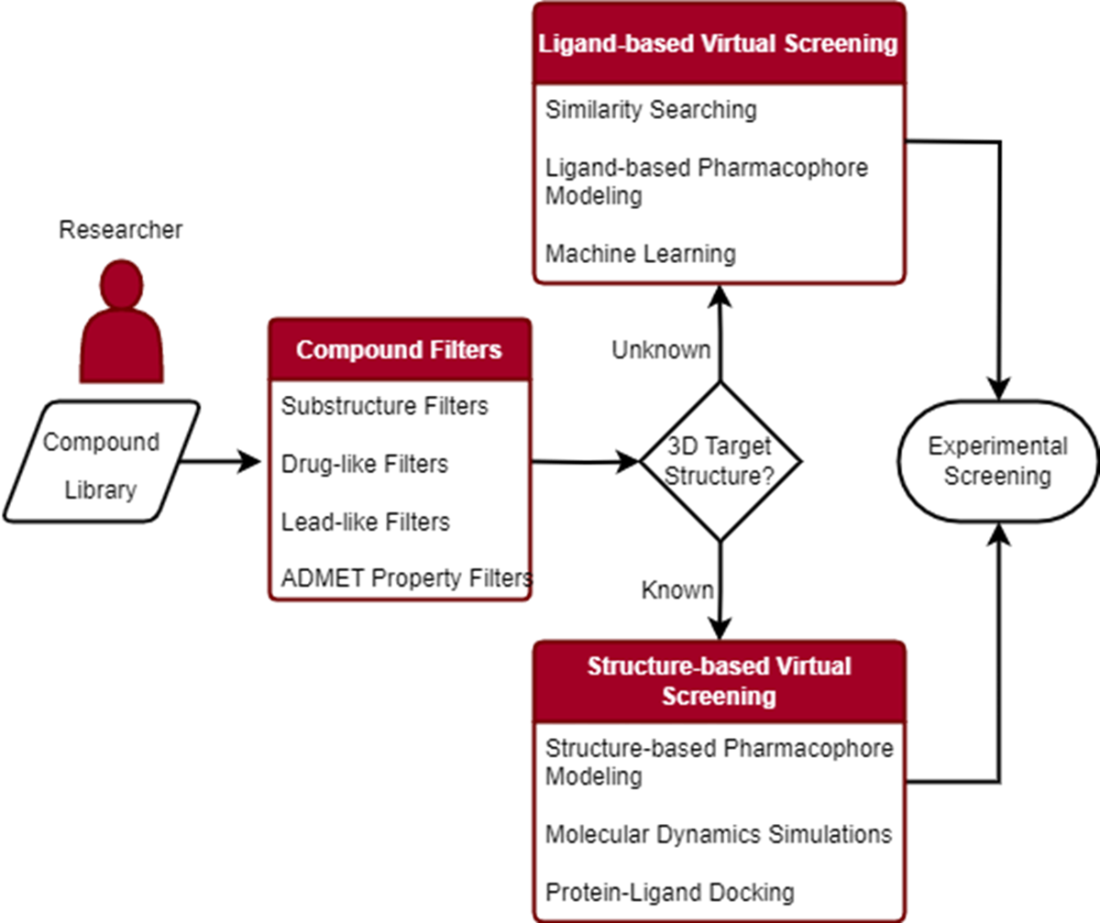
Regarding ligand-based strategies, machine learning becomes available if we have examples of both positive class and negative class compounds within our data. If we only have examples of positive class compounds, then search based strategies are more appropriate. Positive class means the compound is “positive” for the property we are assessing whether it be activity, toxicity, or some other property.
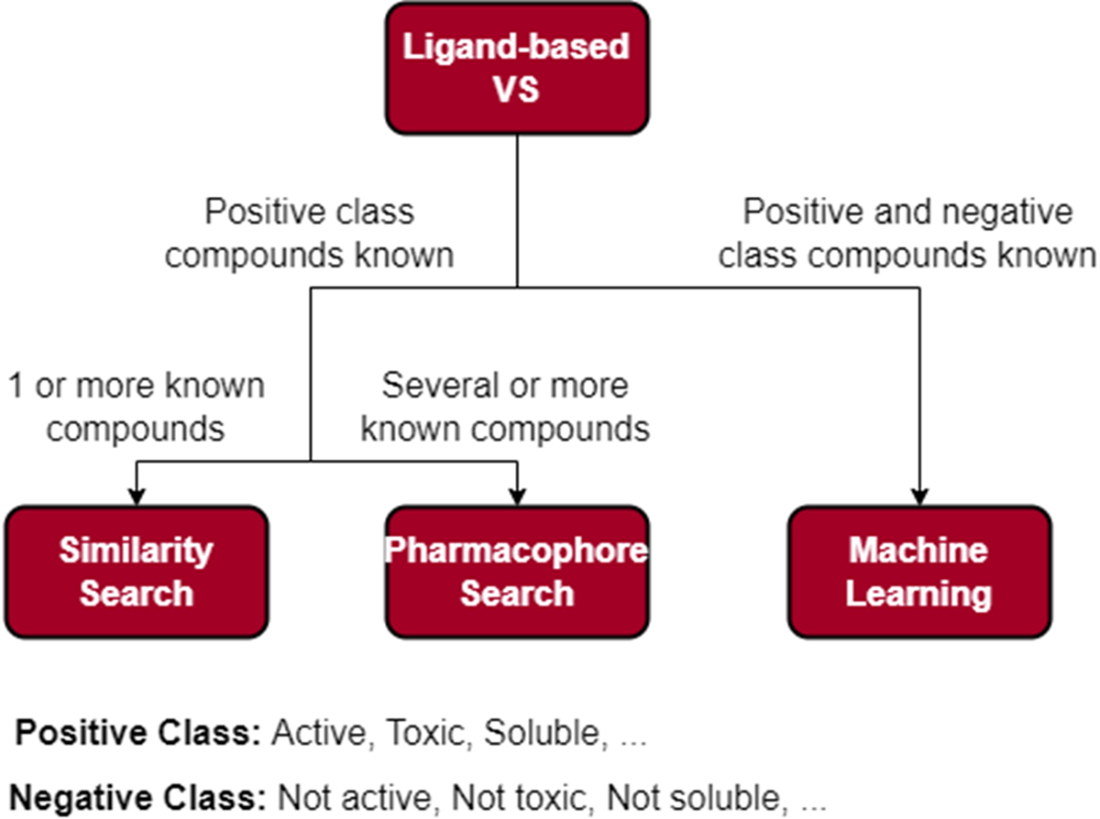
Structure-property relationships are nuanced. Discovering similar molecules doesn’t guarantee desired, similar function with respect to a query molecule.
Example of RDKit output when calling a Mol object in our notebook cell. Note that an RDKit Mol object is not an image-based object. It is a central data structure within RDKit. Calling type(mol) outputs rdkit.Chem.rdchem.Mol.
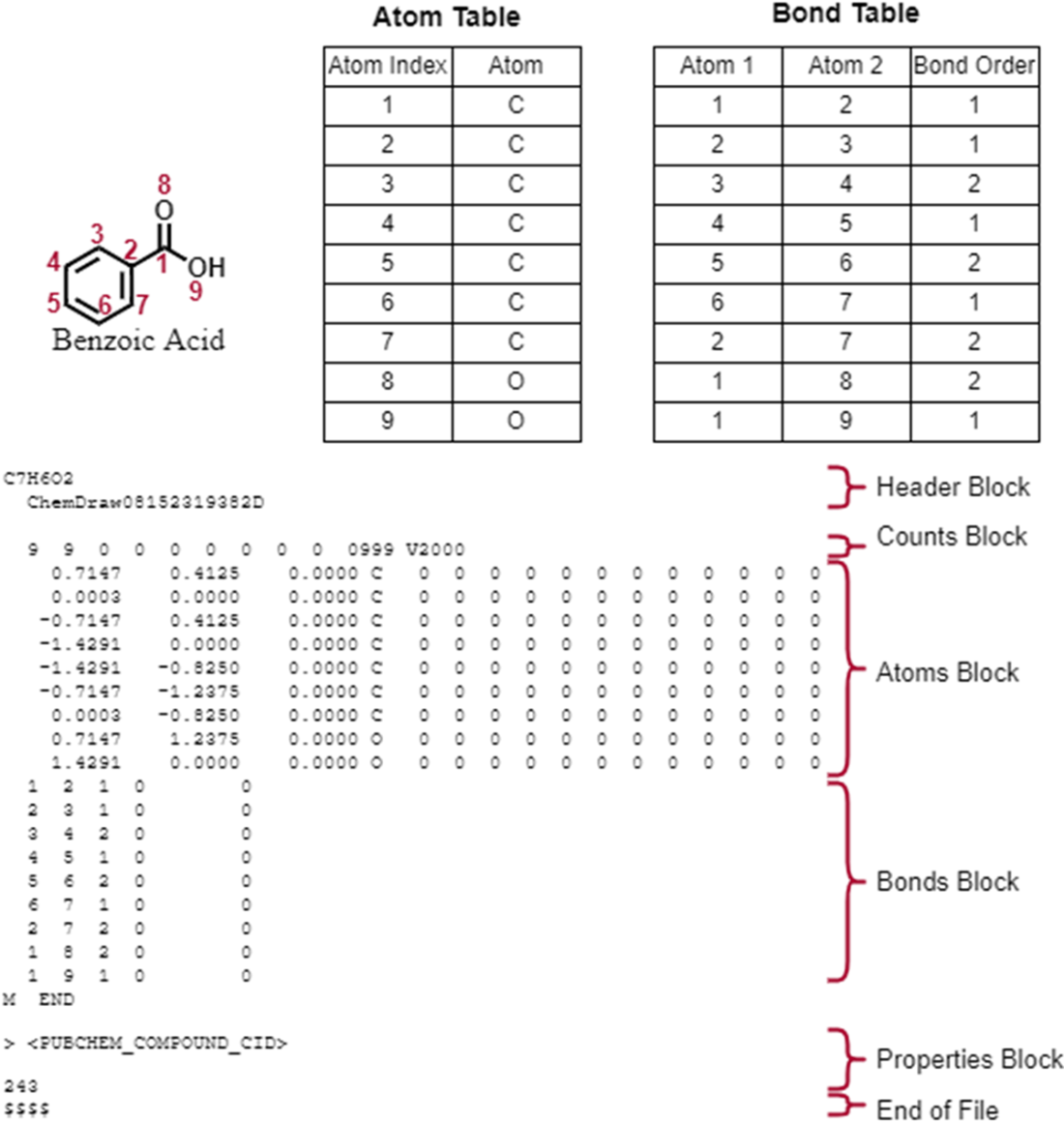
(Top) A simplified connection table (SCT) requires only an atom table and a bond table. An atom table indexes each atom. A bond table designates the two atoms involved in each bond and the type of bond. (Bottom) V2000 formatted entry for the same molecule.
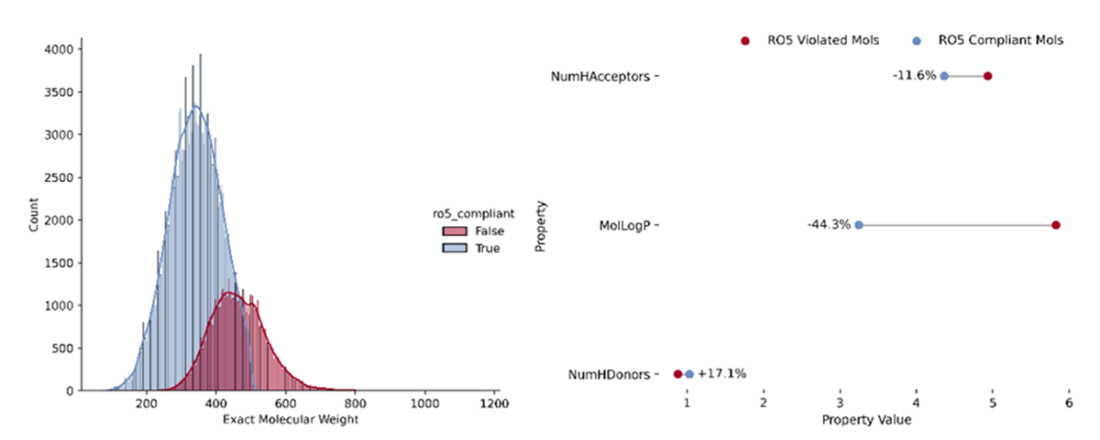
(Left) Comparison of the molecular weight distribution for molecules that are RO5 compliant against molecules that are not RO5 compliant. (Right) Comparison of average values for number of HBAs, logP, and number of HBDs.
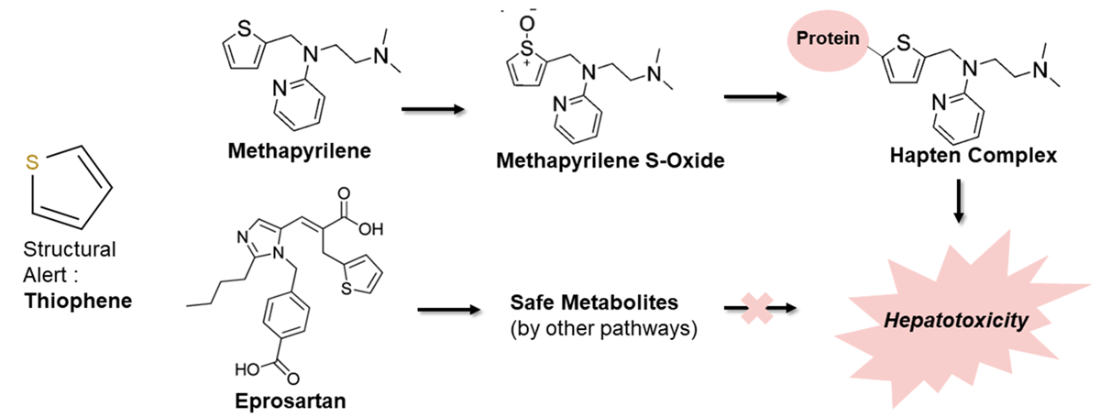
Structural alerts can be informative when used in conjunction with other models but are not a hard-set rule. In fact, 50% of the top 200 most prescribed drugs contain at least on structural alert. By themselves, structural alerts can be misleading and overestimate toxicity hazard or completely miss compounds that are toxic but do not contain a structural alert. For example, the thiophene structural alert present in methapyrilene mediates a metabolic pathway that results in hepatoxicity (liver toxicity), while the same alert structure in eprosartan does not. The safety profiles of the two compounds are drastically different. While suprofen is withdrawn from the market due to hepatotoxicity, eprosartan is safe.
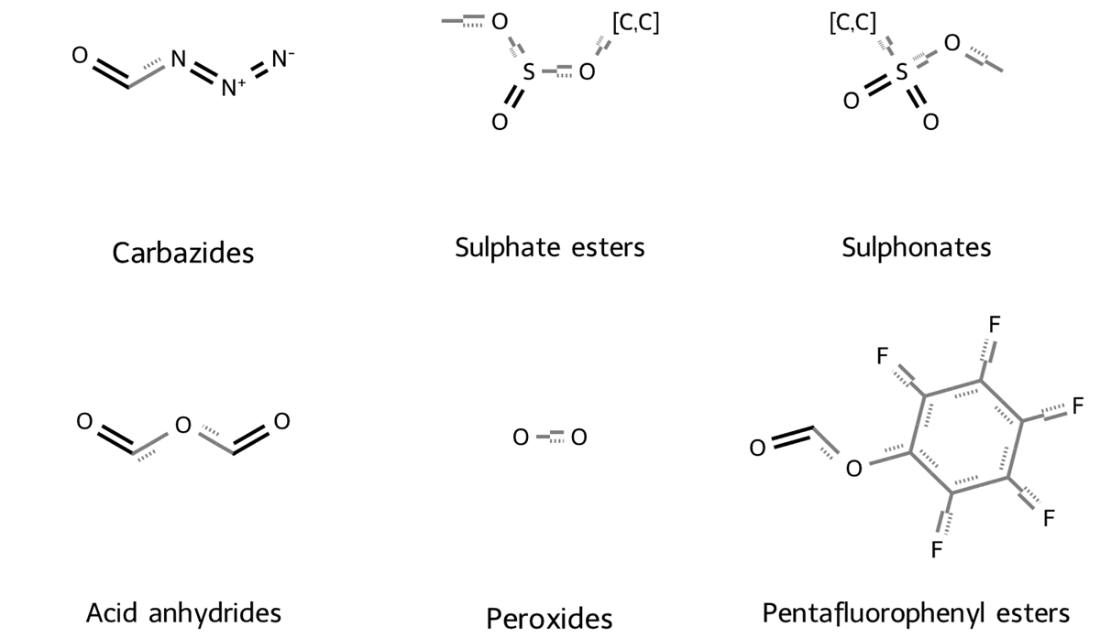
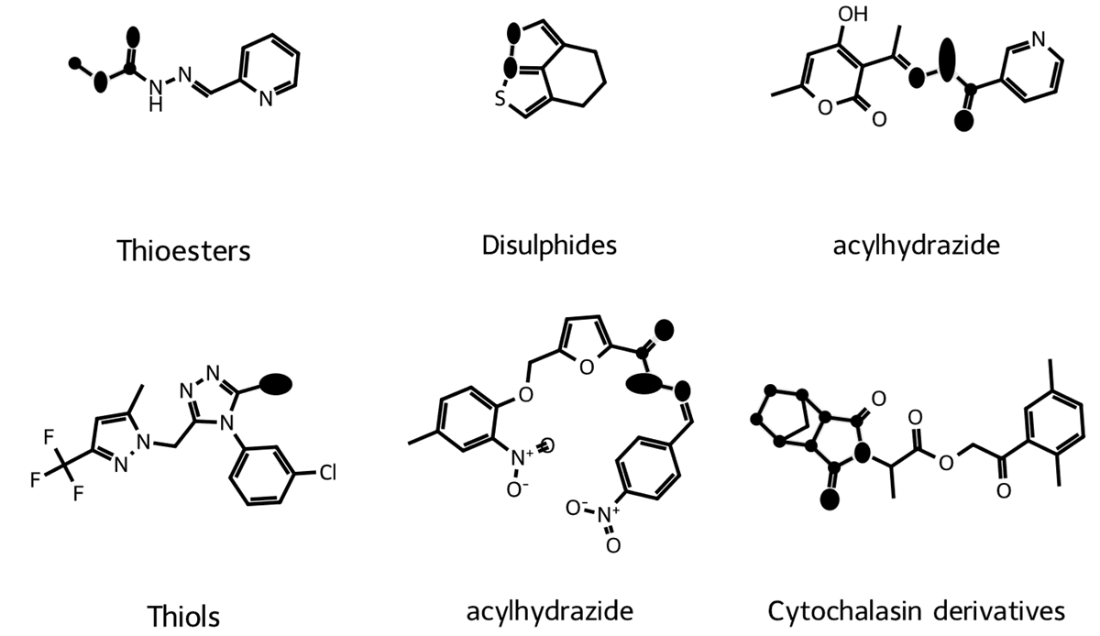
Examples of 6 substructures within the set of Glaxo Wellcome hard filters. Molecules in our library that have these substructures will be filtered out.
Examples of 6 molecules that registered a match against the Glaxo Wellcome hard filters. Two of the molecules matched against the acylhydrazide substructure, along with individual matches against thioester, disulphide, thiol, and cytochalasin derivative substructures.
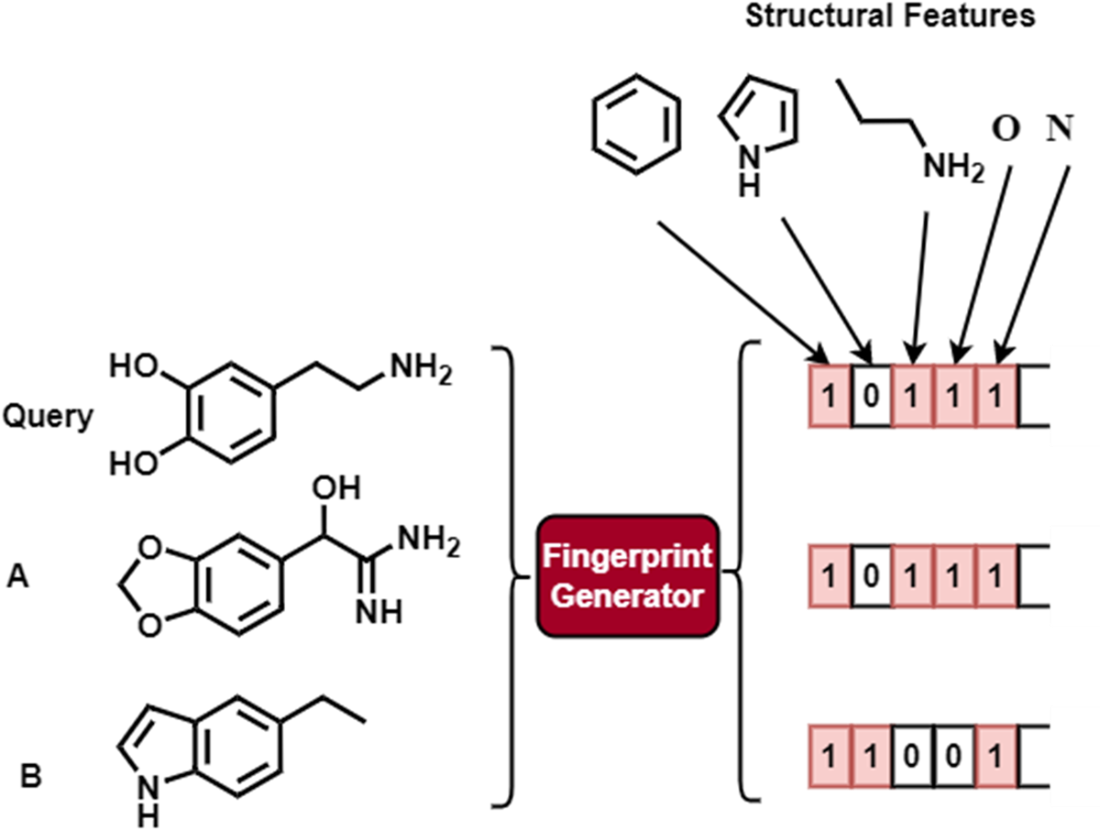
Given a query molecule with known desired properties, a common virtual screening use case is to evaluate fingerprint similarity between a library of compounds and the query. Compounds with high similarity to the query proceed to the next stage of screening. In this example, molecule A sets all the same bits as the query and would proceed. Molecule B sets some of the same bits, but also sets bits not set by the query and misses bits set by the query. Molecule B does not proceed.
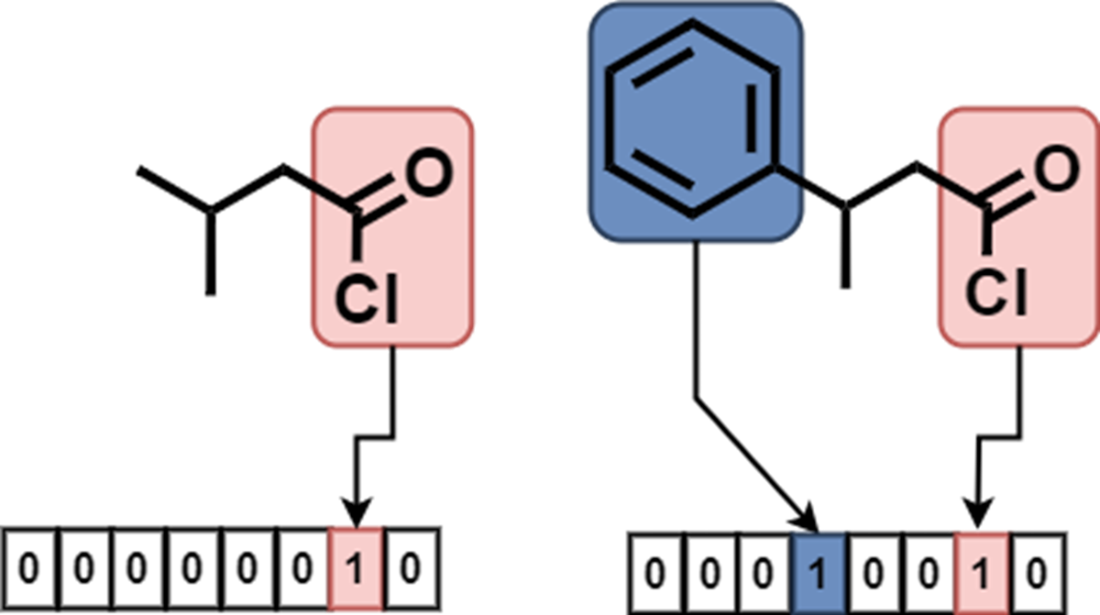
Suppose we have a fragment library with 8 structural keys. Our bit string of length 8 initially has all positions set to “0”. The molecule on the left contains one structural feature that corresponds to the 7th bit, flipping it to “1.” The molecule on the right contains both the 7th bit’s structural feature and a structural feature encoded by the 4th bit.
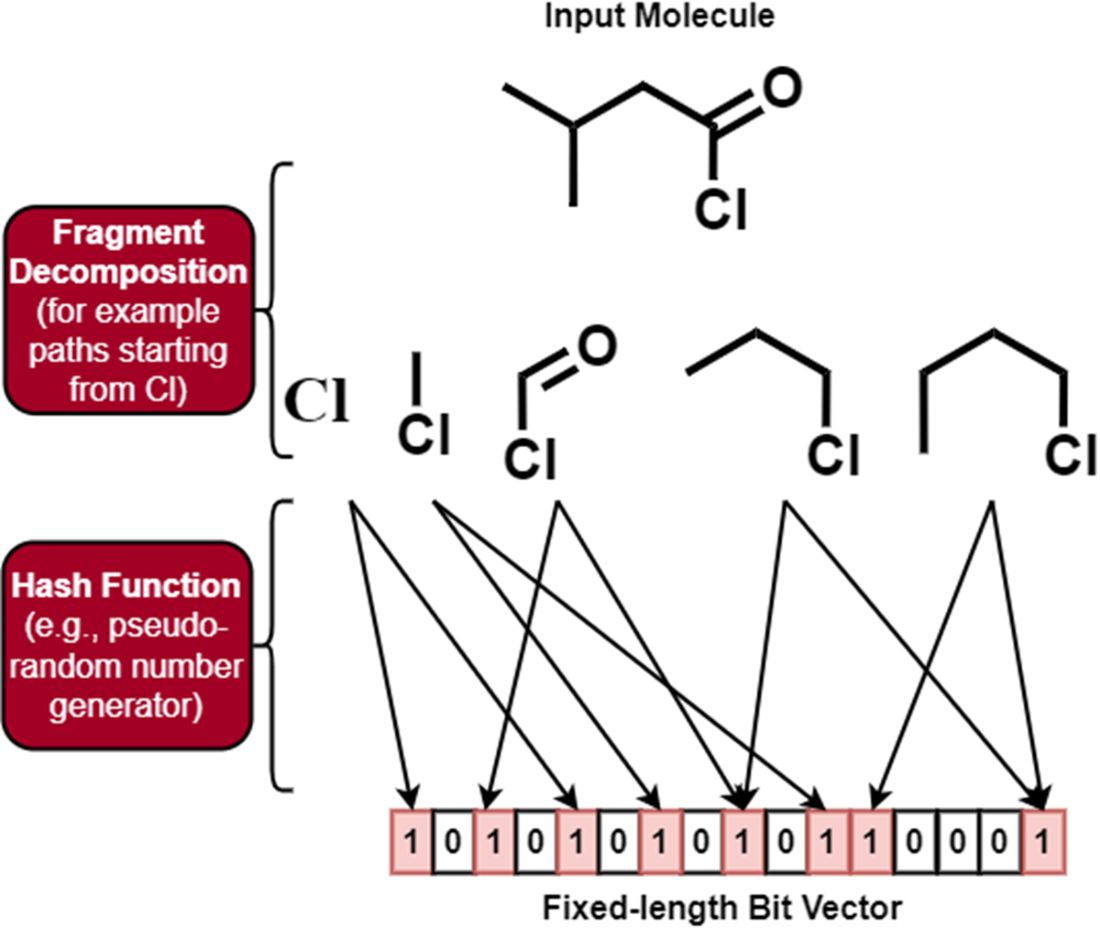
Example of hashed fingerprint computation for paths of up to length 4 bonds starting from the chlorine atom. In reality, we decompose the molecule into all possible fragments originating from every atom. Each path sets multiple bits and hash collisions are possible. The more bits allowed, and the more bits set per pattern, the lower the likelihood that all of the bits of a given pattern collide. If all of a pattern’s bits result in collision, then that pattern is erased by the bits of the colliding patterns.
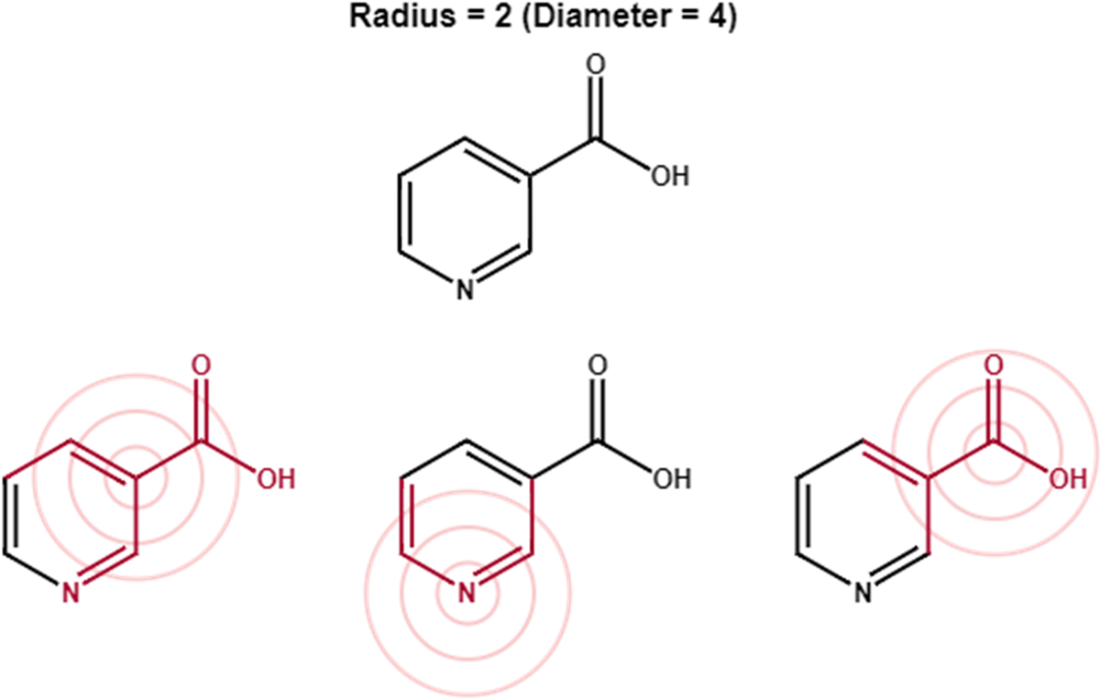
Circular fingerprints look for patterns extending radially from each start position, rather than patterns of linear structures. The example shows how the search is conducted for a radius of 2 at three different start points.
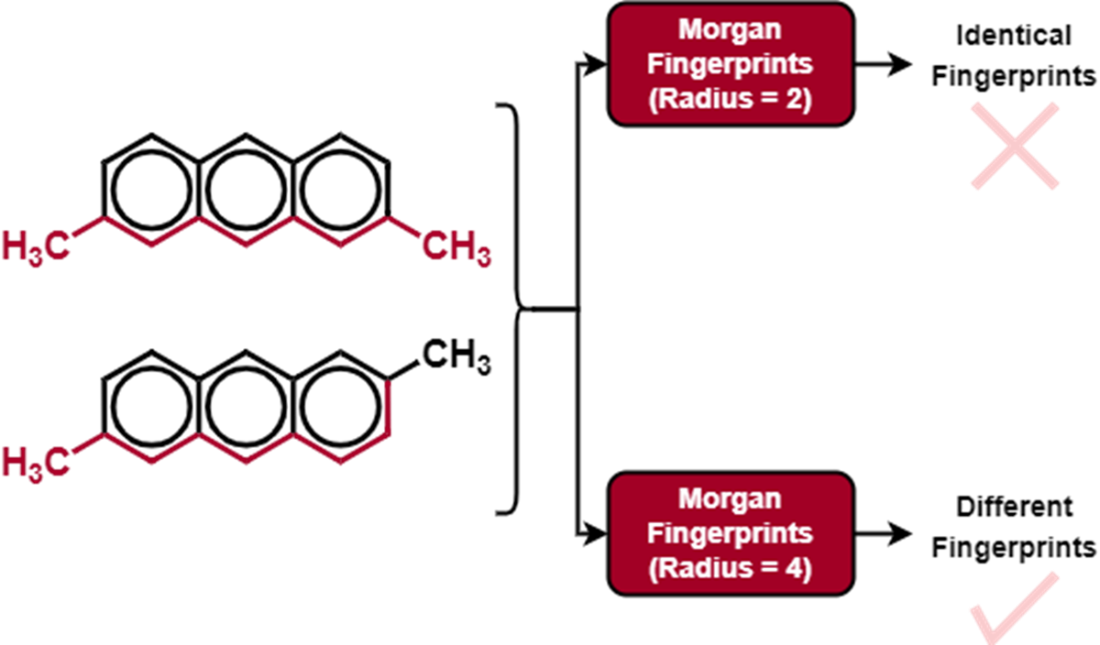
If we use Morgan fingerprints with a radius of 2, then both molecules will be encoded into identical fingerprints. A radius of 2 is small enough that it produces no fragments large enough to discriminate between both molecules. We would need to use Morgan fingerprints with a radius of 4 to generate different fingerprint encodings between the two compounds, as the compounds structurally diverge when considering the red highlighted paths of 8 bond lengths.
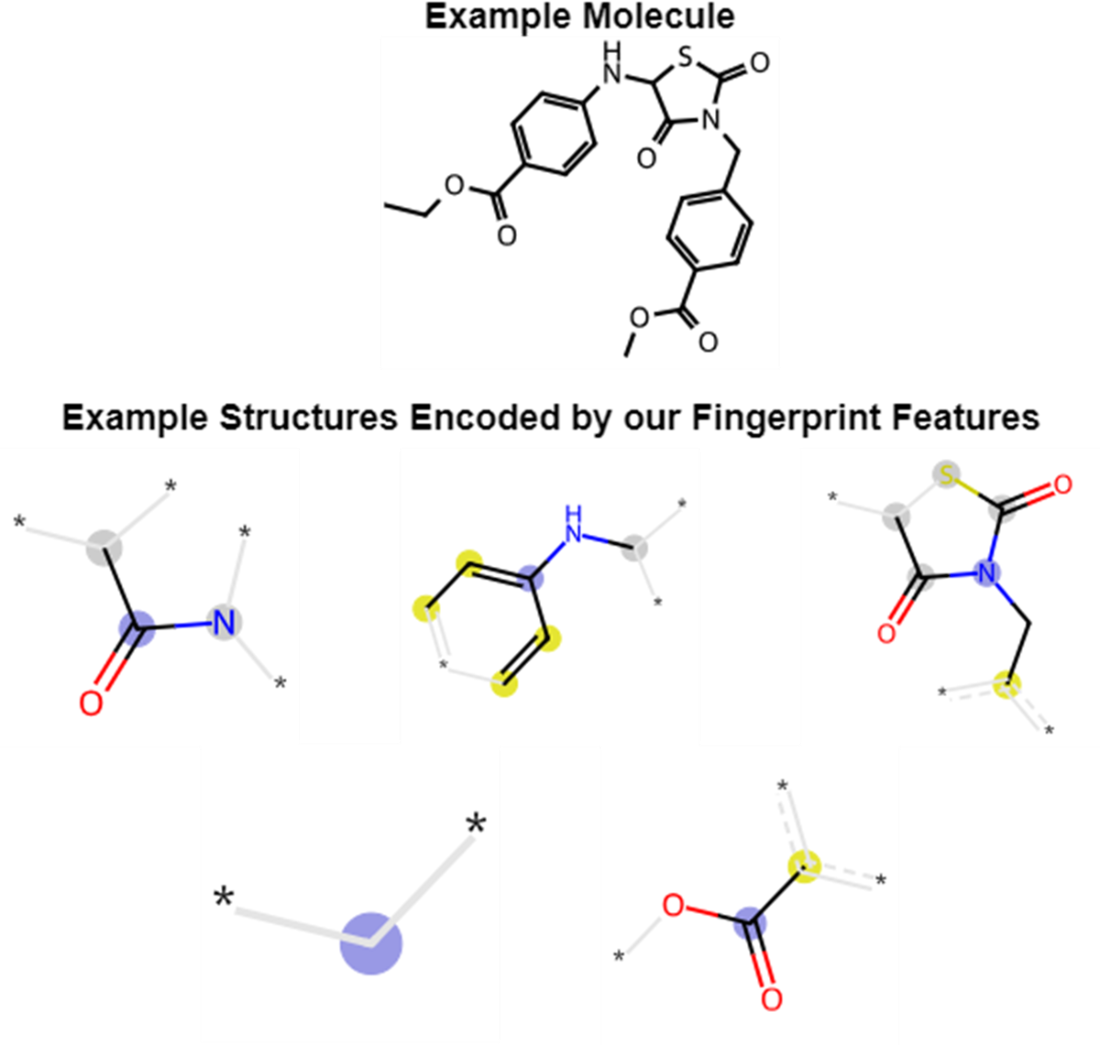
Example of decomposing a molecule into a few of the structures represented by its corresponding fingerprint feature.
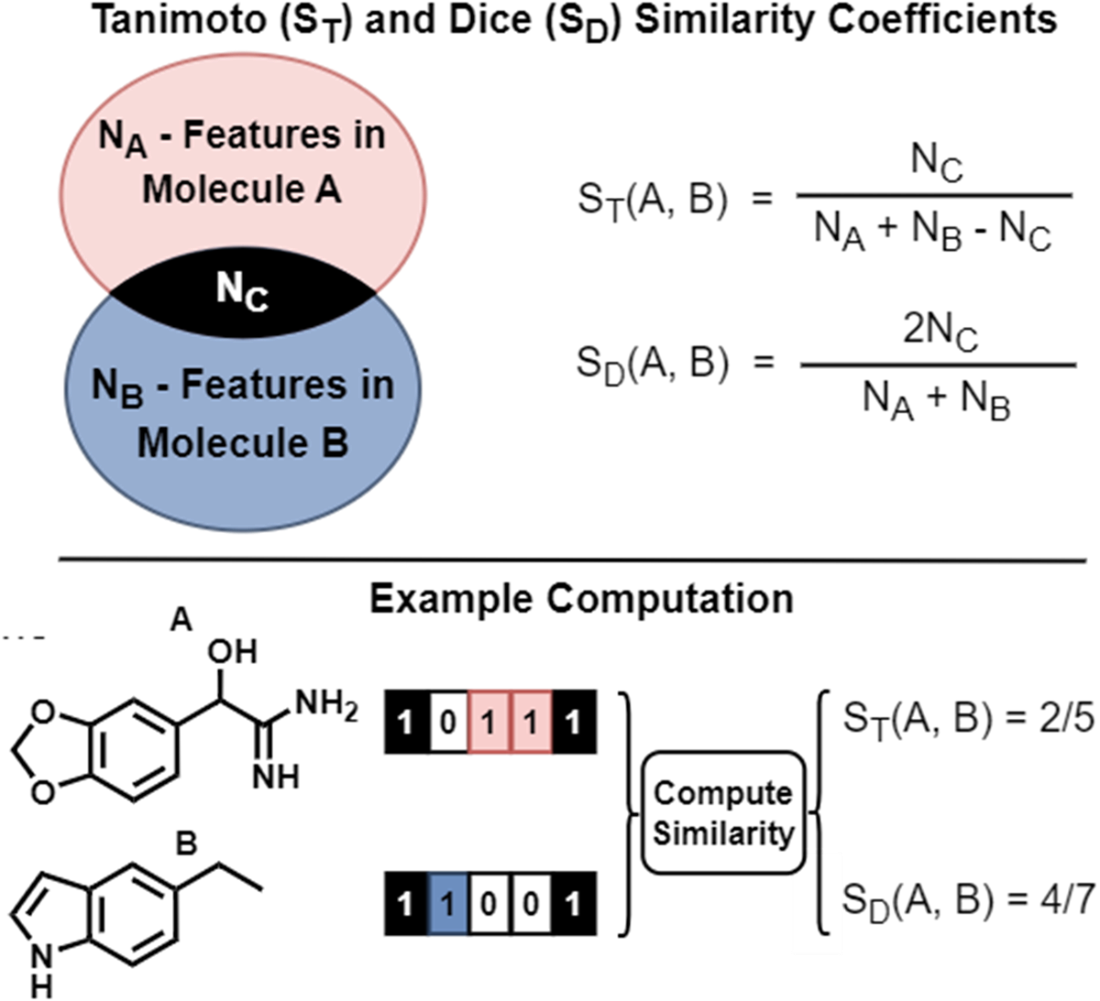
Mathematical definition of Tanimoto and Dice similarity coefficients with example computation for assessing the similarity of molecule A to molecule B.
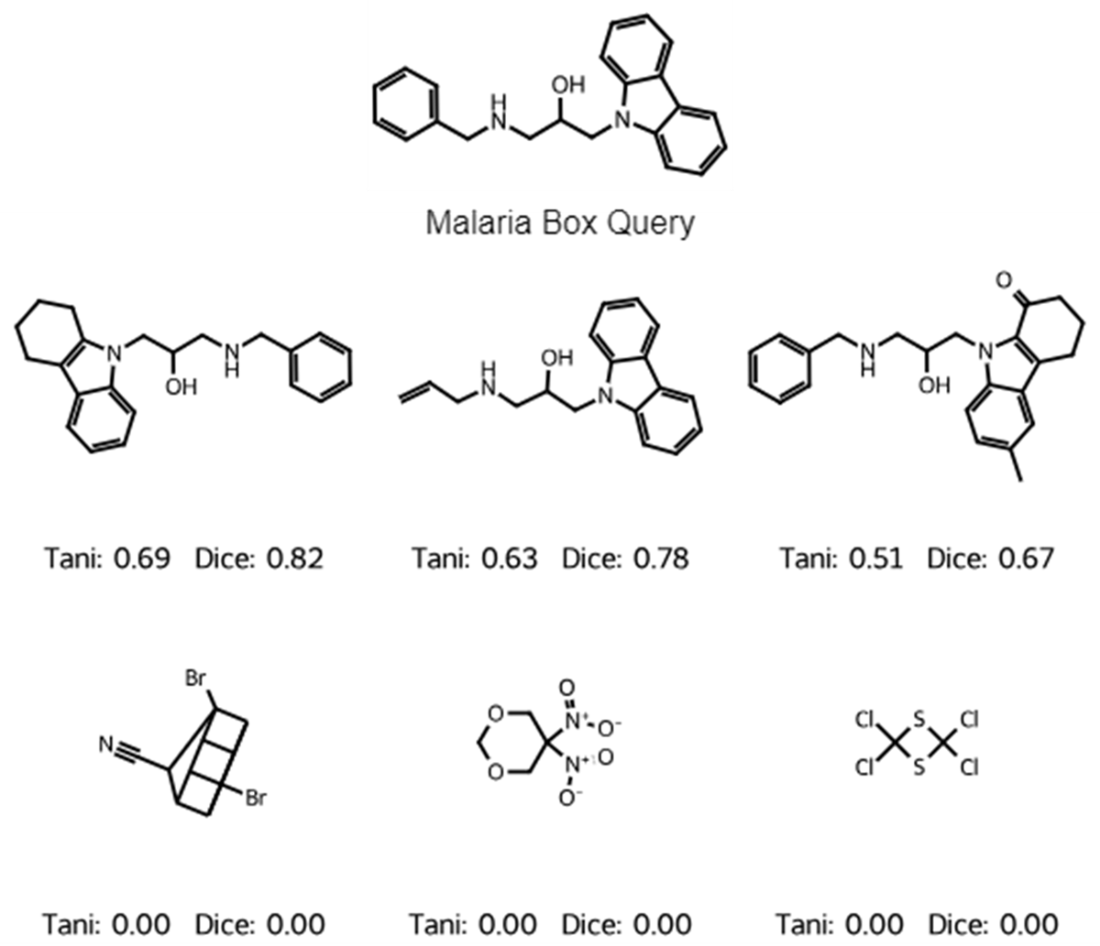
Tanimoto and Dice similarity scores against a single Malaria Box compound. Top row contains the 3 most similar structures in our library; bottom row contains the 3 least similar structures.
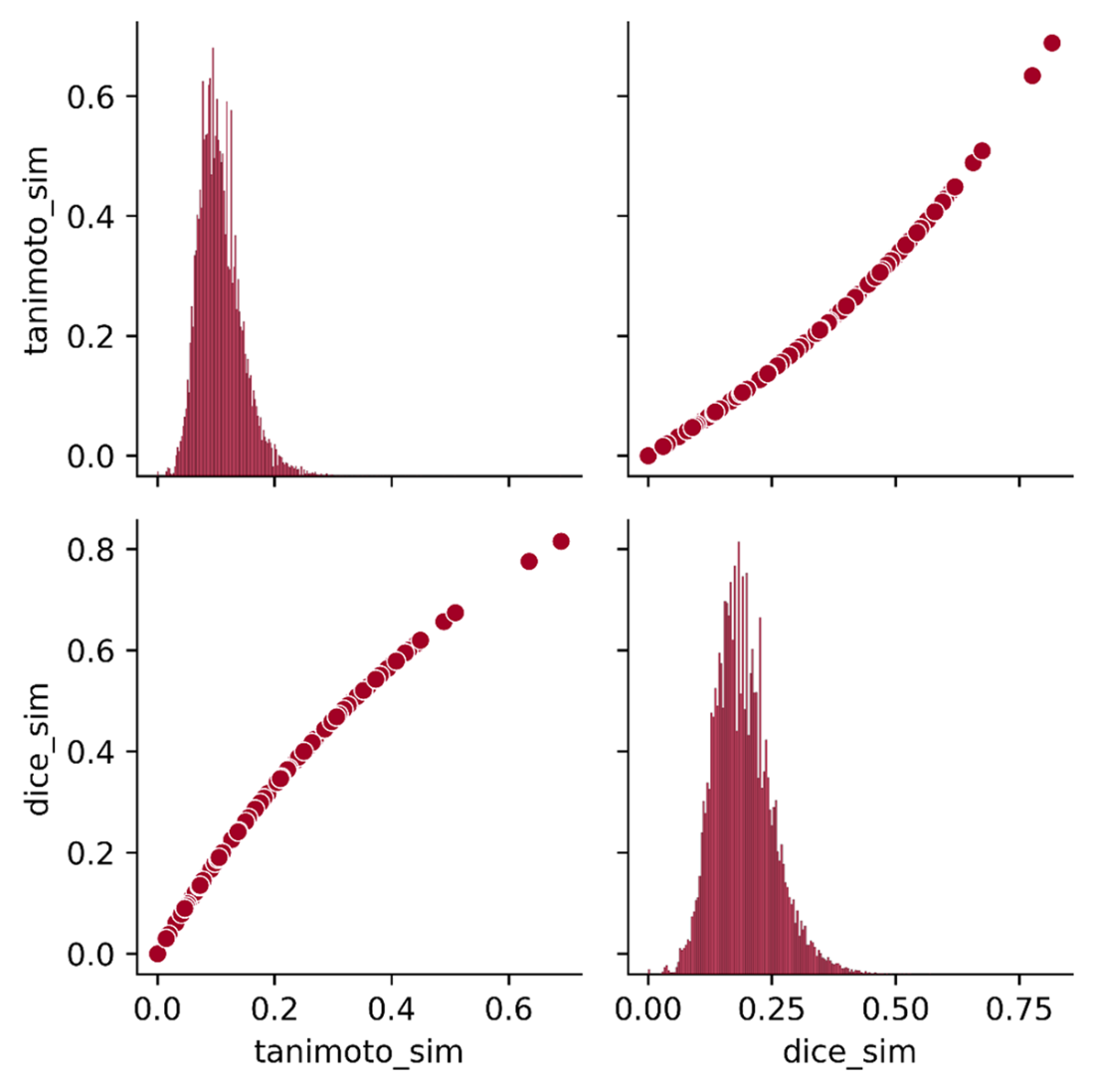
Tanimoto and Dice similarity metrics are correlated, but Dice similarity results in higher scores than Tanimoto similarity.
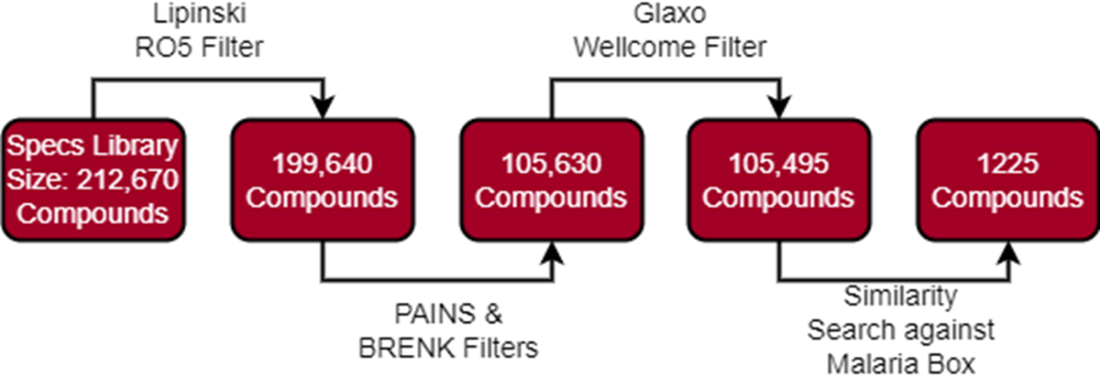
How much our Specs compound library was reduced at each phase of our screening pipeline.
Summary
- Virtual screening consists of a diverse set of methods that we can navigate based off of information we have regarding the biological target’s 3D structure and about a set of ligands with either known or unknown behavior with respect to our predictive property of interest.
- Computers don’t look at molecules the same way that humans do. We need to represent molecules in such a way that a computer can process and interact with them. There are many descriptors that can be invoked to describe a molecule’s physicochemical, structural, topological, and quantum mechanical properties, among others.
- We can use descriptors to filter compounds by their properties, ensuring that our molecules obey important criteria such as Lipinski’s Rule of 5. We can also use pre-defined catalogs or SMARTS to match molecules against known problematic substructures with association to the PAINS filter, the BRENK filter, the Glaxo Wellcome hard filter, or any other filters that aim to remove swill from our library.
- Similarity searching is a valuable ligand-based screening tool that only requires at least one known active. We used similarity searching to exploit the relationship between molecule structure and function, matching our library against 400 query structures within the Malaria Box. As a representation of molecule structure, fingerprints are a highly valuable fragmental descriptor. Tanimoto and Dice similarity metrics are commonly used for fingerprint comparisons, and a basic search strategy is to simply keep the top N molecules in our library based on their similarity to our query molecule(s).
- Similarity searching is strongly dependent on the descriptors used to represent the molecules in our data set, the similarity metrics used to evaluate similarity between two molecules, and the search strategy. We will dive deeper into all three aspects. It is necessary to report the decisions and methodology used for each of these steps, aiding in others’ ability to reproduce, understand, and scrupulously review results.

 Build AI Drug Discovery Pipelines ebook for free
