12 Transformers for Protein Structure Prediction
This chapter introduces protein structure prediction as a central challenge in drug discovery, since a protein’s function and druggability depend on its three-dimensional shape. It explains why experimental structure determination is slow, expensive, and incomplete relative to the vast number of known protein sequences, creating a major gap that computational methods aim to fill. The discussion frames folding and design as closely connected problems: one asks how a sequence folds, while the other asks how to create a sequence that will fold into a desired structure.
The chapter then builds the biological and computational intuition needed for transformer-based folding models. It reviews the hierarchy of protein structure, from the amino-acid sequence to local secondary structures and full tertiary folds, and emphasizes the chemical forces that drive folding, especially hydrophobic collapse and backbone hydrogen bonding. It also shows why folding is difficult to model with older approaches: the search space is enormous, interactions are long-range, and simple sequential models struggle to retain all relevant context across long proteins.
To address these challenges, the chapter presents transformers as a natural fit for protein modeling because self-attention lets every residue directly consider every other residue in the sequence. It explains positional encoding, multi-head attention, residual connections, and encoder-only architectures as the basis for protein language models, then shows how those models can be trained with masked language modeling and reused for downstream tasks such as antibody classification, mutation scoring, and structure prediction. The chapter closes by highlighting how large pretrained models like ESM-2 and systems like SimpleFold turn sequence data into rich representations that support faster, more scalable protein analysis and structure generation.
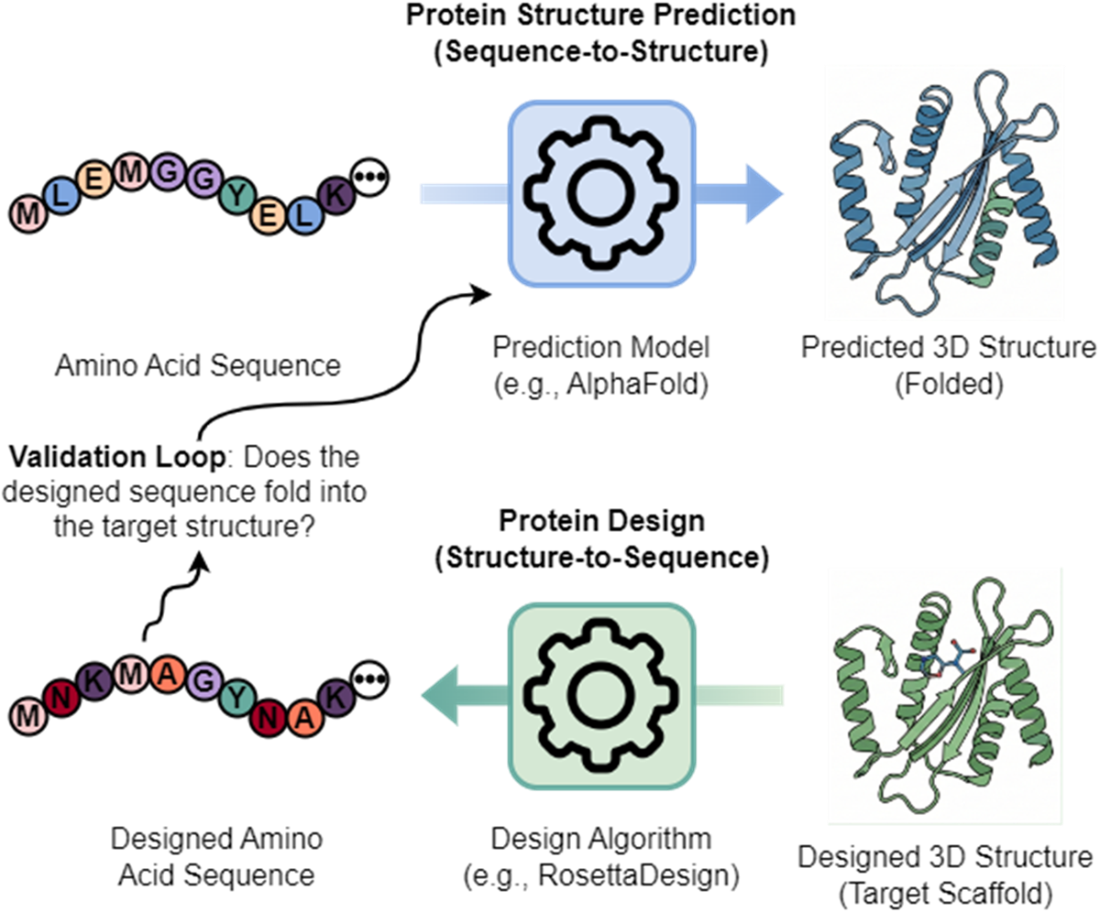
Structure prediction (top) takes a sequence and predicts its folded shape. Protein design (bottom) works in reverse, starting with a target shape and finding a sequence that will fold into it. The validation loop shows how prediction models are often used to verify that a designed sequence will actually adopt the intended structure, creating a cycle of design and testing (analogous to the active learning approaches we discussed in chapter 9).
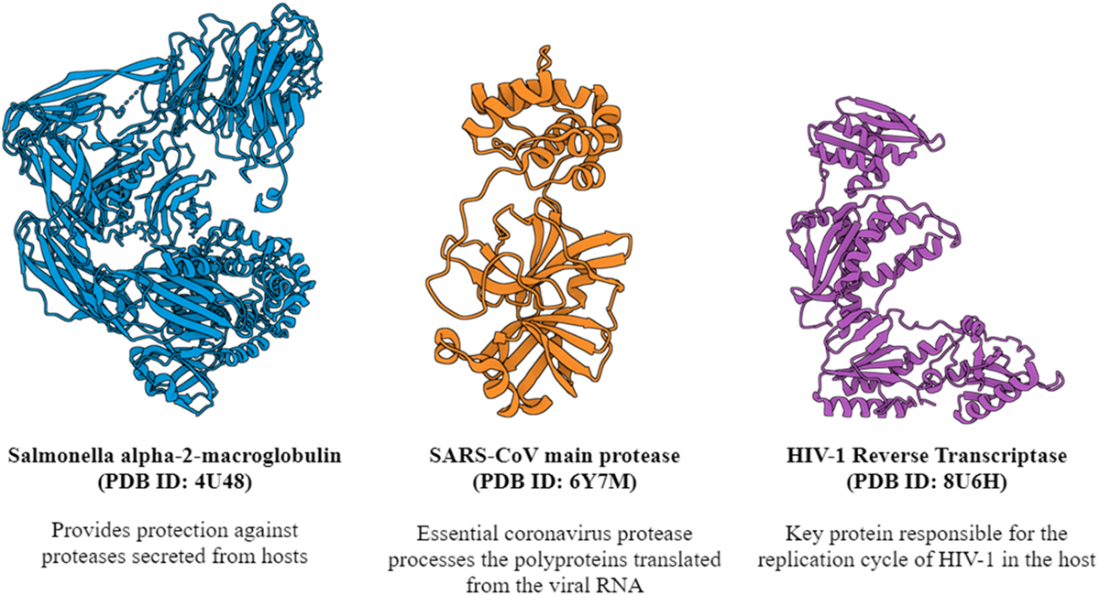
The relationship between protein 3D structure and biological function. The figure illustrates three distinct protein architectures—Salmonella alpha-2-macroglobulin, SARS-CoV main protease, and HIV-1 Reverse Transcriptase—demonstrating how unique folding patterns enable specific biological roles, ranging from host protection to viral replication.
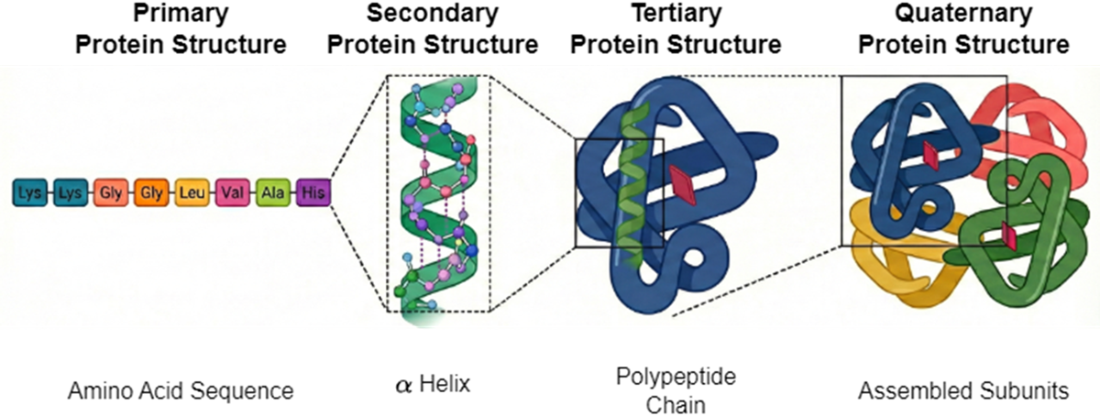
Primary structure is the linear sequence of amino acids. Secondary structure is local backbone geometry—chiefly alpha-helices and beta-strands—stabilized largely by backbone hydrogen bonding. Tertiary structure is the full three-dimensional arrangement of a single polypeptide chain, including how its secondary-structure elements and connecting loops pack together. Quaternary structure describes an assembly of more than one chain.
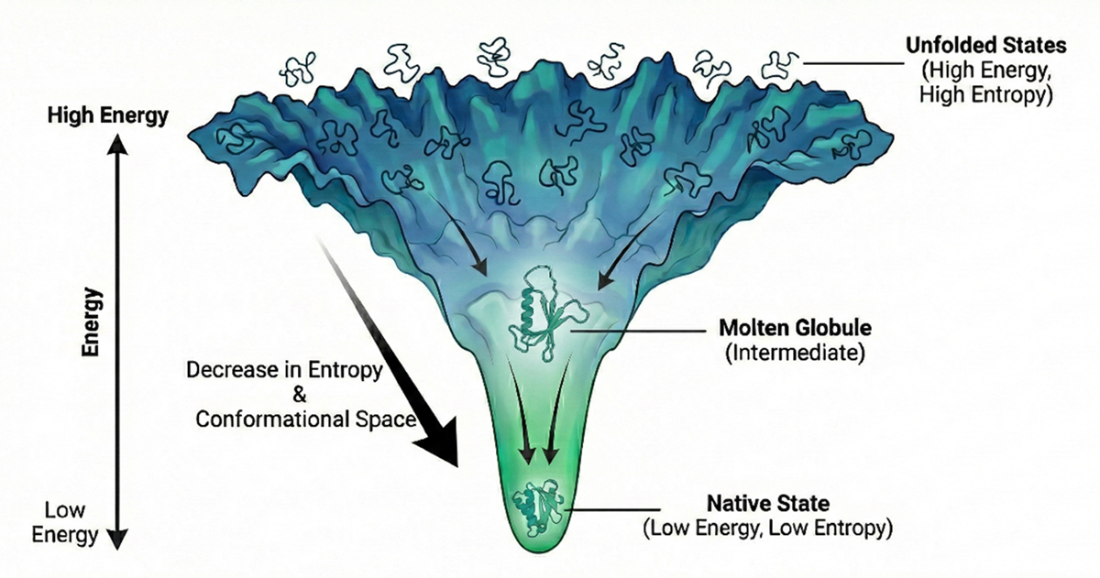
The protein folding energy landscape funnel transitions from high-energy unfolded states to the low-energy native state, with decreasing entropy and conformational freedom.
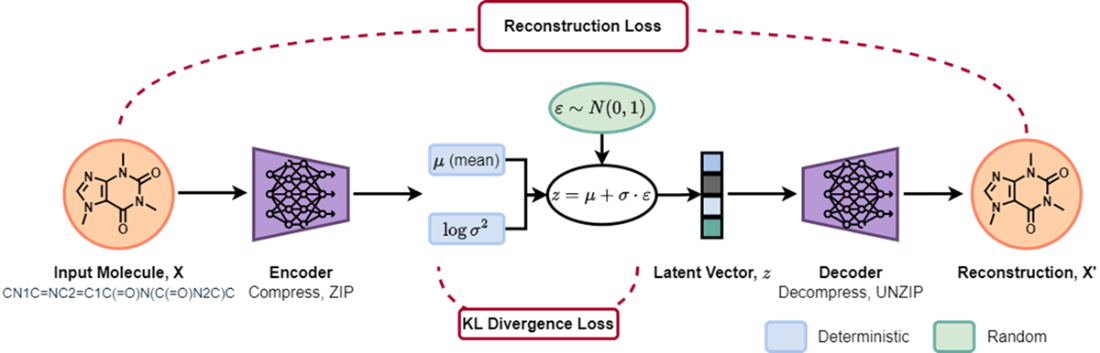
VAE architecture from chapter 10, where a single context vector must encode the entire input.
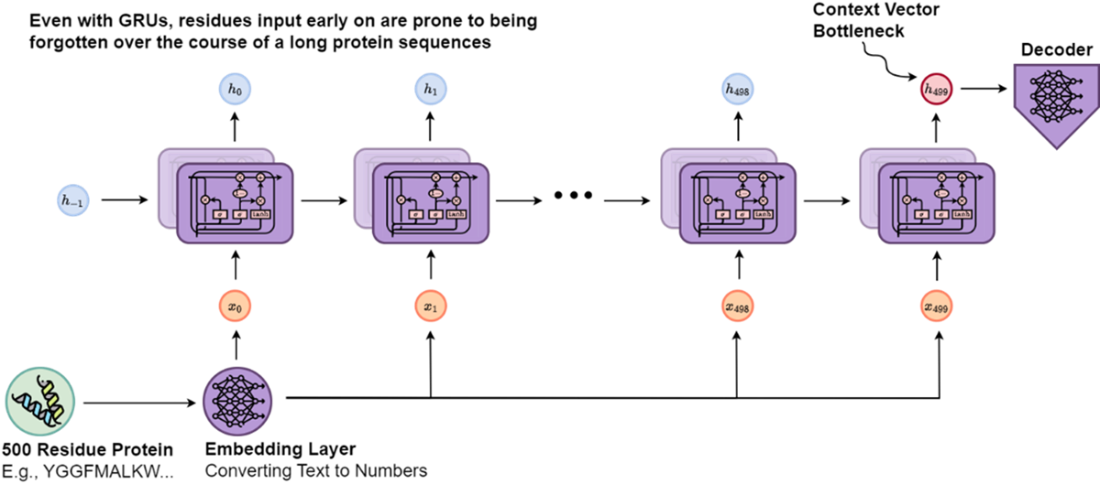
A sequence of 500 AAs feeding through a GRU encoder, with all information eventually funneling into a single final hidden state vector that gets passed to the decoder. This begs the question: why do we only need to use the final hidden state as the context vector passed to the decoder? Spoiler alert: we can incorporate information from the prior hidden states.
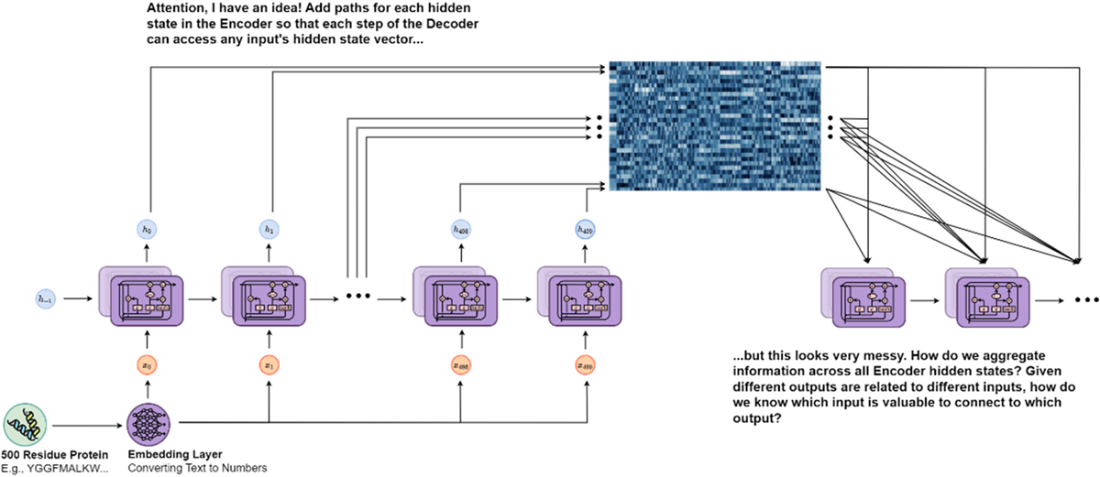
Each position produces its own hidden state, which we can arrange as a matrix where each row is a hidden state vector. The variance in color in this hidden state matrix reflects the different contextual information captured by each hidden state. Rather than have an output depend on only the final hidden state content, we would benefit by allowing each hidden state vector to influence all outputs.
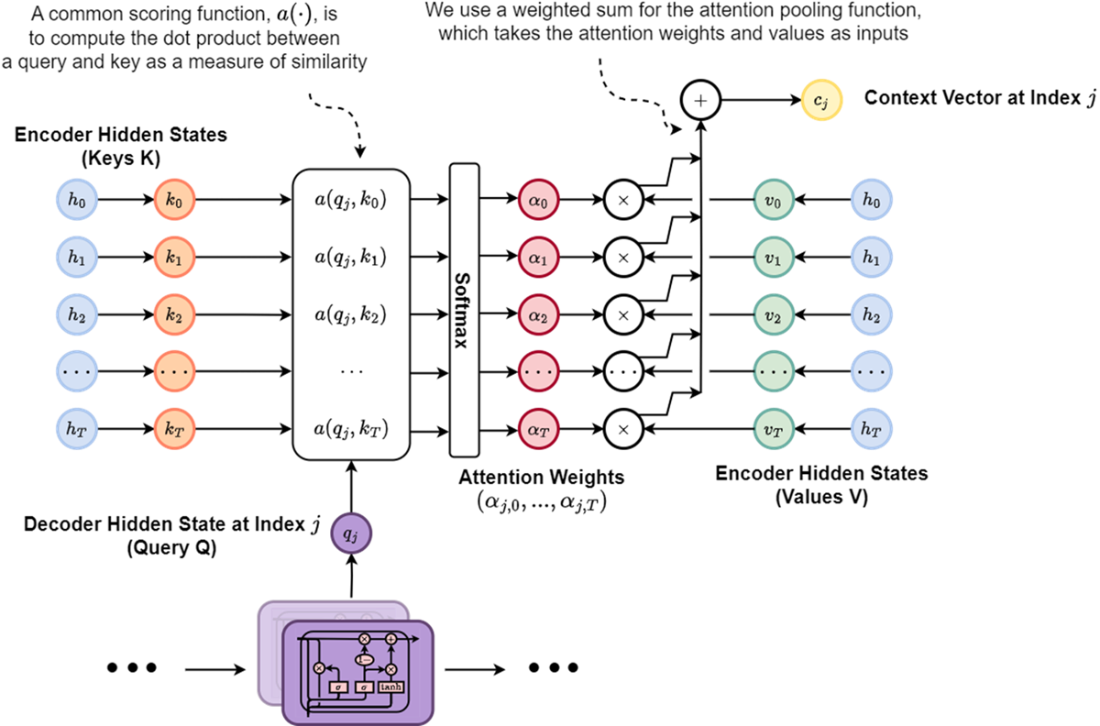
The mechanics of cross-attention. A decoder state acts as a query (qj) and compares itself against all encoder states (keys, K). These comparisons generate attention weights (α), which are used to compute a weighted sum of the encoder states (values, V), creating a context vector (cj) specific to the current prediction step.
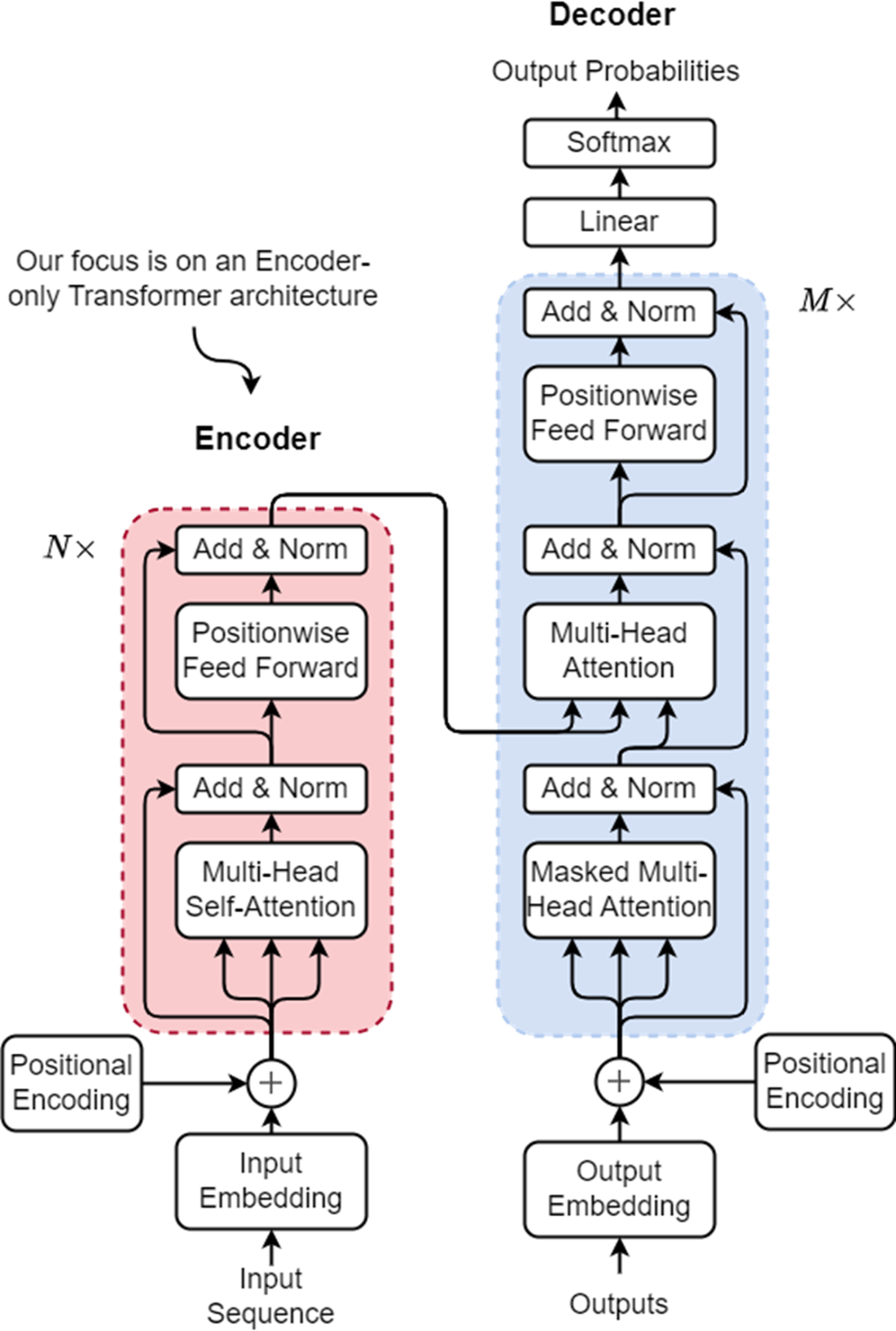
The transformer architecture. While the original transformer includes both an encoder and decoder for translation tasks, protein language modeling primarily uses the encoder-only architecture (left). This stack processes the entire sequence in parallel to generate embeddings for every residue.
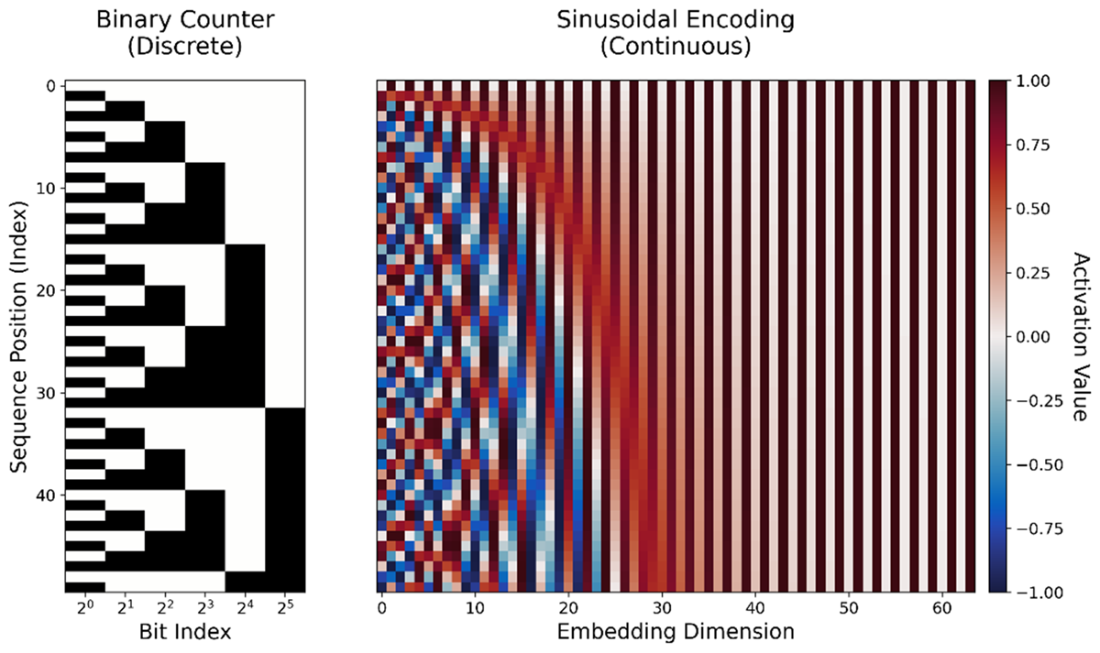
(Left) A discrete binary counter (black/white), showing how lower bits (towards the left on the x-axis) oscillate rapidly while higher bits (towards the right on the x-axis) oscillate slowly. (Right) The Transformer's sinusoidal encoding (red/blue), showing the exact same frequency gradient but in a continuous, differentiable form, using sine and cosine waves of different frequencies to assign a unique, differentiable vector fingerprint to every position in the sequence.
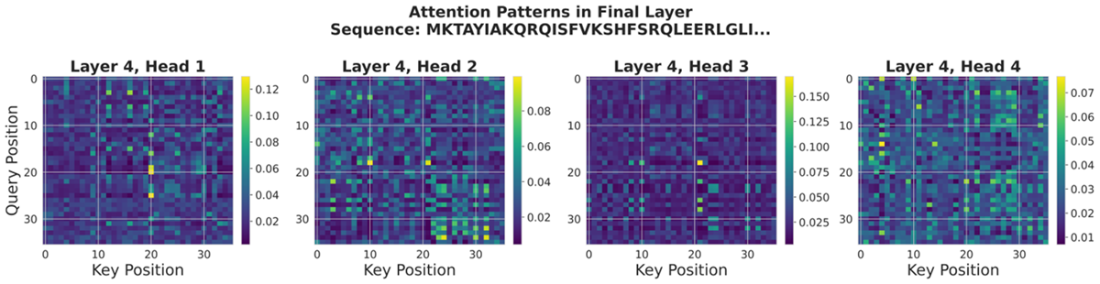
Attention weights from each of the 4 heads in layer 4 (the final Transformer layer) reveal a diversity of learned patterns. Each heatmap shows query positions (Y-axis) attending to key positions (X-axis) for the sequence MKTAYIAKQRQISFVKSHFSRQLEERLGLI (~37 AAs). The viridis colormap indicates attention weight magnitude (darker purple = lower weight, brighter yellow-green = higher weight). Some heads learn to focus on local neighbors (tending towards the diagonal), while others attend to distant residues (further off-diagonal spots) or broad global context, demonstrating how the model divides the labor of understanding protein structure.
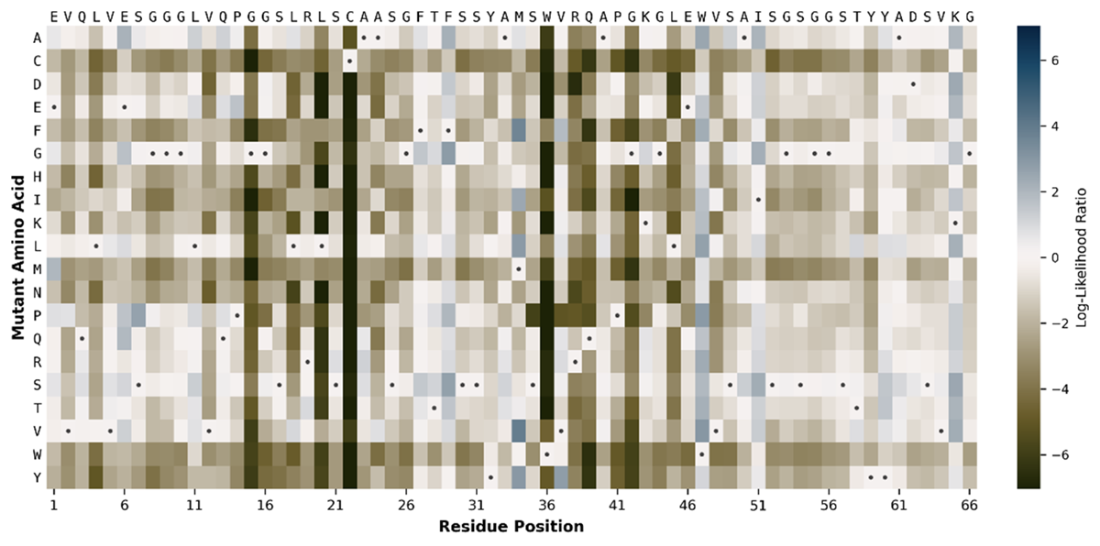
A zero-shot mutation landscape predicted by ESM-2. The x-axis represents the residue position, and the y-axis represents the 20 possible AA mutations. The color indicates the Log-Likelihood Ratio (LLR): brown regions indicate deleterious mutations that the model views as evolutionarily unlikely, while white/blue regions indicate neutral or beneficial mutations.
Summary
- Mutation effect prediction with ESM-2 leverages evolutionary patterns learned from millions of sequences to score variants computationally. Log-likelihood ratios quantify whether mutations increase or decrease sequence plausibility. Comprehensive mutation landscapes reveal conserved and variable regions, guiding where mutations are tolerable. Targeted scoring of specific mutations enables efficient evaluation of design candidates or disease variants. Pseudo-perplexity assesses overall sequence quality, catching problematic combinations. Together, these approaches transform protein engineering workflows from exhaustive experimental screening to hypothesis-driven testing of computationally prioritized variants.
- While genomic sequencing has identified hundreds of millions of protein sequences, experimental methods like X-ray crystallography have determined the 3D structures for only a tiny fraction of them. This disconnect creates a massive "blind spot" in drug discovery, as knowing the 3D structure is critical. Deep learning bridges this gap by computationally predicting structures for the millions of sequences that lack experimental data.
- Proteins are not static strings; they are dynamic chains that fold into precise hierarchies – from local helices and sheets to global 3D arrangements. This folding is driven by physical forces, such as the "hydrophobic effect," where oily parts of the protein collapse inward to escape water. A successful prediction model must implicitly learn these geometric constraints and physical laws to distinguish valid biological shapes from random tangles.
- SimpleFold approaches structure prediction not just as a regression problem, but as a generative one using "flow matching." Similar to how AI might generate art, the model learns to guide a cloud of random noise into a structured protein shape over several steps. This allows the model to capture the complex distribution of possible protein conformations rather than just predicting a single average structure.
- Proteins have complex long-range dependencies; an AA at the beginning of a chain might chemically interact with one at the very end. Traditional sequential models (like RNNs) struggle to "remember" these distant connections due to information bottlenecks. Transformers solve this using self-attention, which allows every part of the sequence to look at and influence every other part simultaneously, regardless of how far apart they are.
- By training models on millions of raw protein sequences using "Masked Language Modeling"—hiding parts of a sequence and asking the model to fill in the blanks—we force the model to learn fundamental rules of biology. The model learns which AA patterns are evolutionarily conserved and structurally stable without needing explicit labels, creating rich representations of proteins.
- The "knowledge" a model gains during pre-training can be transferred to specific drug discovery tasks. We demonstrated this by adapting a protein language model to classify antibodies, distinguishing between those that target HIV-1 and SARS-CoV-2. This highlights how a general understanding of protein language can be fine-tuned to solve highly specific biological classification problems with limited labeled data.
- Advanced models like ESM-2 are so capable that they can predict the effects of mutations without further training, a technique called "zero-shot" inference. By scoring how "natural" a mutated sequence looks to the model, researchers can identify stabilizing mutations or flag deleterious ones. This enables computational screening of thousands of therapeutic candidates before a single experiment is run in the lab.

 Build AI Drug Discovery Pipelines ebook for free
