13 New developments and challenges in text-to-image generation
The chapter offers a concise tour of how modern text-to-image systems convert language into compelling visuals, tracing the arc from early transformer-based tokenization to today’s diffusion-driven approaches. It highlights the DALL·E series and its improvements in text-image alignment and instruction following, Google’s Imagen with T5-XXL text encoders and cascaded diffusion for progressive refinement, and latent diffusion models such as Stable Diffusion and MidJourney, which generate in a compressed latent space to lower compute while empowering iterative, collaborative creative workflows.
It then examines the field’s core challenges and societal risks. Technically, models still struggle with geometric consistency due to weak 3D priors and limited understanding of physics, while training and deployment demand significant computation with environmental costs. Societally, misuse—especially deepfakes and misinformation—raises ethical and legal concerns, alongside unresolved questions about copyright and fair use in web-scale training data. The chapter also underscores the importance of bias auditing and mitigation, warning that both under- and over-correction can misrepresent people and contexts. Progress, it argues, requires better alignment, robust evaluation, and multidisciplinary governance.
To pair innovation with safeguards, the chapter presents a practical blueprint for detecting AI-generated images by fine-tuning ResNet-50. Instead of training from scratch, it builds a balanced real-versus-fake dataset, applies the pretrained model’s transforms, replaces the classification head with a two-class output, freezes the backbone, and trains the new head with early stopping before testing on unseen images. The resulting detector attains strong accuracy, offering a resource-efficient approach to deepfake identification and equipping readers with a dual perspective: how to create powerful generators and how to evaluate and defend against the risks they introduce.
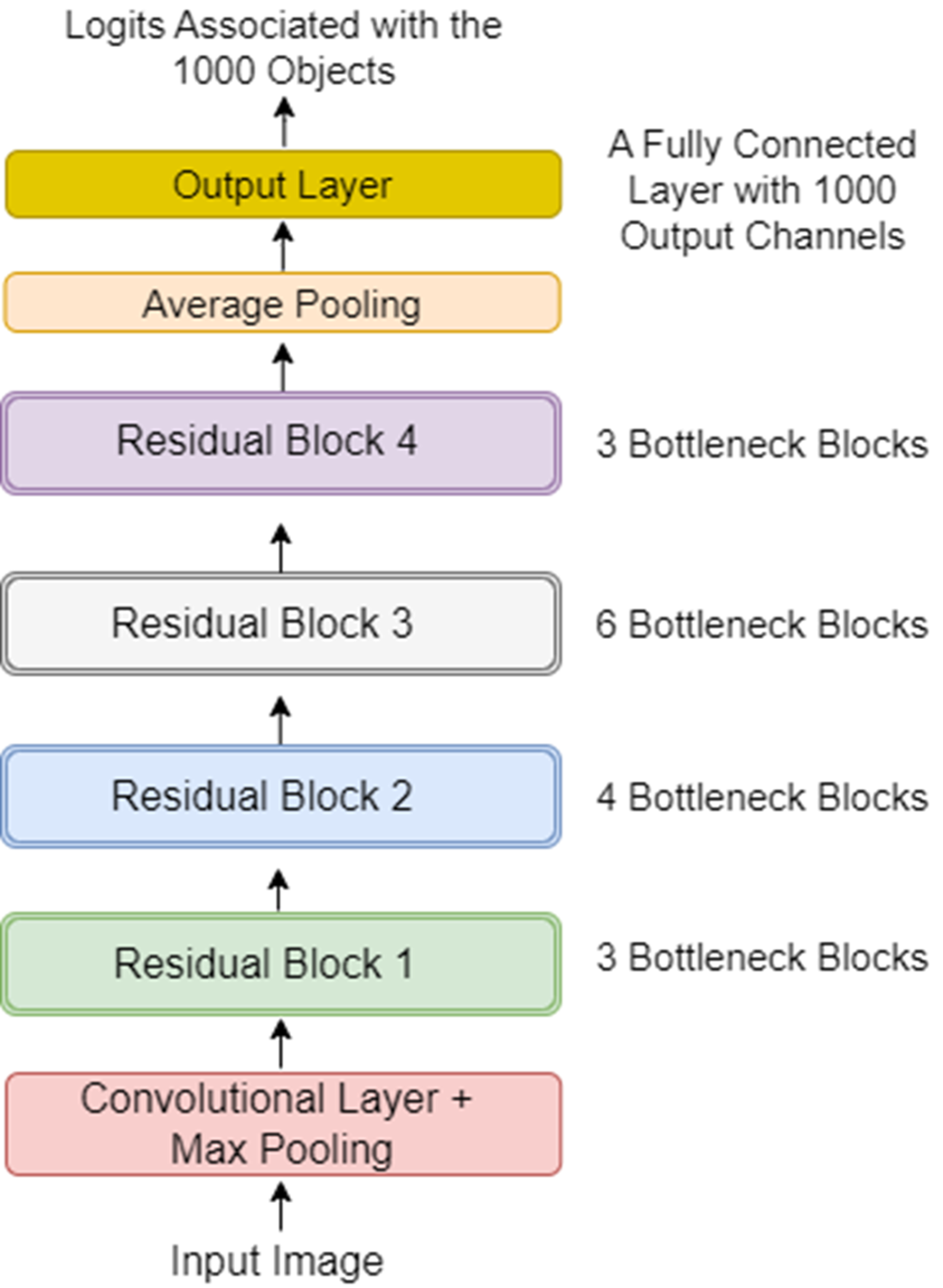
The architecture of ResNet-50. ResNet-50 is structured as follows: (1) An initial convolutional layer followed by max pooling to reduce spatial dimensions; (2) Four sequential “residual blocks” composed of bottleneck units with residual connections; (3) An average pooling layer; (4) A fully connected output layer. The model takes an image as input and outputs logits for 1,000 object classes, which can be converted into predicted probabilities using the softmax activation function.
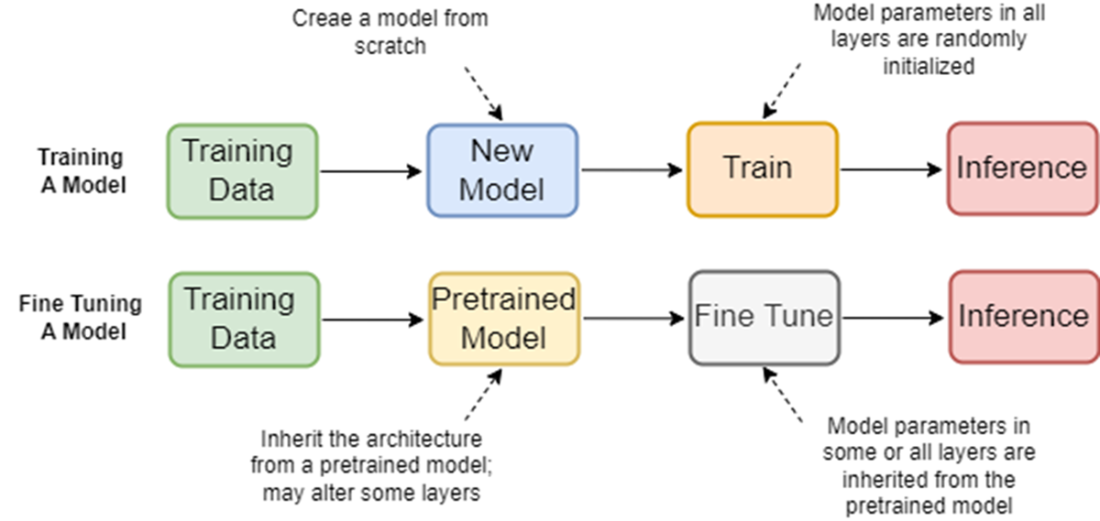
Training from scratch vs. fine-tuning an existing model. Training from scratch (top row in the diagram) involves building a model with randomly initialized parameters, requiring the network to learn all features from raw data. In contrast, fine-tuning uses the architecture and pretrained weights of an existing model, modifying (often only) the output layer for a new downstream task. The bulk of the network retains the learned parameters, while only the final layers are updated for the new objective.
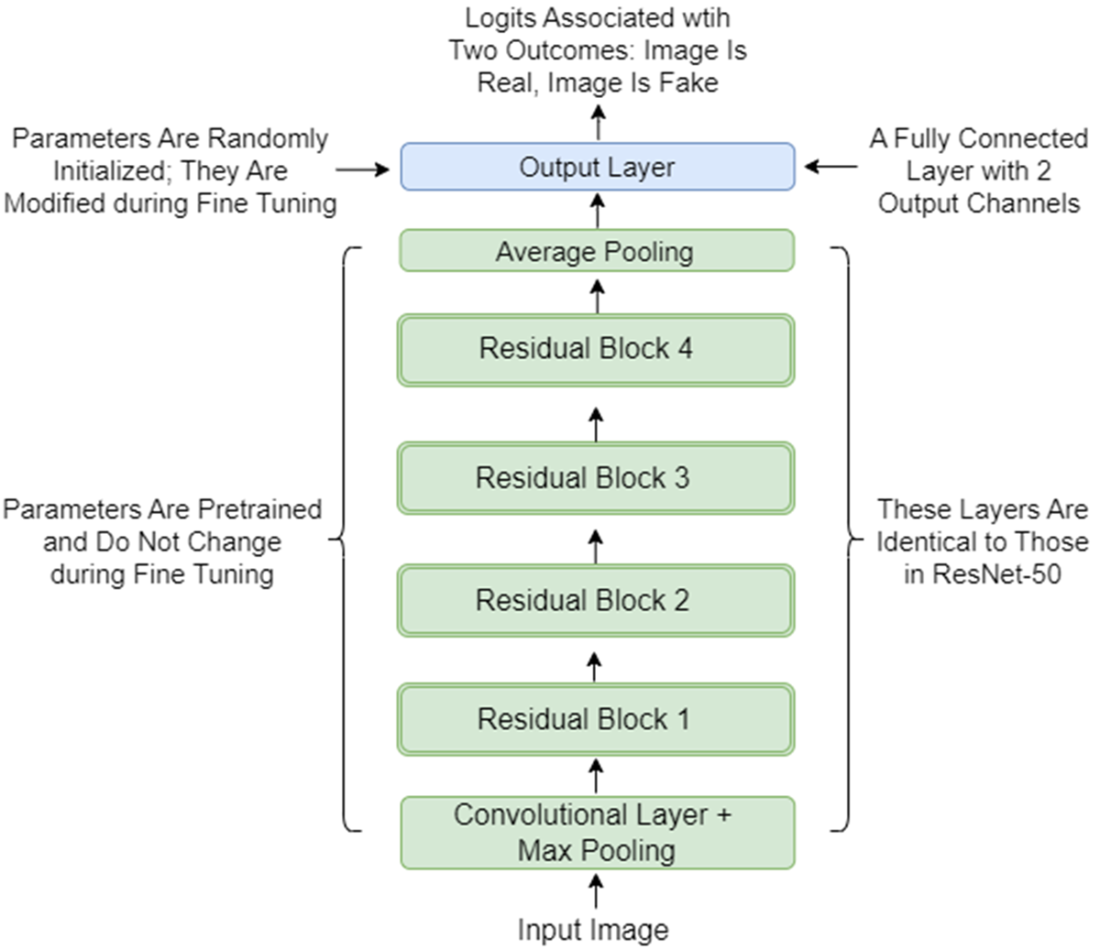
Modified ResNet-50 architecture for deepfake detection. All original layers of ResNet-50 are retained, except for the last fully connected output layer. The original output head (with 1,000 output channels) is replaced with a new head (with 2 output channels), producing logits for the “real” and “fake” classes. Parameters in the new output layer are initialized randomly and trained on our dataset. All other parameters are inherited from the pretrained model and kept frozen during fine-tuning.
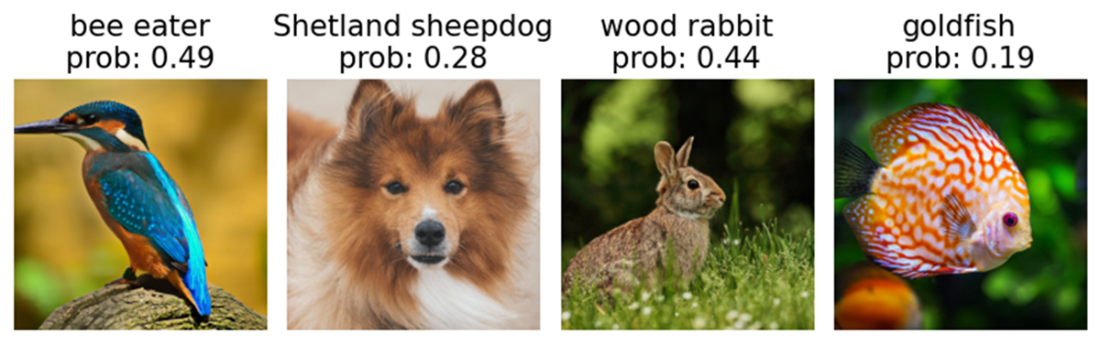
Using ResNet-50 to make predictions on images. Each image is shown with its top predicted class and the corresponding probability as determined by ResNet-50. The results highlight both the strengths and quirks of large-scale classification models: for example, the model may predict “bee eater” for a bird image that looks like a kingfisher, since “kingfisher” isn’t among the 1,000 ImageNet classes. Such observations show that the model’s predictions depend not only on the input image, but also on the set of categories it was trained to recognize.
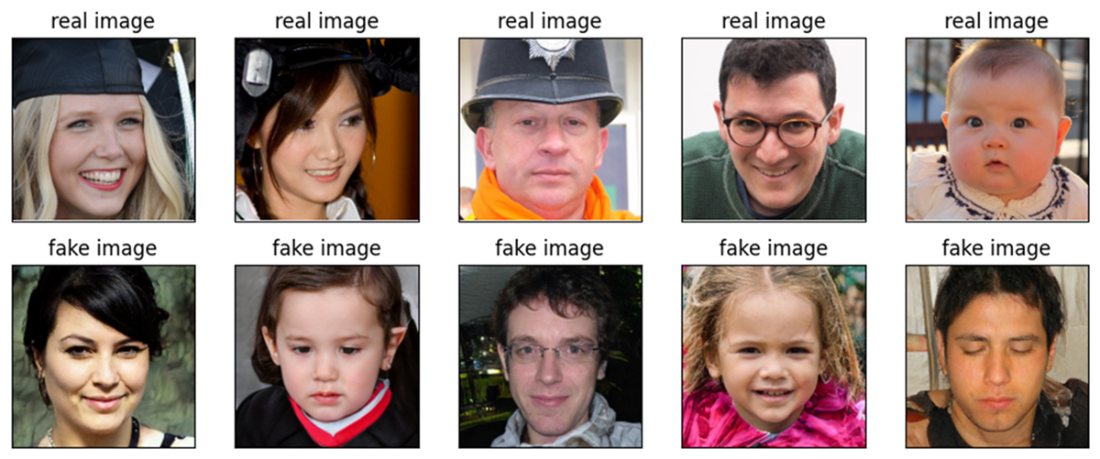
Sample real and fake images from the 140k Real and Fake Faces dataset. The top row displays five real face images, while the bottom row shows five face images generated by AI. At a glance, both sets look convincingly realistic. This side-by-side comparison highlights the subtlety of the deepfake detection challenge: to the naked eye, even AI-generated images can appear authentic. Such visualizations emphasize the need for advanced machine learning methods to distinguish between real and fake images.
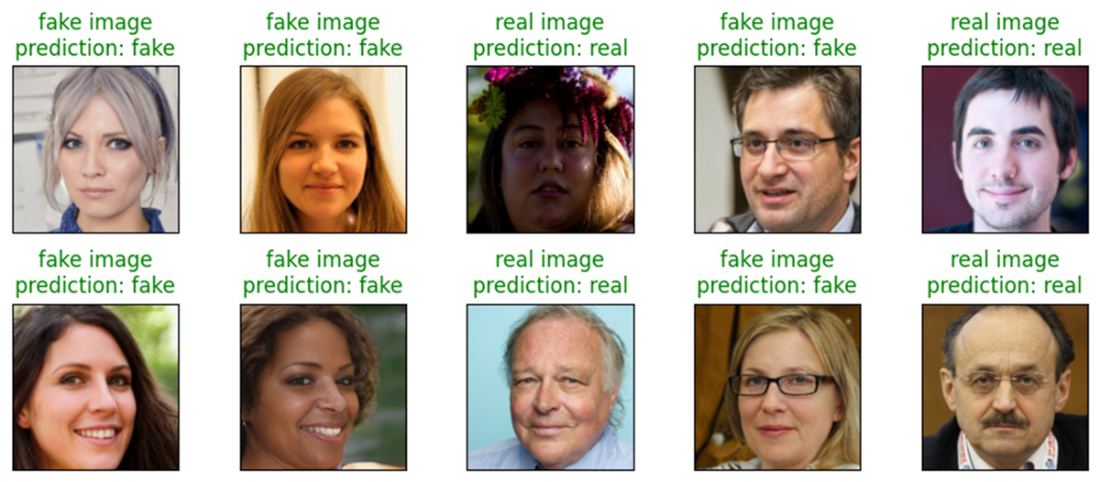
Using the fine-tuned model to differentiate real images from deepfakes. Each image is labeled with both its ground-truth class (real or fake) and the model’s prediction. This side-by-side visualization provides immediate feedback on the model’s predictions. Notice how convincingly realistic some “fake” images appear, underscoring the importance of robust deep learning solutions.
Summary
- The DALL-E series harness the combined strengths of transformer architectures and advanced image generation techniques. Each successive version of DALL-E has pushed the boundaries of what’s achievable in generating images from textual descriptions.
- Imagen combines pretrained language models with advanced cascaded diffusion architectures, generating remarkably precise, high-resolution images directly from sophisticated and nuanced textual descriptions.
- Latent diffusion models such as Stable Diffusion have emerged as a powerful paradigm in text-to-image generation by substantially reducing computational costs while maintaining visual quality and semantic fidelity. MidJourney extends the core capabilities of Stable Diffusion into user-friendly, creatively empowering applications.
- Despite remarkable progress, state-of-the-art text-to-image generation models still have many challenges and concerns. These include geometric inconsistency and the societal risks posed by misinformation, bias, and copyright concerns.
- Training from scratch involves building a model with randomly initialized parameters, requiring the network to learn all features from raw data. In contrast, fine-tuning uses the architecture and pretrained weights of an existing model, modifying (often only) the output layer for a downstream task. The bulk of the network retains the learned parameters, while only the final layers are updated for the new objective.
- Fine-tuning a neural network requires high-quality, well-labeled data that closely matches your target task. For our deepfake detection problem, this means gathering and organizing a large number of images, clearly labeled as either “real” or “fake.” The more representative and diverse the dataset, the better the model will be at generalizing to new, unseen images.
- The fine-tuned ResNet-50 model performs well on unseen, out-of-sample images, achieving an accuracy of 93.73% among a test dataset.

 Build a Text-to-Image Generator (from Scratch) ebook for free
