12 A minimal implementation of DALL-E
This chapter introduces a practical, minimal implementation of a DALL-E–style text-to-image generator, showing how transformer-based language modeling and vector-quantized image representations work together to turn natural language into high-resolution images. Building on open-source efforts inspired by OpenAI’s DALL-E—especially DALL-E Mini and its PyTorch port, min-DALL-E—the chapter emphasizes understanding the full pipeline rather than treating it as a black box. Readers follow a concrete prompt through each stage, gaining intuition from intermediate outputs that reveal how the picture gradually emerges token by token.
The method is framed as sequence-to-sequence generation: a pretrained BART encoder converts a prompt into dense text embeddings; a transformer decoder (trained in the DALL-E Mini project) autoregressively predicts a sequence of 256 discrete image tokens; and a pretrained VQGAN decoder reconstructs those tokens into a complete image. Training (as done in DALL-E Mini) uses large-scale image–caption pairs, VQGAN-encoded image tokens as targets, cross-entropy supervision, and a frozen text encoder so the decoder learns to “speak image.” At inference, min-DALL-E tokenizes the prompt, encodes it, generates tokens stepwise from a BOS seed, and detokenizes the result. Working in a compressed, discrete token space makes the approach efficient and conceptually similar to language modeling.
Hands-on sections walk through the essential components: BPE tokenization and padding, initializing and loading pretrained BART encoder/decoder and the VQGAN detokenizer, and configuring sampling with temperature, top-k, and classifier-free guidance via a superconditioning factor. The chapter details the iterative decoding loop over a 16×16 grid of image tokens, attention masking and caching, and capturing intermediate states for visualization. Finally, readers detokenize to pixels, inspect snapshots as the image forms (e.g., after 32, 64, …, 256 tokens), and even animate the full progression—cementing key ideas such as vector quantization, autoregressive decoding, and sampling strategies from prompt to pixels.
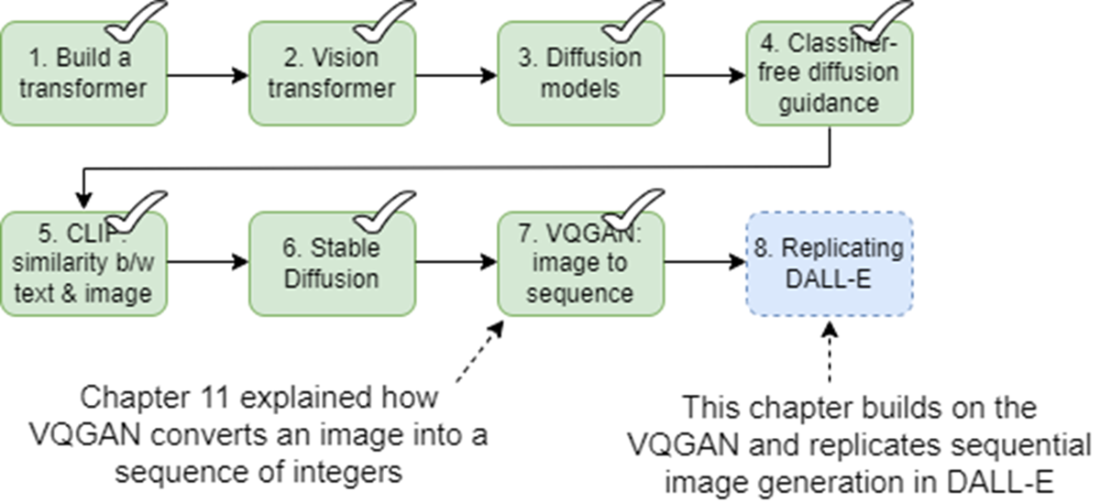
Eight steps for building a text-to-image generator from scratch. This chapter focuses on the last step: replicating a transformer-based text-to-image generator such as DALLE.
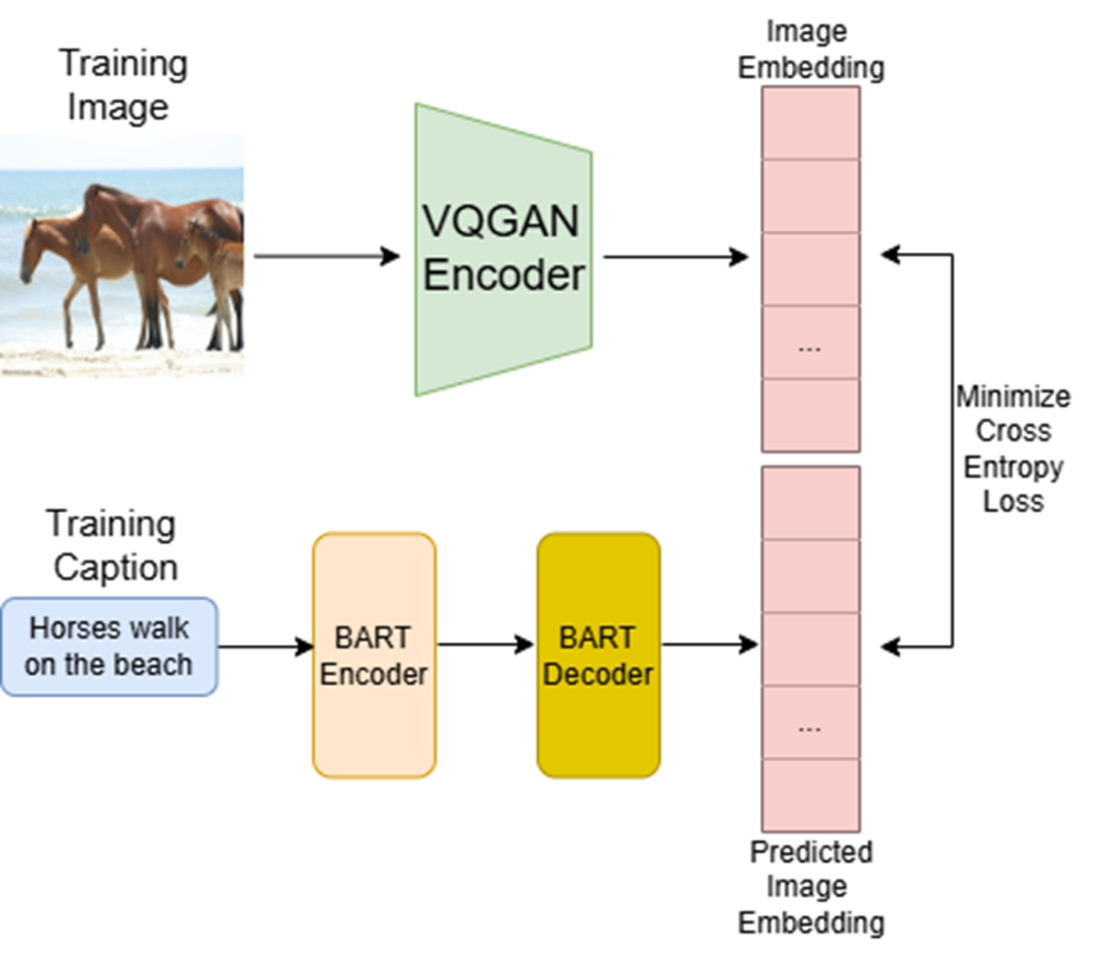
Training pipeline of the DALL-E Mini model. The model is trained on a large dataset of image-caption pairs to replicate the functionality of OpenAI’s proprietary DALLE. During training, each image is encoded into a sequence of discrete tokens using a pretrained VQGAN encoder. At the same time, the accompanying caption is tokenized and passed through a pretrained BART encoder to produce a sequence of text embeddings. These embeddings, along with the VQGAN-encoded image tokens, are used to train a BART decoder from scratch. The decoder learns to autoregressively predict the image tokens, and the training objective is to minimize the cross-entropy loss between the predicted and actual image token sequences.
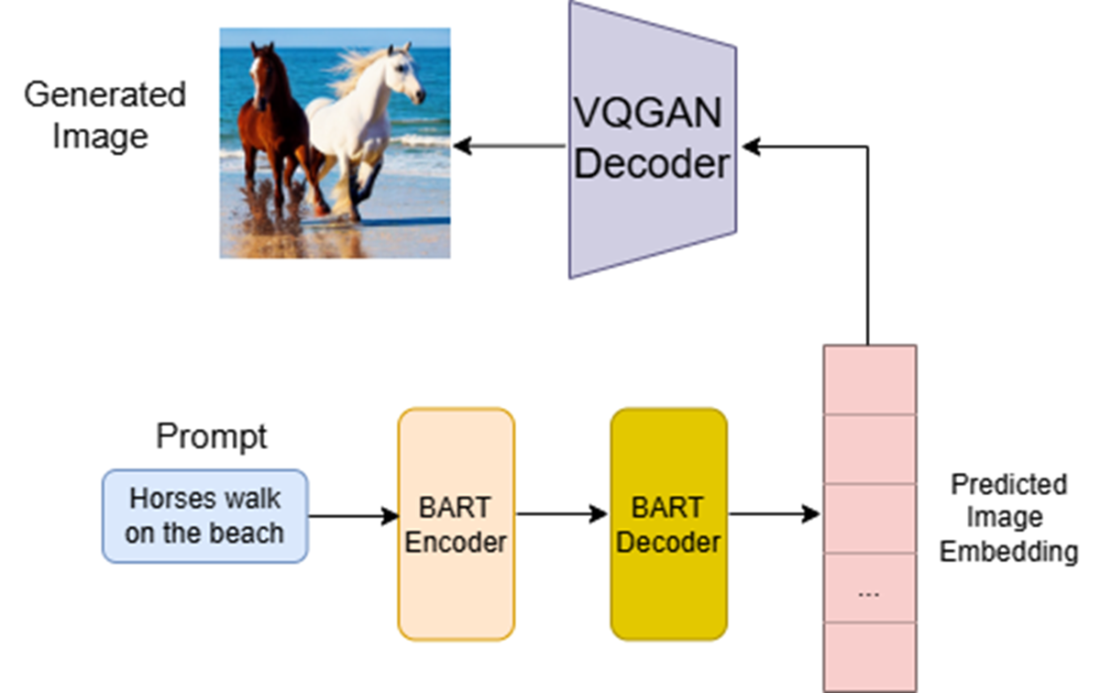
The image generation process in min-DALL-E. To generate an image from a text prompt. The prompt is first tokenized and passed through a pretrained BART encoder to produce text embeddings. The trained BART decoder then autoregressively predicts a sequence of 256 image tokens. Generation begins with a special BOS (beginning-of-sequence) token and proceeds one token at a time, appending each predicted token to the input sequence. Once all 256 image tokens are generated, they are passed to a pretrained VQGAN decoder, which reconstructs them into a high-resolution image.
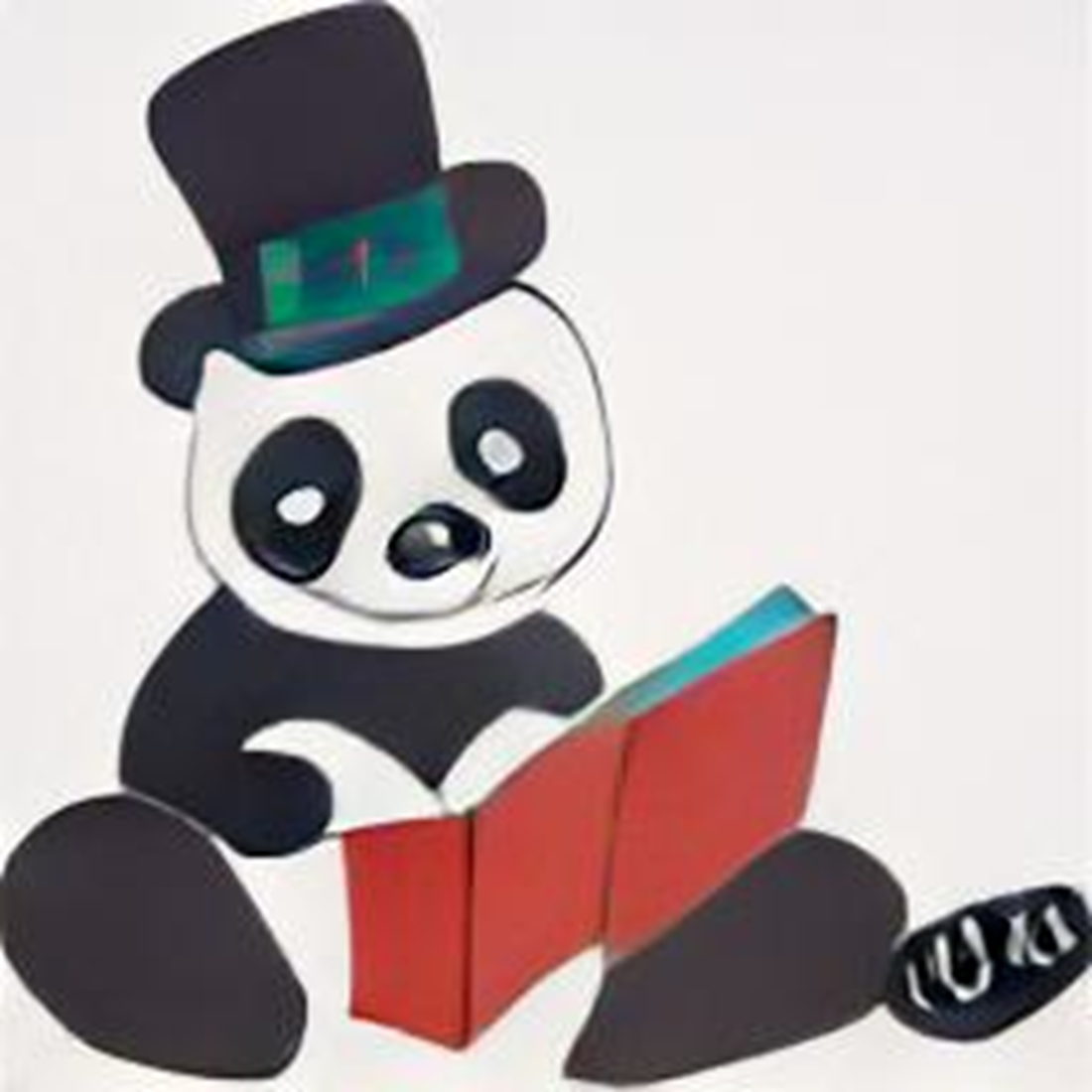
An image generated by the min-DALL-E model with the prompt “panda with top hat reading a book.”
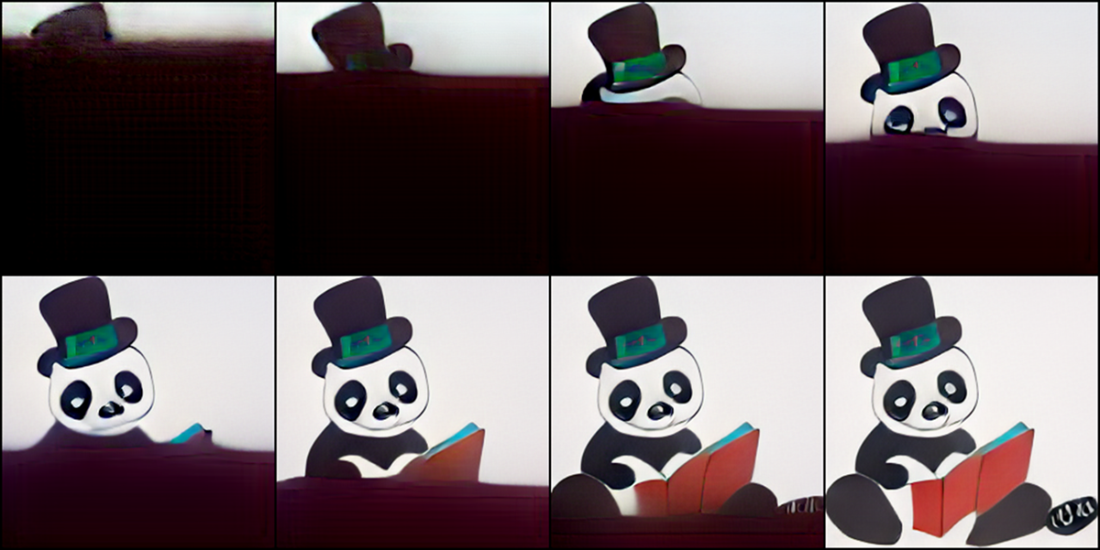
How the min-DALL-E model generates an image based on the prompt "panda with top hat reading a book." The model divides an image into 256 patches, organized in a 16x16 grid. When generating an image based on a text prompt, the model first predicts the top left patch. In the next iteration, the model predicts the patch next to it, based on the first patch and the prompt. The process is repeated until we have all the needed patches in the image. In this figure, the top left subplot shows the output when 32 image patches are generated. The second subplot in the top row shows the output when 64 patches are generated. The rest of the images show the outputs when 96, 128, ..., and 256 patches are generated.
Summary
- DALL-E Mini is a project to replicate the proprietary DALL-E model, and min-DALL-E is the PyTorch reimplementation of DALL-E Mini, which was built using the FLAX/JAX deep learning framework.
- To convert natural language to images, min-DALL-E first tokenizes and encodes the text prompt using a pretrained BART encoder, which converts the prompt into dense vector embeddings that condition the image generation process.
- The min-DALL-E model then autoregressively generates 256 image tokens using a trained BART decoder, where each token corresponds to an image patch in a 16×16 grid.
- A pretrained VQGAN decoder then converts the sequence of image tokens into a high-resolution color image by looking up visual features from a learned codebook.
- Building the min-DALL-E model from scratch allows us to understand how state-of-the-art text-to-image generators such as DALL-E work. The project provides hands-on experience with encoding, decoding, detokenization, and sampling strategies.
FAQ
What is min-DALL-E, and how is it related to OpenAI’s DALL-E?
min-DALL-E is a compact, open-source PyTorch reimplementation that reuses pretrained weights from the DALL-E Mini project (trained in Flax/JAX). It mirrors the core DALL-E idea: encode a text prompt with a transformer encoder, autoregressively predict a sequence of image tokens with a transformer decoder, and reconstruct pixels with a VQGAN detokenizer. It’s not OpenAI’s proprietary DALL-E, but a practical, lightweight way to study and run a DALL-E–style pipeline.How does the end-to-end text-to-image pipeline work?
- Tokenize the prompt with a BPE tokenizer (adds special tokens, pads to a fixed length).- Encode text with a pretrained BART encoder to get dense embeddings.
- Autoregressively predict 256 image tokens (a 16×16 grid) with a BART-style decoder, conditioned on the text embeddings (and previously generated tokens).
- Convert the image tokens to pixels with a pretrained VQGAN detokenizer to obtain the final image.
How is the model trained in DALL-E Mini, and what does this chapter actually run?
Training (DALL-E Mini):- Use ~15M image–caption pairs.
- Pretrained VQGAN encoder converts each image into 256 discrete tokens.
- Pretrained BART encoder (frozen) embeds the caption; a BART decoder is trained to predict the image tokens autoregressively with cross-entropy loss.
Inference in this chapter (min-DALL-E):
- You don’t train; you load pretrained weights converted from DALL-E Mini and run the full generation pipeline in PyTorch.
What are “image tokens,” and why use a VQGAN codebook?
Image tokens are discrete indices into a learned VQGAN codebook. Each token corresponds to a small image patch. Using tokens (rather than raw pixels) makes the problem more tractable for transformers and aligns it with language modeling. The VQGAN decoder (detokenizer) converts the 256-token sequence back into a coherent, high-resolution image.How are prompts tokenized and prepared for the encoder?
- Tokenization uses BPE with vocab.json and merges.txt (Hugging Face).- Special tokens: <s> (start), </s> (end), <pad> (padding).
- Inputs are padded to length 64.
- Two sequences are formed: an “unconditional” row (for classifier-free guidance) and a “conditional” row with the actual prompt. Both are encoded by the BART encoder.
What happens at inference time when generating tokens?
- Start with a BOS placeholder for image tokens.- For i from 1 to 256, the decoder predicts the next token given: previous image tokens, text embeddings, attention mask, and its cached attention state.
- After 256 tokens are generated, drop the BOS and pass the 256 tokens to the VQGAN detokenizer to get the image.
What do temperature, top-K, and the supercondition factor control?
- Temperature: randomness in sampling (lower ≈ sharper/more conservative; higher ≈ more diverse/creative).- Top-K: restricts choices to the K most likely tokens at each step (smaller K yields safer/more coherent outputs).
- Supercondition factor: balances unconditional vs. conditional guidance; higher values make the image adhere more strongly to the prompt.
How can I visualize the model’s “painting” process?
- Save the image tokens after each step (or at milestones like 32, 64, …, 256).- Detokenize these snapshots to images and arrange them in a 2×4 grid to see the image progressively fill in patch-by-patch.
- Create a GIF from all 256 frames to watch the full autoregressive generation unfold.
Which files do I need, and where do they come from?
- Tokenizer: vocab.json, merges.txt (Hugging Face).- Models: encoder.pt (BART encoder), decoder.pt (BART decoder), detoker.pt (VQGAN detokenizer).
- Store locally (e.g., files/DALLE/) and add the min-dalle repo to your Python path to import its modules.
What shapes and common checks should I expect (and common gotchas)?
- Typical encoder output: [2, 64, 2048] (two rows: unconditional and conditional; 64 tokens; 2048-dim embeddings).- Image token sequence length: 257 with BOS included; pass only the last 256 to the detokenizer.
- Always mask pads in attention and set modules to eval() for inference.
- Ensure the min-dalle directory is on sys.path, correct device/dtype (e.g., float16 on CUDA), and sufficient GPU memory. If you see odd results, double-check special tokens, padding, BOS handling, and that all weights downloaded correctly.

 Build a Text-to-Image Generator (from Scratch) ebook for free
