Overview
Appendix A. References and further reading
This appendix serves as a curated map of the book’s technical ecosystem, pointing readers to the foundational papers, tools, tutorials, and commentary that inform each stage of building reasoning-capable language models. It begins with the earliest signals of the reasoning-model era, including OpenAI’s o1 announcement, DeepSeek-R1’s technical report, and later discussions about what chain-of-thought models can and cannot do. It also recommends a companion book on building large language models from scratch for readers who want a deeper implementation background before moving into reasoning-specific methods.
Across the middle chapters, the references focus on practical components of the pipeline: setting up environments, using GPU platforms, understanding tokenization, working with PyTorch, measuring memory with KV caches, and evaluating mathematical reasoning with datasets such as MATH and MATH-500. The appendix also highlights inference-time techniques such as chain-of-thought prompting, self-consistency, and best-of-N selection, as well as training approaches centered on reinforcement learning, RLHF, GRPO, and the DeepSeek-R1 family of methods. In several places, it emphasizes that modern reasoning systems are not magic, but powerful systems whose capabilities come from carefully combining data, prompting, search, verification, and optimization.
The later references broaden the picture to efficiency and evaluation, covering knowledge distillation, supervised fine-tuning, benchmark design, leaderboard limitations, and LLM-as-a-judge methods. The overall message is that progress in reasoning models depends not only on better training algorithms, but also on better ways to test, compare, and compress them for real-world use. By assembling papers, tutorials, and critical analyses, the appendix gives readers a practical reading list for both learning the field and questioning its assumptions.
FAQ
Which resource in Chapter 1 introduces OpenAI’s o1-preview model?
The announcement article is Introducing OpenAI o1-preview: https://openai.com/index/introducing-openai-o1-preview/. It is presented as the first LLM-based reasoning model.What resource does the appendix recommend for understanding DeepSeek-R1 and reasoning emerging from reinforcement learning?
The key reference is DeepSeek-R1: Incentivizing Reasoning Capability in LLMs via Reinforcement Learning: https://arxiv.org/abs/2501.12948. The chapter highlights it as an important technical report on reasoning with verifiable rewards.Where can I find a beginner-friendly guide to building and training large language models from scratch?
The appendix points to Build a Large Language Model (From Scratch): http://mng.bz/orYv. It is described as an in-depth book and guide for step-by-step implementation and training.What is a good resource for learning about tokenization in Chapter 2?
For tokenization, the appendix recommends two resources: Chapter 2 of Build a Large Language Model (From Scratch) and the article Implementing A Byte Pair Encoding (BPE) Tokenizer From Scratch: https://sebastianraschka.com/blog/2025/bpe-from-scratch.html.Which papers are suggested for learning about evaluating mathematical reasoning?
The appendix cites Measuring Mathematical Problem Solving With the MATH Dataset and Let’s Verify Step by Step. These cover the MATH dataset and the MATH-500 split, respectively: https://arxiv.org/abs/2103.03874 and https://arxiv.org/abs/2305.20050.What reference explains chain-of-thought prompting and “Let’s think step by step”?
The appendix points to Large Language Models are Zero-Shot Reasoners: https://arxiv.org/abs/2205.11916. It formally described chain-of-thought prompting and introduced “Let’s think step by step.”Which paper introduced GRPO for training reasoning models?
The appendix names DeepSeekMath: Pushing the Limits of Mathematical Reasoning in Open Language Models: https://arxiv.org/abs/2402.03300. This is the paper that introduced the GRPO algorithm.What classic paper is recommended for knowledge distillation in reasoning-model training?
The key distillation reference is Distilling the Knowledge in a Neural Network: https://arxiv.org/abs/1503.02531. It is described as the original paper that popularized combining hard and soft distillation objectives.Which resources are suggested for understanding benchmark evaluation and LLM leaderboards?
The appendix recommends several references, including Measuring Massive Multitask Language Understanding, the Elo rating system, and Chatbot Arena: An Open Platform for Evaluating LLMs by Human Preference. It also suggests The Leaderboard Illusion for criticism of leaderboard methodology.Where can I read about LLM-as-a-judge methods and small model judges?
Two suggested resources are A Survey on LLM-as-a-Judge: https://arxiv.org/abs/2411.15594 and PHUDGE: Phi-3 as Scalable Judge: https://arxiv.org/abs/2405.08029. These cover judge-model approaches and an example of a small LLM used as a judge.
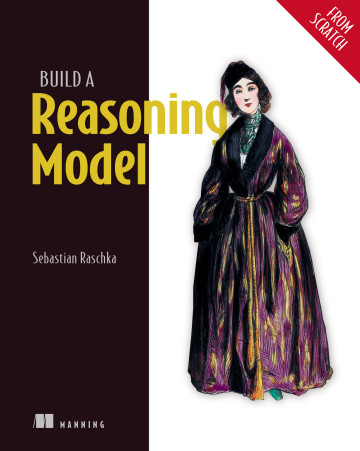 Build a Reasoning Model (From Scratch) ebook for free
