6 Application and integration architecture
Autonomy in enterprise systems is presented as a boundary problem rather than a model problem. The chapter uses a real payment error and a quality-investigation scenario to show that technical validity is not the same as correct business action. The core issue is making sure that intent, authority, state, evidence, and recovery stay aligned as work moves across applications, tools, workflows, events, agents, and human roles.
The chapter organizes that challenge around bounded interaction surfaces: the points where an agent enters the application estate and interacts with systems or people. It explains how to decide what an agent should own, what should remain in deterministic services, policy components, systems of record, workflow or case management, and human decision-making. It then defines conversational contracts as the missing interaction-level meaning behind API calls and events, capturing intent, context, constraints, authority, outcome, and evidence obligations so that agentic actions can be governed, not just executed.
From there, the chapter lays out the main architectural patterns needed for safe autonomy: governed tool wrappers to mediate access to enterprise capabilities and prevent raw API abuse; event-mediated coordination to preserve accountability across time and across systems; Agent Mesh design to control how specialist agents collaborate without creating hidden authority; and fallback-to-human paths to transfer control cleanly when autonomy reaches its limit. It closes by highlighting common anti-patterns, such as treating prompt chains, agent frameworks, or orchestrators as the architecture itself, and offers a phased playbook for establishing a bounded agentic flow with durable state, explicit governance, reconstructible evidence, and clear human re-entry.
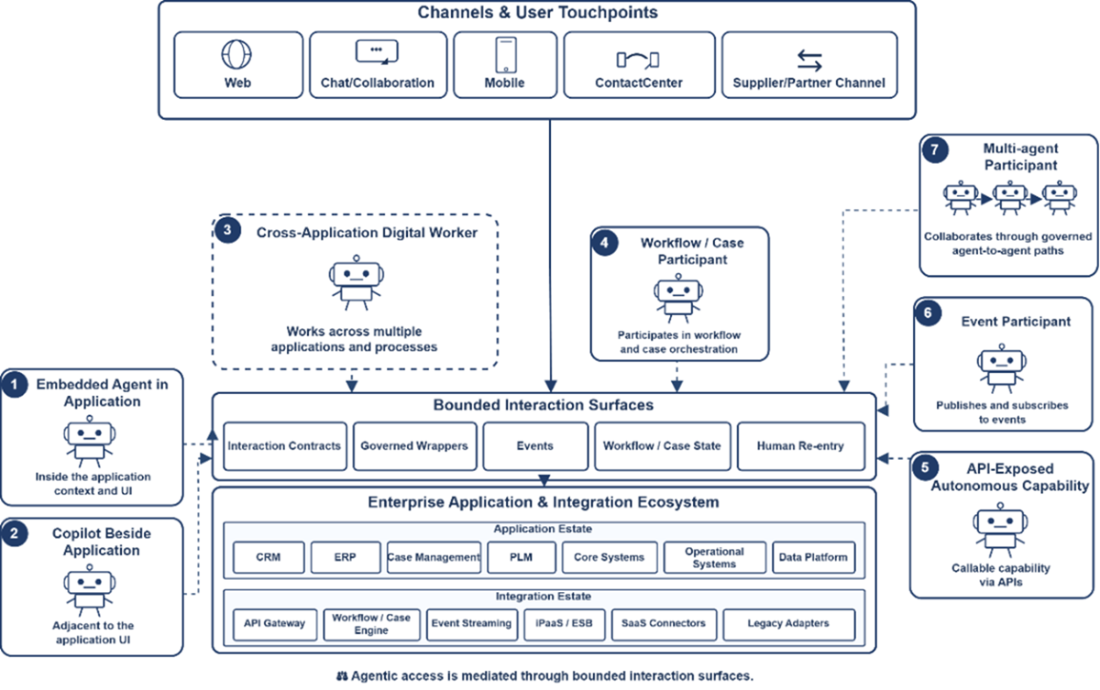
Agent participation in the enterprise application estate. An agent may occupy any of the seven positions relative to applications, users, workflows, APIs, events, and other agents. Each position creates one or more bounded interaction surfaces.
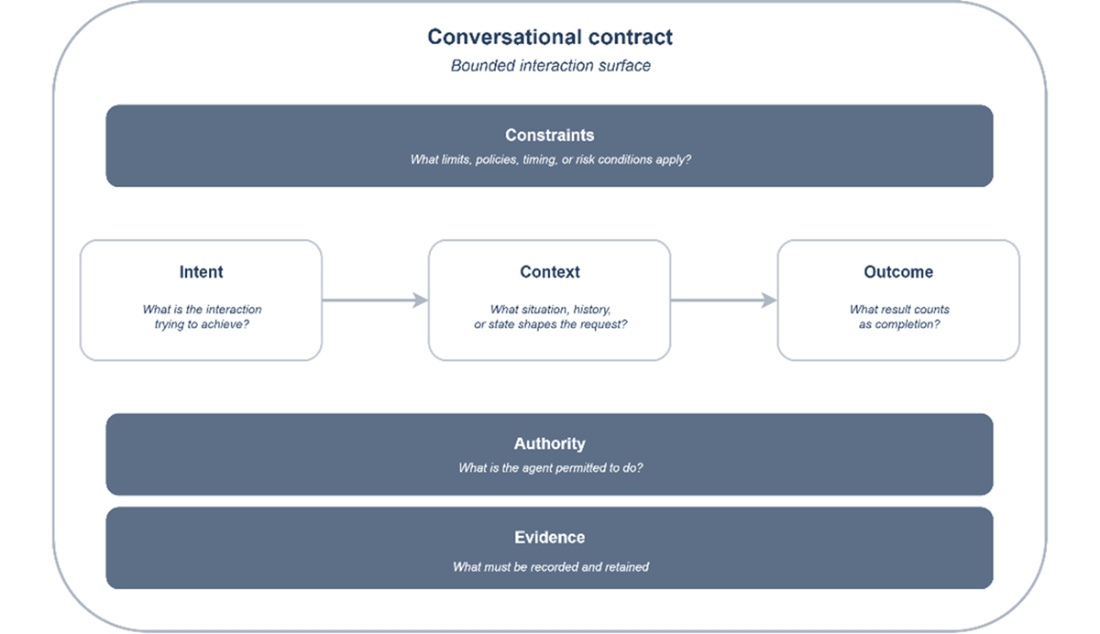
Anatomy of a conversational contract. A conversational contract carries an agentic interaction from intent toward outcome. Context shapes how the intent is interpreted, constraints and authority define the boundary within which the agent may act, and the evidence obligation defines what must remain after the agent has acted.
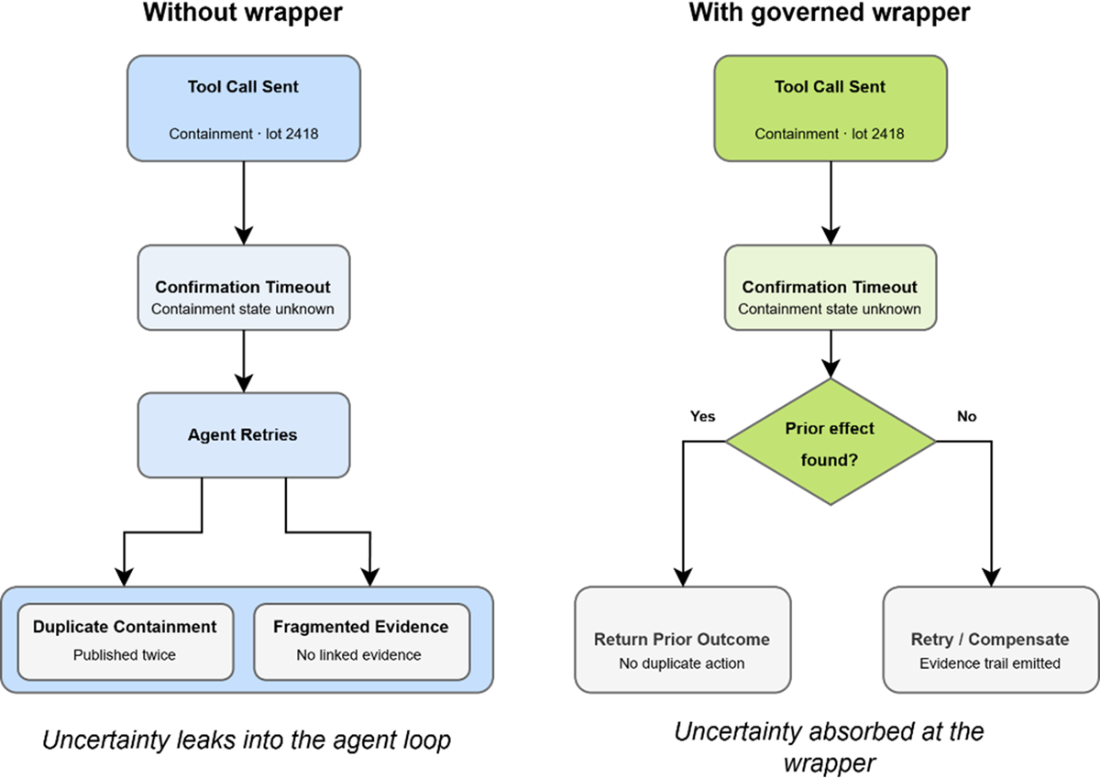
Why integration uncertainty requires governed wrappers. Without a wrapper (left), a confirmation timeout drives the agent to retry, and the enterprise sees a duplicate business effect with no linked evidence. With a governed wrapper (right), the retry is resolved against the prior effect recorded for the conversational contract instance, so uncertainty is absorbed at the boundary rather than leaking into the agent loop.
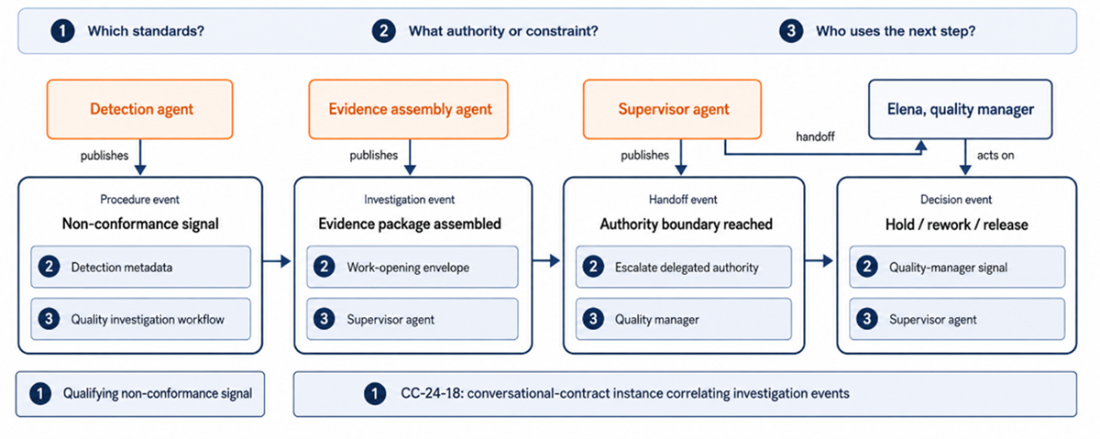
A correlated event chain preserves the relationship among the originating interaction, authority context, next ownership, and evidence. The qualifying nonconformance signal triggers the workflow or case platform to create conversational-contract instance CC-2418, which then correlates the investigation, handoff, and human decision so the flow can be reconstructed afterward.
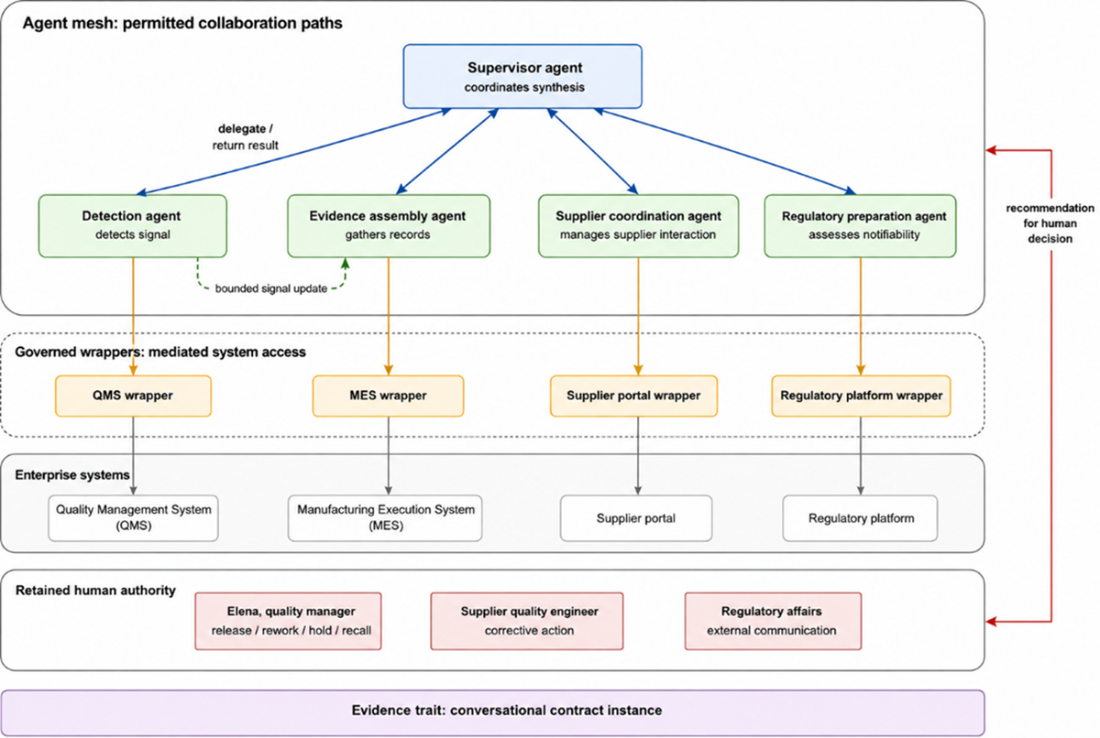
The quality-investigation mesh. The supervisor holds the conversational contract for the containment recommendation and delegates bounded work to four specialist agents. Every path into the enterprise estate passes through a governed wrapper. The three retained human authority holders remain outside the agent boundary; decisions requiring their authority return to the flow through them.
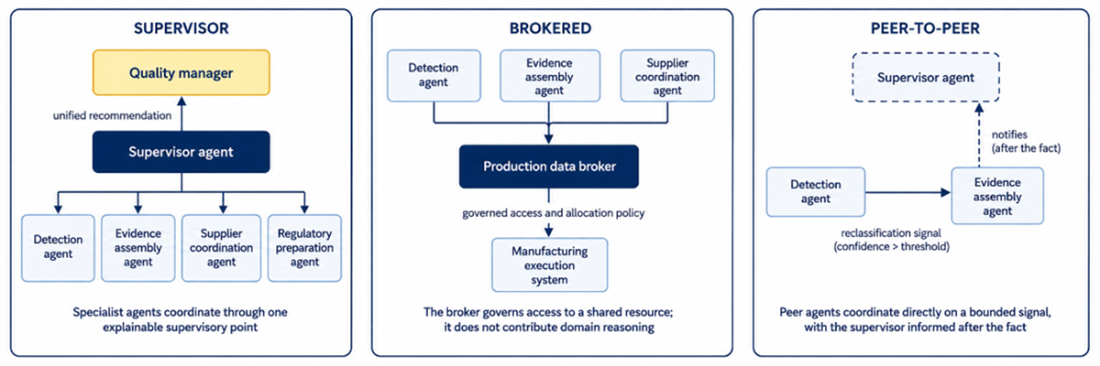
Three coordination structures within an Agent Mesh. In the supervisor structure, one coordinating agent delegates to specialists and reconciles their outputs, so every decision that crosses the mesh boundary passes through a single explainable point. In the brokered structure, an intermediary mediates access to a shared resource or enforces policy without contributing domain reasoning. In the peer-to-peer structure, specialist agents coordinate directly through bounded interaction paths.
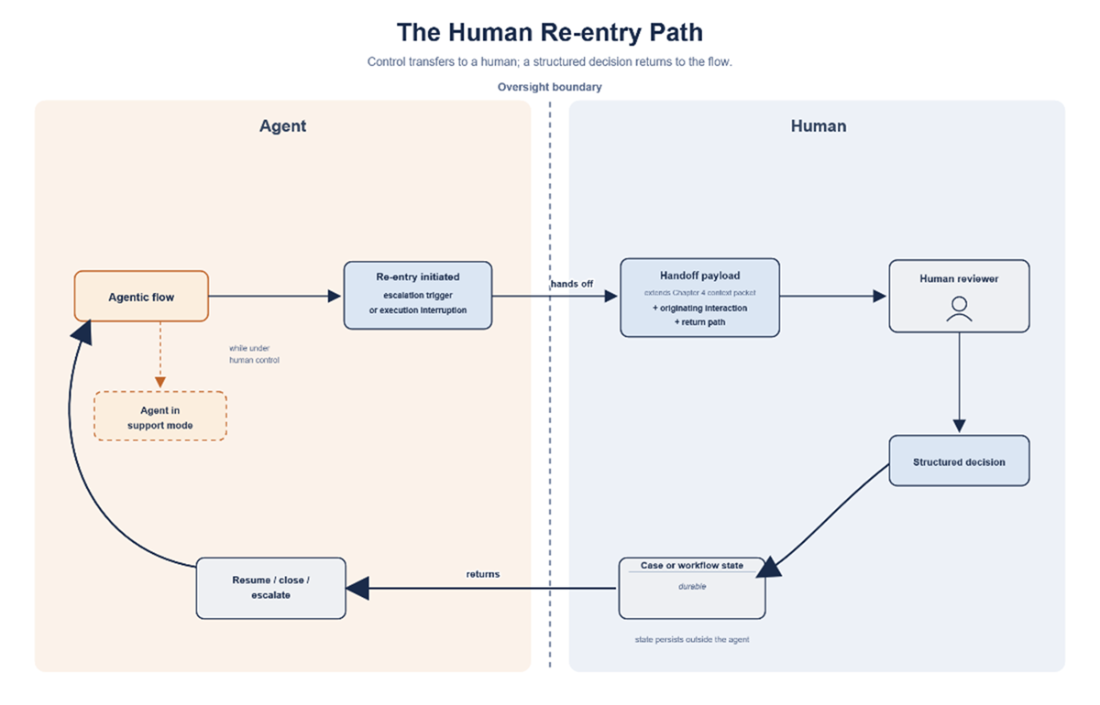
The human re-entry path. A trigger ends autonomous execution; control crosses the oversight boundary to a human, carrying a handoff payload that extends the chapter 4 context packet (table 4.8) with the originating interaction and a return path. The human's structured decision re-enters the flow as a case or workflow state so the flow can resume, close, or escalate, while the agent holds a bounded support role until the decision is recorded. Unlike a notification, this path transfers control, preserves state and evidence, and returns the decision to the flow.
Summary
- Application and integration architecture for agentic systems starts by identifying where agents participate in the estate and the bounded interaction surfaces they create. These surfaces keep authority, accountability, and evidence explicit as agents communicate, invoke systems, coordinate work, and hand off control.
- Conversational contracts extend traditional API and event contracts by expressing intent, context, constraints, authority, outcomes, and evidence obligations, making the interaction auditable.
- Governed tool wrappers prevent raw system access by translating agentic intent into bounded, validated, auditable, and recoverable invocations of enterprise capabilities.
- Wrappers must treat agent-generated parameters as untrusted input and enforce idempotency, retry control, compensation, and auditability as design obligations.
- Event-mediated coordination allows agents and systems to work asynchronously, but events must preserve causation, decision context, the basis of authority, evidence, and next ownership.
- Agent Mesh design defines the governed collaboration structure between specialist and supervisory agents; governed wrappers, events, and human reentry paths connect that collaboration to enterprise systems and people.
- Orchestration may own the durable execution state needed for sequencing, waiting, and recovery, but it should not absorb delegated business authority, policy interpretation, direct system access, or authoritative business state.
- Human re-entry paths preserve state, evidence, authority context, and pending action when autonomy reaches its boundary, then return the human decision or action to the automated flow.
- Application and integration anti-patterns emerge when APIs, prompts, orchestration layers, event choreography, or agent SDKs are allowed to make architectural decisions implicitly.
- Taken together, these patterns express the Agentic Enterprise Framework's bounded-autonomy principle in application and integration, grounded in the Foundation for Autonomy paradigm: autonomy is permitted, but only within boundaries that keep authority, accountability, and evidence explicit at runtime.
FAQ
What is the main goal of application and integration architecture in an autonomous enterprise?
Its goal is to make agentic interactions bounded, governed, and recoverable. That means clearly defining where agents participate, what they own, how they access systems, how they coordinate with other agents, and how control returns to humans when needed.
What is a bounded interaction surface?
A bounded interaction surface is the point where an agent interacts with an application, tool, workflow, event stream, another agent, or a person under defined constraints. It is where authority, state, evidence, accountability, and recovery must be explicit.
What are the seven ways an agent can participate in the application estate?
The chapter describes seven participation modes: embedded agent, copilot alongside an application, cross-application digital worker, workflow or case participant, API-exposed autonomous capability, event participant, and multi-agent participant. These are not mutually exclusive; an agent can play more than one role.
How should responsibility be divided between an agent and surrounding systems?
The agent should interpret changing context, reason across evidence, and prepare bounded recommendations. Deterministic services should handle repeatable calculations and validation, policy components should evaluate rules, systems of record should hold authoritative data, workflows should manage sequencing and recovery, governed wrappers should mediate access, and humans should retain consequential decisions outside delegated authority.
What is a conversational contract?
A conversational contract defines the intent, context, constraints, authority, expected outcome, and evidence obligation for an agentic interaction. It gives the interaction governed meaning and boundary, beyond what an API schema or event payload alone can express.
How is a conversational contract different from an API or event contract?
An API contract defines how an operation is invoked, and an event contract defines how a fact or state change is published. A conversational contract defines why the agent is acting, what authority it has, what limits apply, and what evidence must remain afterward.
What is a governed tool wrapper?
A governed tool wrapper is a mediated access layer between an agent and an enterprise system. It translates agentic intent into bounded system action under defined authority, validation, retry, recovery, and evidence rules, instead of letting the agent call systems directly.
Why are idempotency, retry control, compensation, and auditability so important?
Because agentic retries can create duplicate or conflicting business effects. Idempotency prevents repeated effects, retry control keeps the agent from looping, compensation provides deterministic recovery when state has already changed, and auditability preserves a reconstructable record of what happened and why.
What is an Agent Mesh?
An Agent Mesh is the governed collaboration structure between specialist agents. It defines which agents may interact, under what contract, through which paths, with what authority, and with what evidence obligations. It is not just free-form agent-to-agent communication.
When should human re-entry be used?
Human re-entry should be used when an agent reaches an oversight boundary or cannot continue safely. Triggers include low confidence, policy conflict, high consequence, timeout, exception, or unresolved conflict. The handoff must preserve state, evidence, authority context, and a structured return path.

 Architecting for Autonomy ebook for free
