4 Business architecture for agentic systems
Business architecture is presented as the point where agentic autonomy becomes an organizational reality rather than a technical possibility. The chapter argues that once systems can reason probabilistically and act on their own within limits, enterprises must redesign value streams to make judgment, authority, escalation, and accountability explicit. Instead of treating work as a simple sequence of tasks, organizations need to identify where decisions actually happen, define the boundaries of autonomous action, and ensure every delegated action has a named owner and a policy basis.
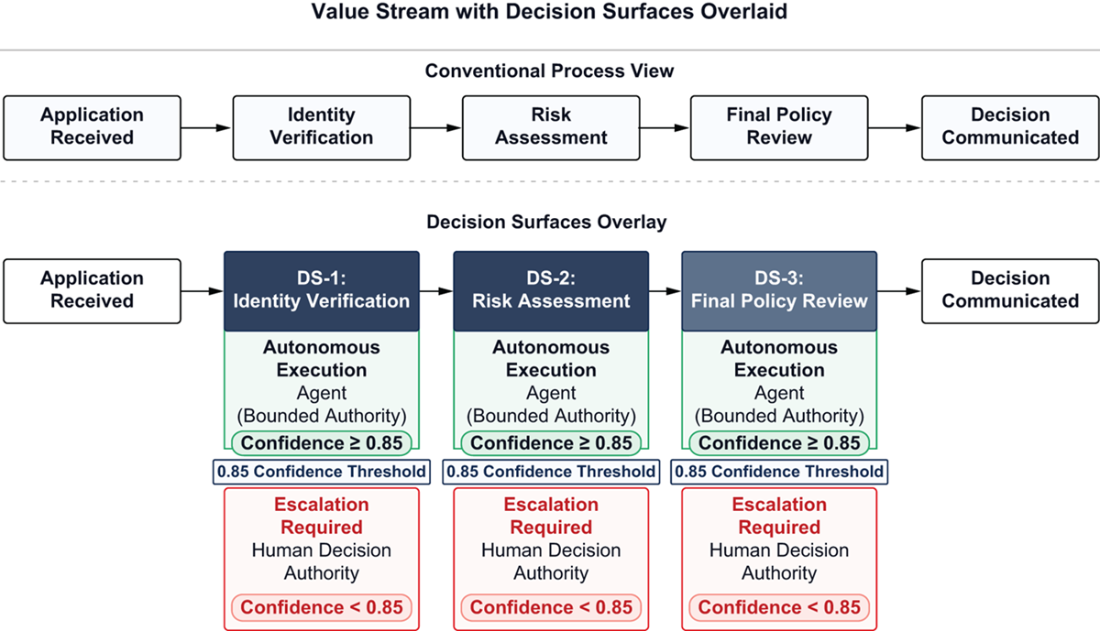
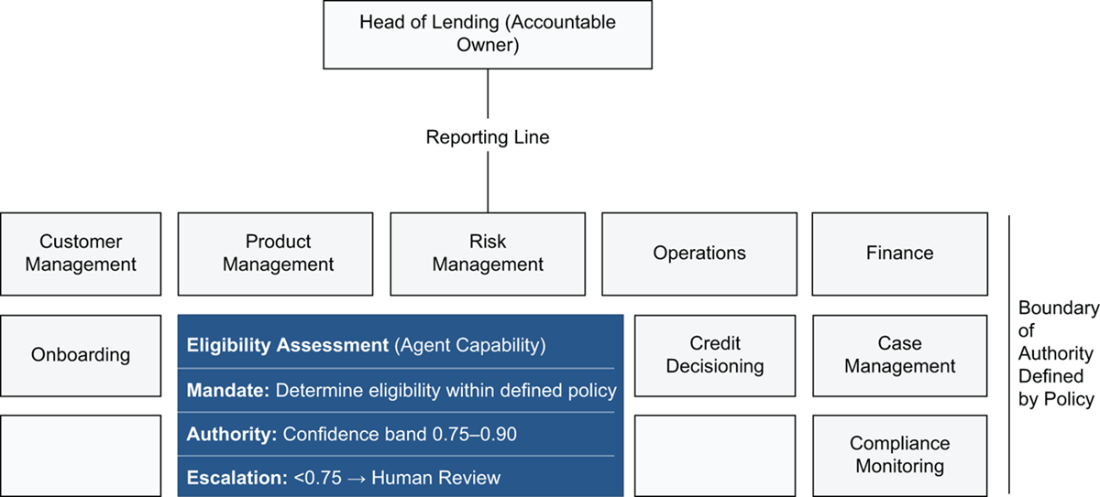
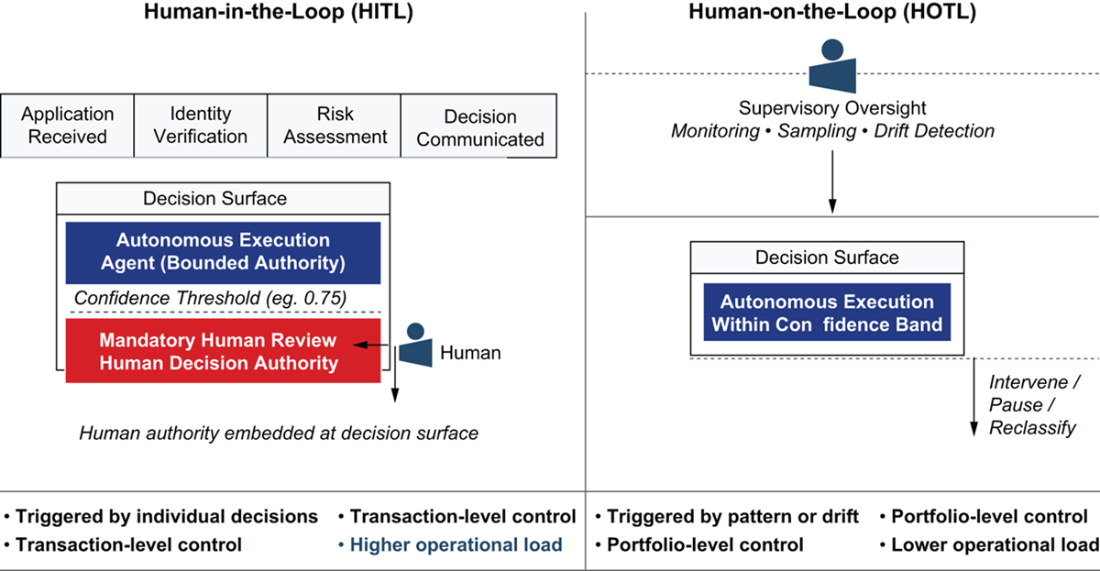
The core design move is to map decision surfaces across value streams and classify whether each surface should be automated, delegated with oversight, assisted by the agent, or reserved for humans. This is paired with patterns such as goal-oriented journeys, which frame work around intended outcomes rather than step completion, and agent-as-a-capability, which treats the agent as a business capability with a mandate, operating envelope, and accountable business owner. Human oversight is built into the architecture through HITL and HOTL models, escalation triggers, and structured handover so that uncertainty, policy conflicts, or high-consequence cases transfer cleanly to human review with full context.
The chapter also warns that autonomy fails quietly when it is not governed as a living business capability. Invisible autonomy emerges when agents gain authority without visible boundaries, while escalation deadlock appears when cases are routed to humans without ownership, context, or resolution paths. To move from pilots to production, the organization must steward authority over time, use migration strategies such as parallel run or gradual delegation, and formally integrate the agent into the enterprise capability model. In the end, successful autonomy depends less on model performance than on disciplined business architecture that keeps decision rights visible, bounded, and accountable.
Value stream with decision surfaces overlaid
The Goal-Oriented Journey Model
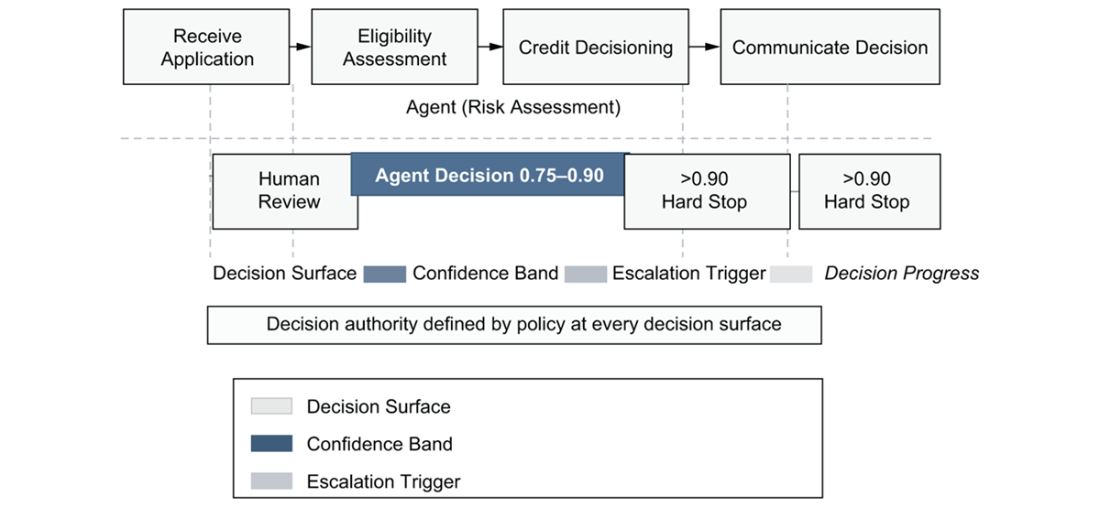
Agent-as-a-Capability in a business capability map, with mandate, confidence band, and escalation threshold shown as explicit architectural properties
Oversight postures at a decision surface. In Human-in-the-Loop (HITL), human authority is embedded directly in the decision surface and triggered by individual cases. In Human-on-the-Loop (HOTL), the value stream remains autonomous within defined confidence bands, while a supervisor monitors and intervenes at the portfolio level.
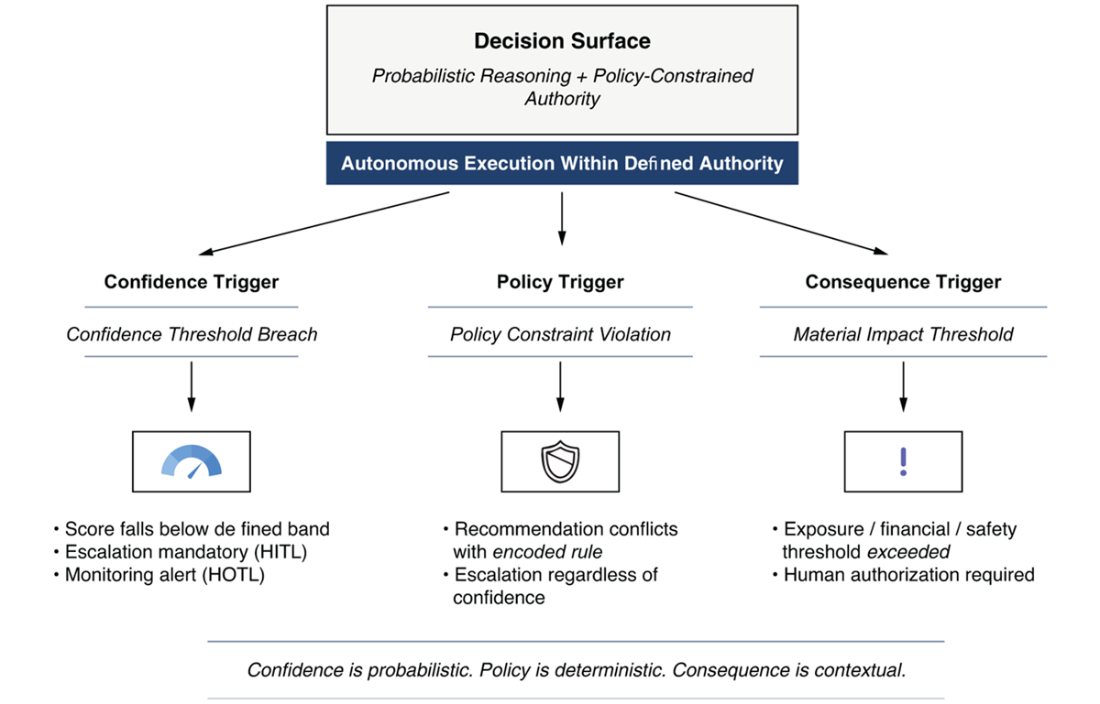
Escalation-trigger taxonomy at a decision surface. Three distinct trigger classes govern the boundary of delegated authority: probabilistic confidence breaches, deterministic policy violations, and contextual consequence thresholds.
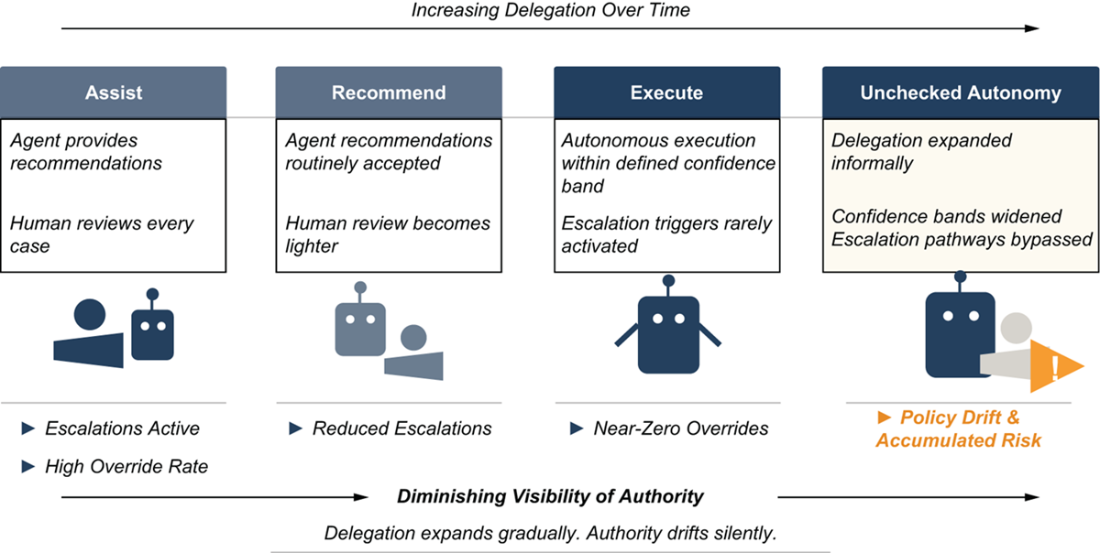
Progression of invisible autonomy. Delegation expands incrementally from assisted recommendations to unchecked execution, while visibility into escalation and active governance gradually diminishes.
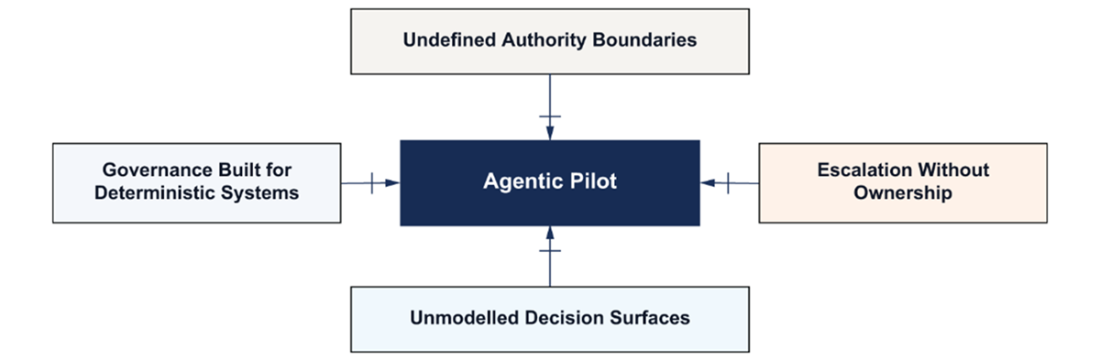
Structural stresses that undermine pilot-to-production migration. Four stresses act simultaneously on the agentic pilot as it transitions to production. Each is absorbed by human judgment at the pilot scale and becomes architecturally significant at volume.
Summary
- The Agentic Enterprise Framework becomes operational at the business layer when decision surfaces, authority boundaries, escalation paths, and accountable capabilities are modeled explicitly.
- Autonomous judgment must be deliberately built into value streams through explicit decision surfaces with defined confidence bands and authority boundaries.
- The pattern cards provide reusable structures for Decision Surfaces, Goal-Oriented Journeys, Agent-as-a-Capability, Human-in-the-Loop, and Human-on-the-Loop designs.
- Escalation is governed by three distinct classes of triggers: confidence thresholds, policy violations, and consequence thresholds.
- Responsibility for execution may shift between agents and humans, but accountability remains anchored to the named business owner.
- Delegated authority must be actively stewarded over time to prevent autonomy from silently expanding beyond its documented boundaries.
- Structural antipatterns emerge when authority boundaries, escalation ownership, or governance mechanisms are left implicit rather than designed.
- Successful scaling requires migration strategies, such as strangler migration, parallel runs, and gradual delegation, that control how and when authority is transferred.
- An autonomous system becomes an enterprise capability only when it is formally registered, accountable, reviewed, and aligned with policy.
- Autonomy is ready to scale only when detection, escalation, and intervention mechanisms are explicitly defined and operational.

 Architecting for Autonomy ebook for free
