3 The economics of autonomy
The chapter argues that autonomy cannot be judged with conventional ROI logic, because agentic systems are not deterministic tools with fixed costs and linear returns. They operate under uncertainty, need ongoing supervision, and create value in uneven stages, so a simple savings calculation often makes them look better than they really are—or causes them to be rejected too early when early costs outweigh near-term benefits. The key lesson is that economics for autonomous systems must account for governance, failure, and delayed value creation from the start.
To replace that flawed framing, the chapter introduces the Agentic Economics Canvas, which examines autonomy through four lenses: cost structure, benefit structure, risk adjustment, and Net Agentic Value. Cost structure includes build, operating, governance, and failure costs, many of which are routinely underestimated because they come from data readiness, integration, safety infrastructure, traceability, and ongoing policy enforcement rather than from model development alone. Benefit structure goes beyond labor savings to include coordination cost reduction, productivity and quality gains, faster decisions, and strategic option value, all of which tend to ramp up over time rather than appear immediately.
The final message is that risk must be priced explicitly because the blast radius of autonomous error can outweigh apparent efficiency gains, especially in regulated or high-stakes settings. Net Agentic Value becomes the main decision tool because it shows whether an initiative is on a credible path to economic viability across learning, signal, and scale phases. The chapter closes by arguing for a pre-architecture gate: only initiatives with a resilient NAV trajectory should proceed to design, scale, or expanded authority, while weak or fragile cases should remain experiments or be narrowed, constrained, or withdrawn.
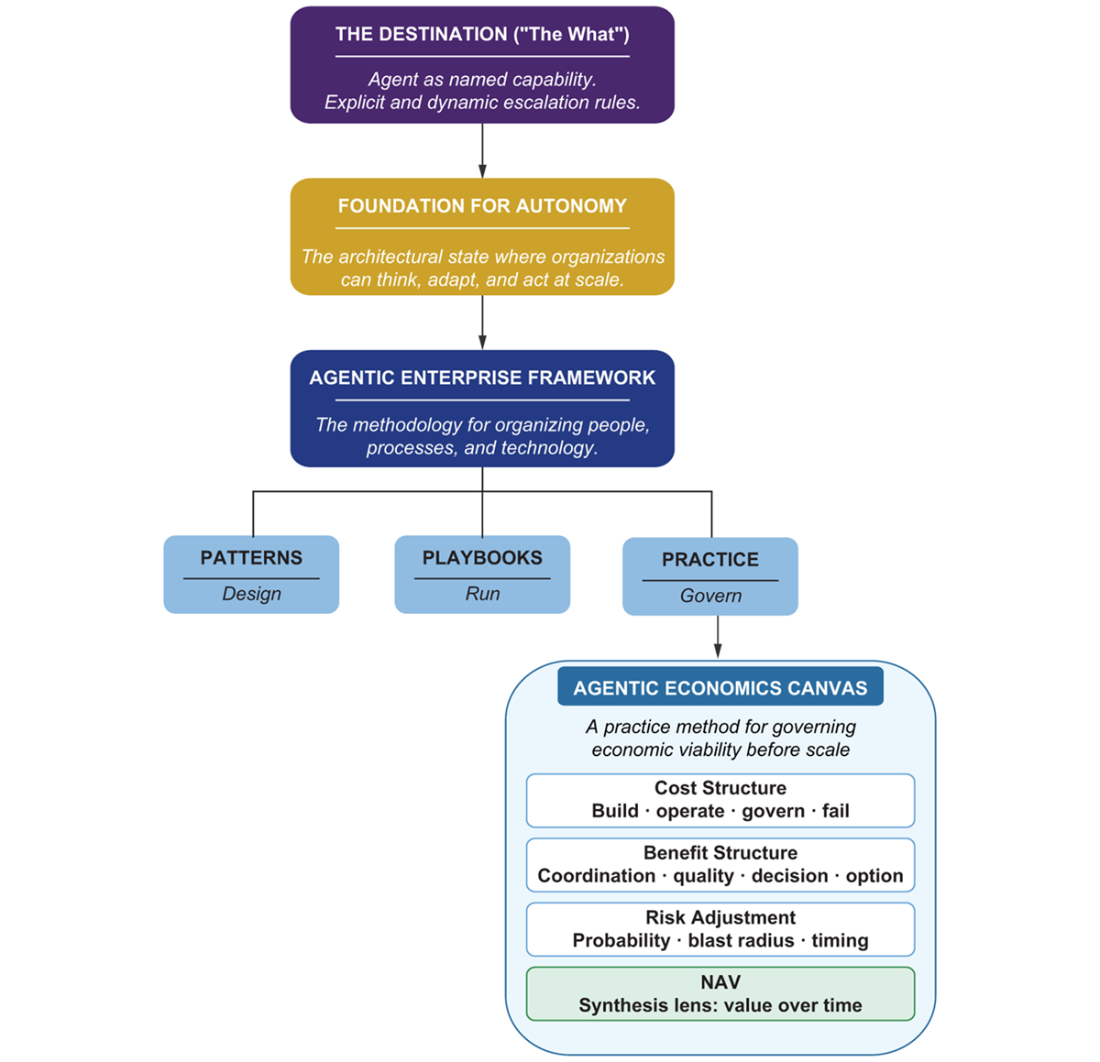
The Agentic Economics Canvas in the Agentic Enterprise Framework. The framework organizes the architectural response to autonomy across patterns, playbooks, and practice. The Agentic Economics Canvas sits within Practice as a governance tool for assessing economic viability. NAV is the fourth AEC lens; it synthesizes cost structure, benefit structure, and risk adjustment into a time-aware view of whether autonomy should be scaled, sustained, constrained, or withdrawn.
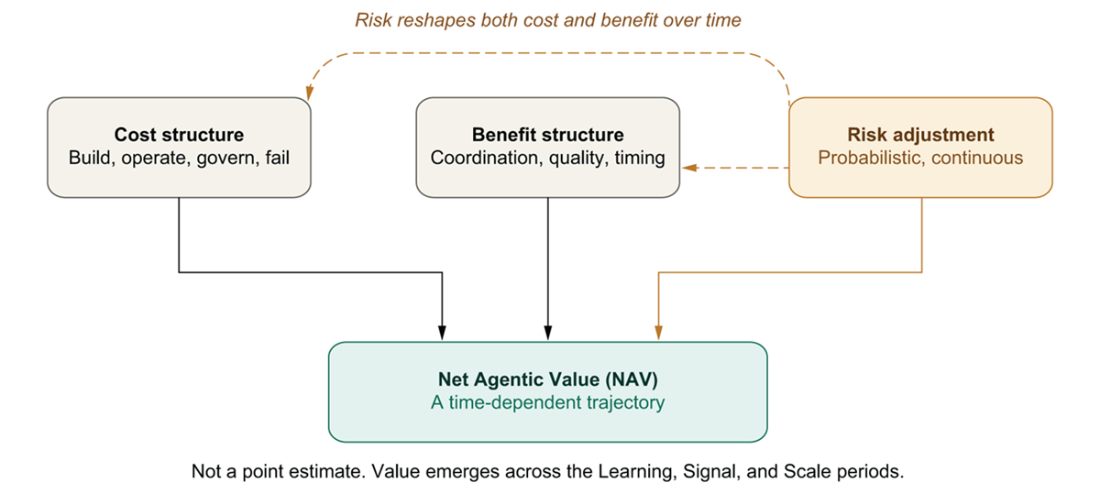
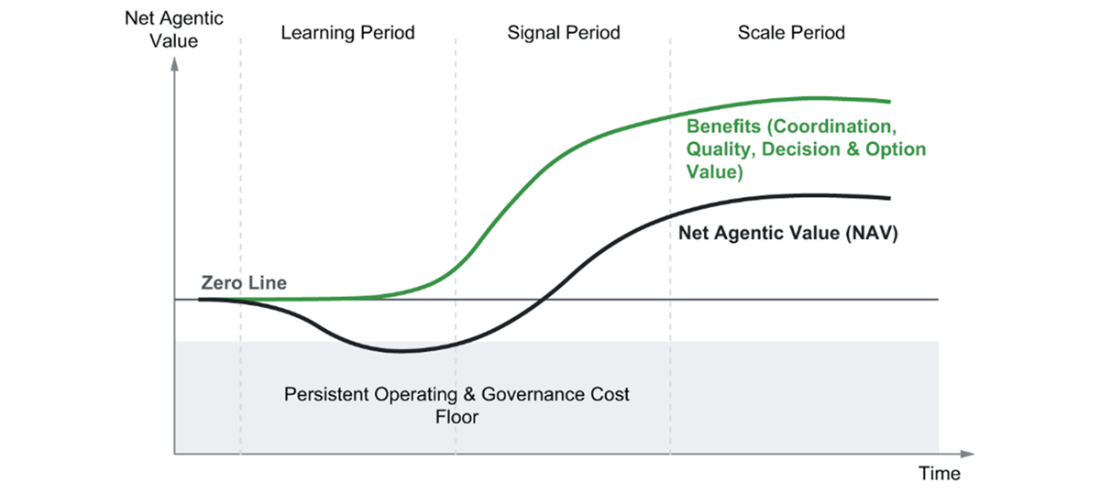
Cost, benefit, and risk do not combine additively in agentic systems. Each input shapes Net Agentic Value, and risk continuously reshapes both cost and benefit over time. NAV therefore emerges as a trajectory, not a fixed output. Figure 3.2 traces this trajectory through the economic lifecycle.
Note: Interpreting the NAV curve
Summary
- Traditional ROI fails for agentic systems because it assumes linear benefits and ignores the continuous costs of governance and behavioral maintenance.
- The Agentic Economics Canvas provides a systemic structure for reasoning about the tradeoffs among build costs, operating expenses, and probabilistic failure risks.
- Failure costs are structural, not anomalous; they must be quantified using blast radius modeling and expected value calculations.
- The economic advantage of autonomy appears in four distinct modes: reduced coordination costs, higher productivity and quality, decision value, and the option value of scalable capacity.
- Net Agentic Value (NAV) tracks an agent’s nonlinear trajectory from the Learning Period to the crossover point of sustained value.
- The Agentic Economics Canvas establishes a pre-architecture gate, ensuring that only initiatives with a credible, resilient NAV trajectory proceed to architectural design.
- Agentic systems often require changes to operating models, such as new review cadences, escalation roles, and cross-team decision ownership. These changes introduce persistent costs that must be explicitly reflected in NAV.
- The Pilot Paradox shows that many initiatives fail because they are evaluated during the negative-value Learning Period with deterministic metrics.
- Economic viability alone is insufficient; organizational readiness to govern, manage probabilistic outcomes, and handle delayed value realization is a prerequisite for autonomous systems.

 Architecting for Autonomy ebook for free
