8 Understanding the consumption layer
The chapter explains how the consumption layer turns an Apache Iceberg lakehouse into practical business value by connecting governed, consistent data to the people and systems that use it. Instead of copying data into separate warehouses, BI platforms, notebooks, and machine learning systems, the lakehouse keeps data in Iceberg tables and exposes it through open, interoperable access paths. This reduces duplication, avoids fragmented metric definitions, and allows teams to use their preferred tools while still relying on shared governance, security, and semantic consistency.
A major theme is that consumption tools must be selected based on real organizational requirements, including performance, latency, accessibility, governance, compliance, cost control, and reproducibility. BI tools need fast dashboards, centralized metrics, and secure access controls; notebook environments need low-latency programmatic access, support for Python and analytical libraries, and reproducible snapshots; AI and ML workloads need scalable access to versioned data, schema evolution, and high-throughput interfaces. Open protocols such as JDBC, ODBC, Arrow Flight, REST APIs, and Model Context Protocol help connect these tools to the lakehouse while keeping policies, definitions, and optimization centralized through catalog, semantic, and federation layers.
The chapter also compares categories of consumption tools, including open-source BI platforms, commercial BI products, notebook systems, feature stores, ML orchestration platforms, vector stores, and AI-agent frameworks. Through multiple scenarios, it shows that the right consumption architecture depends on context: startups may favor lightweight notebooks and direct Iceberg access, regulated enterprises may prioritize semantic layers and auditability, SaaS platforms may need embedded analytics and tenant isolation, and industrial or logistics organizations may combine real-time dashboards with historical analysis. Across all cases, the key lesson is that a successful Iceberg lakehouse consumption layer should be flexible, open, governed, and aligned with the users and workloads it serves.
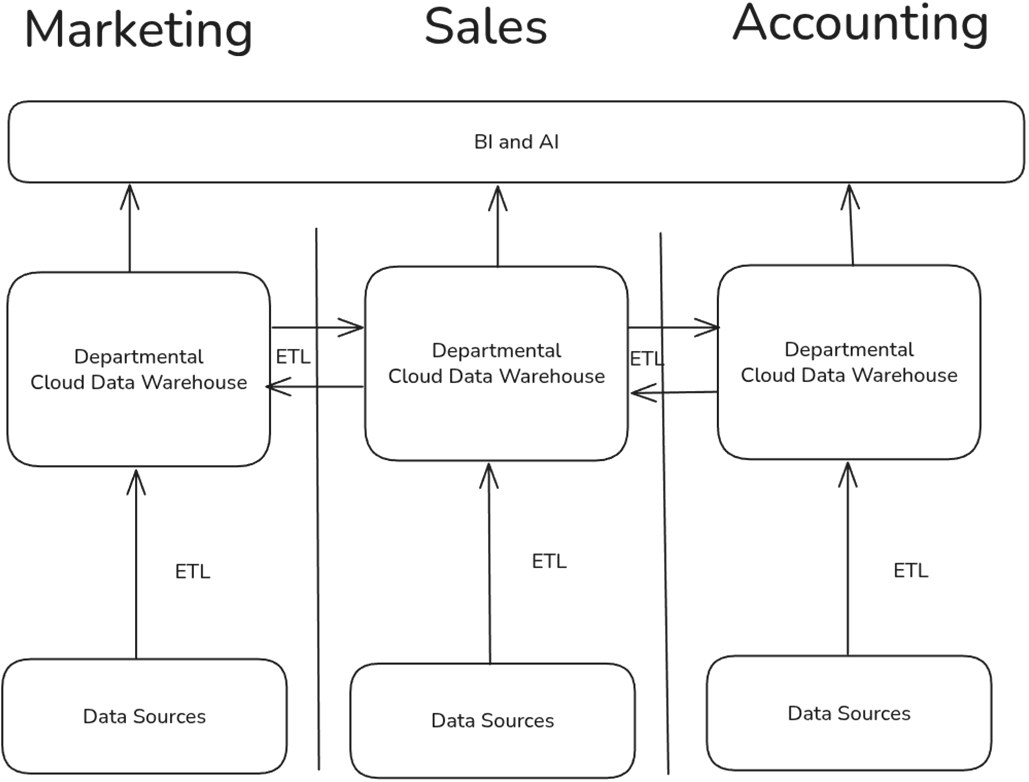
In traditional architectures, different departments replicate data not only into their departmental warehouses but also between them, increasing latency and inconsistency in the data.
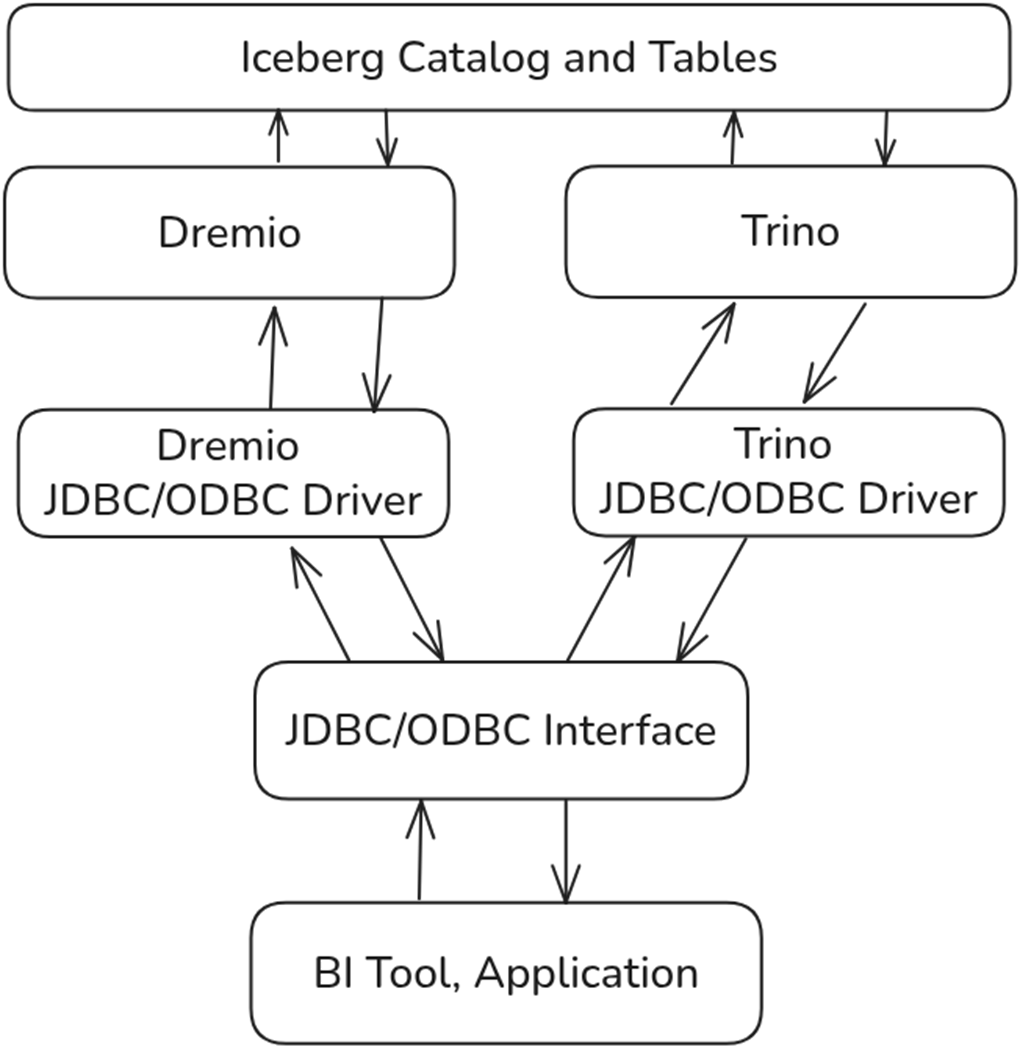
JDBC/ODBC has a large ecosystem of drivers for systems from which you can pull data. This allows you to connect to tools like Dremio and Trino to pull data from your Apache Iceberg Lakehouse.
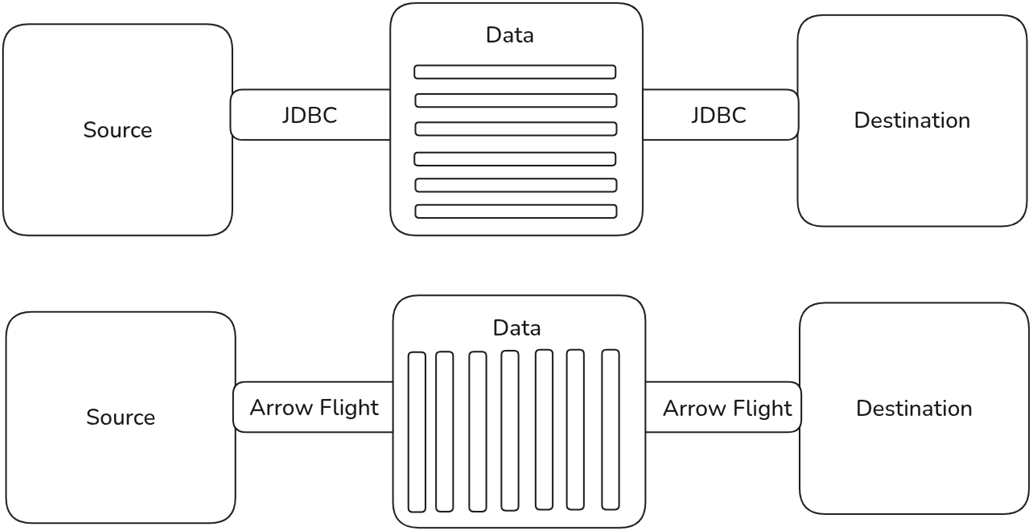
JDBC transfers data in a row-based format, while Apache Arrow Flight transfers data in a columnar format ideal for analytics.
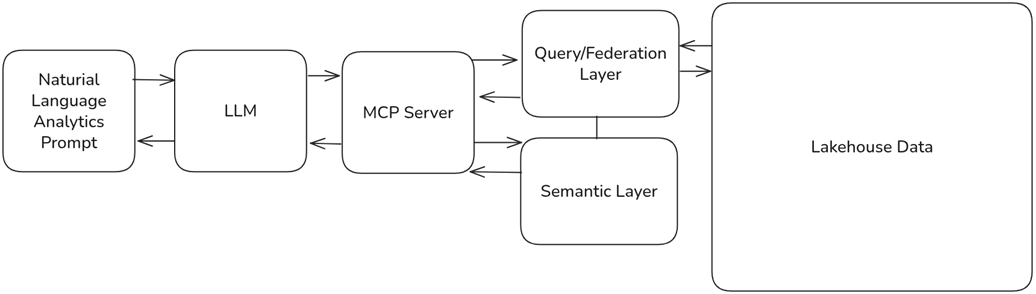
A natural language prompt can have more power to query and transform data using MCP servers that allow LLMs to take actions on your lakehouse.
Summary
- The consumption layer connects your data to your people, where insights, decisions, and automation take place.
- With Iceberg as the table format, you avoid the need to duplicate data across tools and platforms.
- Open interfaces (JDBC, ODBC, Arrow Flight, MCP) ensure that tools can connect to your federation layer reliably and consistently.
- BI tools, notebook environments, ML platforms, and APIs each have unique roles; the lakehouse allows them to coexist on a single data foundation.
- A semantic layer enables shared metric definitions across tools, supporting governance and reducing inconsistency.
- Scenarios across industries show how flexible the consumption layer can be when anchored in an open data infrastructure.
- Iceberg’s time travel, schema evolution, and partitioning features help maintain performance and reproducibility across all consumption modes.
FAQ
What is the consumption layer in an Apache Iceberg lakehouse?
The consumption layer is where data becomes useful to people, applications, and workflows. It connects curated Iceberg tables to BI dashboards, notebooks, machine learning platforms, AI agents, APIs, and embedded analytics. Its goal is to provide governed, consistent, and performant access to data without forcing unnecessary data duplication or tool lock-in.
How does Apache Iceberg improve data consumption compared with traditional architectures?
Traditional architectures often require copying data into separate warehouses, BI platforms, or specialized systems, creating silos, duplicated pipelines, higher costs, and inconsistent results. An Iceberg-based lakehouse stores data once in open tables and lets tools query that data in place through interoperable engines and interfaces. This reduces data movement while preserving governance, consistency, and flexibility.
Why is semantic consistency important in the consumption layer?
Semantic consistency ensures that business metrics such as revenue, churn, customer lifetime value, or gross margin mean the same thing across teams and tools. Without a shared semantic layer, different dashboards or departments may define the same metric differently. A centralized semantic layer helps avoid metric fragmentation, improves trust, and allows BI tools, notebooks, and AI applications to consume shared definitions.
What requirements should be considered when designing the consumption layer?
Key requirements include performance and latency, accessibility and flexibility, governance and compliance, semantic consistency, and cost control. For example, dashboards need fast response times, notebooks need flexible programmatic access, compliance teams need masking and audit trails, and machine learning workloads need reproducible, versioned data access.
What role do JDBC and ODBC play in an Iceberg lakehouse?
JDBC and ODBC are widely adopted interfaces that allow BI tools, reporting applications, spreadsheets, and other analytical tools to connect to query engines such as Trino, Dremio, or Spark SQL. These engines can expose Iceberg tables as if they were traditional relational databases. JDBC and ODBC are especially important for interoperability with tools like Excel, Tableau, Looker, Power BI, and many others.
When should Arrow Flight be used instead of JDBC or ODBC?
Arrow Flight is useful when applications need high-performance transfer of large analytical datasets. Unlike JDBC and ODBC, which commonly move row-oriented results, Arrow Flight uses Apache Arrow’s columnar memory format and gRPC-based transport. This makes it well suited for notebooks, AI platforms, data science tools, and custom applications that need low-latency, high-volume data access.
What is the Model Context Protocol (MCP), and why does it matter for lakehouse consumption?
The Model Context Protocol, or MCP, is an emerging protocol that allows large language models and AI agents to interact with external data, tools, and services through standardized function calls. In a lakehouse, MCP can allow AI assistants to discover datasets, query Iceberg tables through a federation engine, retrieve governed metrics from a semantic layer, and trigger business workflows while respecting access controls and privacy policies.
How should BI tools connect to an Apache Iceberg lakehouse?
BI tools should generally connect through a query engine, federation layer, or semantic layer that exposes open interfaces such as JDBC, ODBC, or supported native connectors. This allows tools to query Iceberg tables in place while centralizing access control, metric definitions, caching, and optimization. Both open-source tools such as Apache Superset and Metabase and commercial tools such as Tableau, Power BI, Looker, Qlik Sense, ThoughtSpot, and Sigma can fit into this model.
What makes notebooks important consumers in a lakehouse architecture?
Notebooks such as JupyterLab, Databricks Notebooks, and Deepnote support exploration, prototyping, feature engineering, and ad hoc analysis. They require direct, low-latency access to raw and transformed data, support for libraries such as Pandas, PyArrow, DuckDB, SQLAlchemy, and Scikit-learn, and strong security controls. Iceberg features such as snapshots, schema evolution, and time travel also help make notebook-based analysis reproducible.
How should organizations choose the right consumption tools for their lakehouse?
Organizations should choose tools based on user needs, governance requirements, performance expectations, cost constraints, and integration with the lakehouse architecture. A startup focused on data science may prioritize Jupyter, DuckDB, PyIceberg, and MLflow, while a regulated financial institution may prioritize a semantic layer, JDBC/ODBC interoperability, audit logging, and strong access controls. The best choice is not a single universal tool, but a set of tools aligned with the catalog, federation, semantic, and governance layers.

 Architecting an Apache Iceberg Lakehouse ebook for free
