3 Design Custom Environments for Reinforcement Learning Algorithms
Reinforcement learning is presented as a process of learning through trial and error, but the chapter emphasizes that real business settings are too costly and risky for direct experimentation. Instead, the key idea is to create safe simulated environments that capture the essential structure of a real problem, allowing agents to explore, make mistakes, and improve without causing harm. The chapter frames environment design as an important step in turning business challenges into problems that reinforcement learning can actually solve.
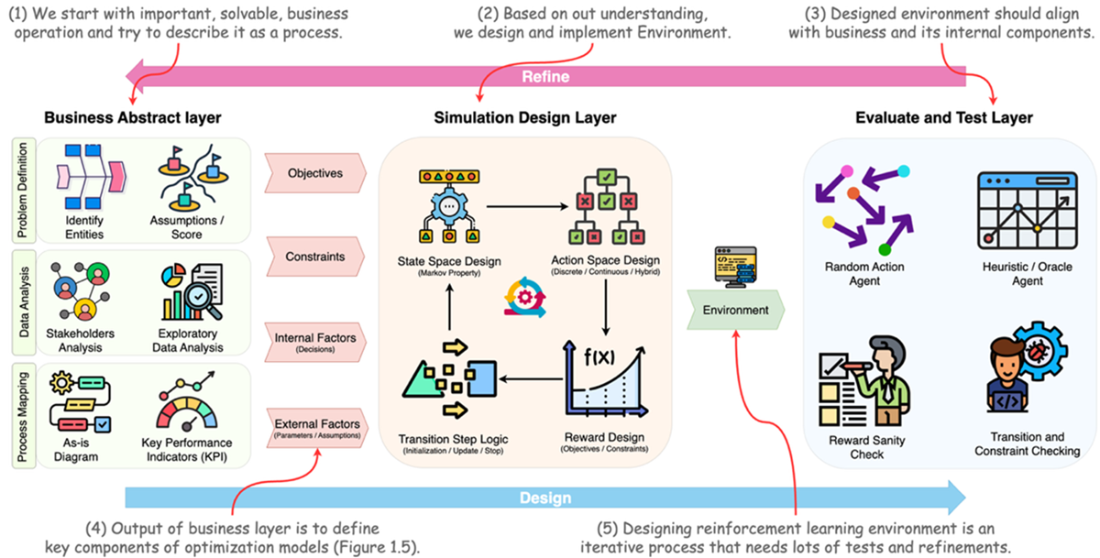
To do this, the chapter introduces a practical framework that starts by narrowing a business problem into a manageable process, identifying entities, assumptions, and performance metrics, and then translating those into a simulation with a clear state space, action space, transition logic, and reward function. It stresses modular design, since complex operations should be broken into smaller decision problems rather than tackled all at once. The examples show how business KPIs become rewards and how environment behavior should reflect realistic constraints, dynamics, and feedback.
The framework is then applied to three custom environments: warehouse order picking, perishable product dynamic pricing, and trailer loading and packing. In each case, the chapter builds the environment step by step, defines state and actions, designs rewards to encourage efficient behavior, and tests the setup with random or heuristic agents to check transitions, constraints, and reward logic. Visualization and sanity testing are treated as essential, because they help confirm that the environment behaves logically and is ready for training a learning agent.
Conceptual framework for designing business optimization environments
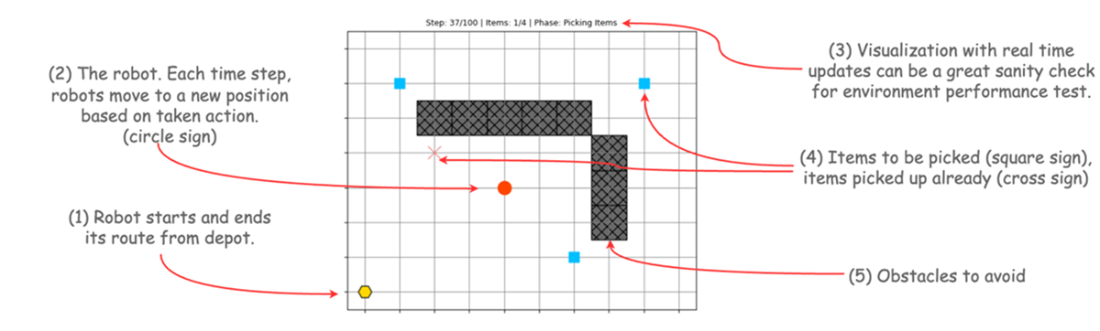
A visual rendering of the warehouse environment.
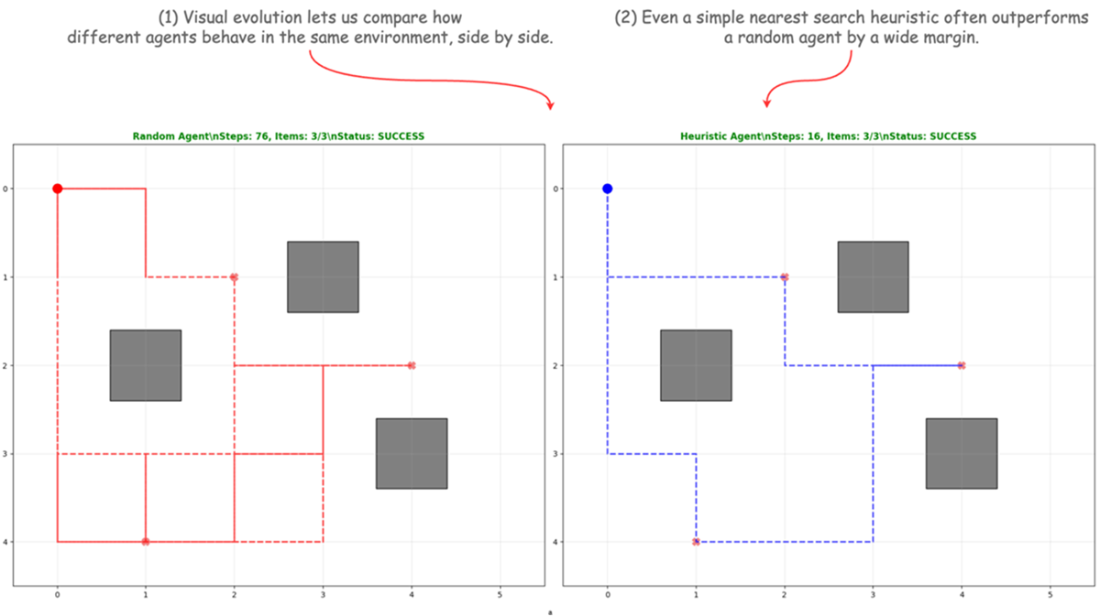
Different agents’ behaviors in the robot warehouse environment.
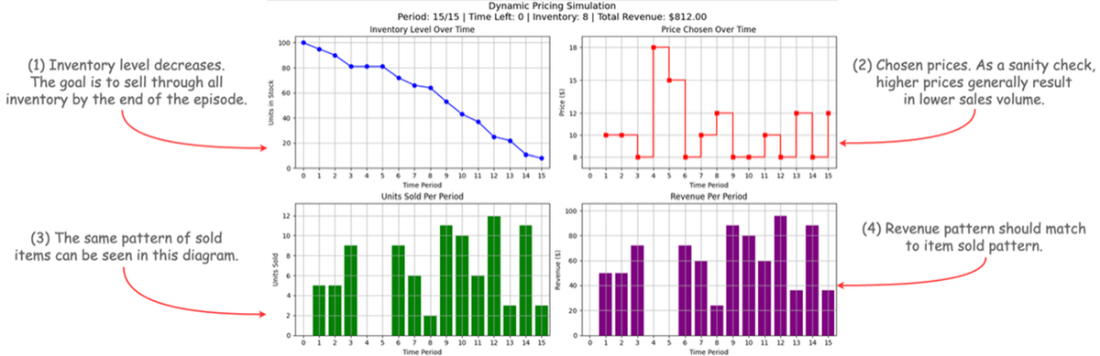
Snapshot of visualization of perishable dynamic pricing environment mechanism.
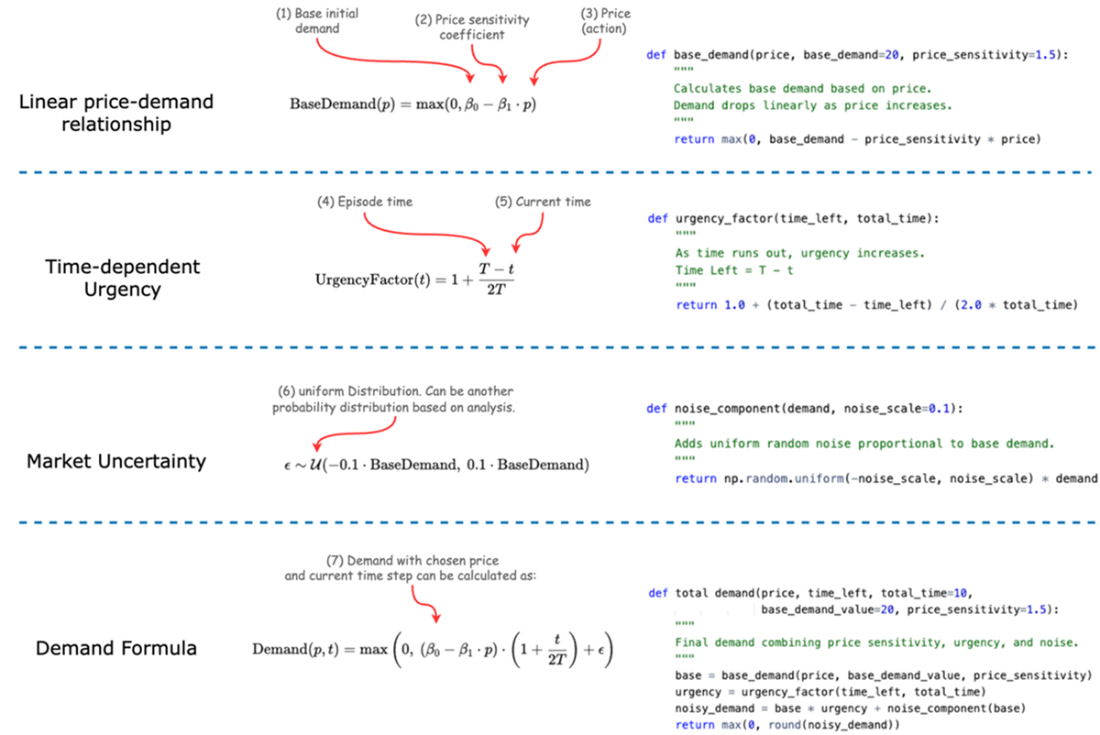
Formulation of dynamic stochastic demand for dynamic pricing
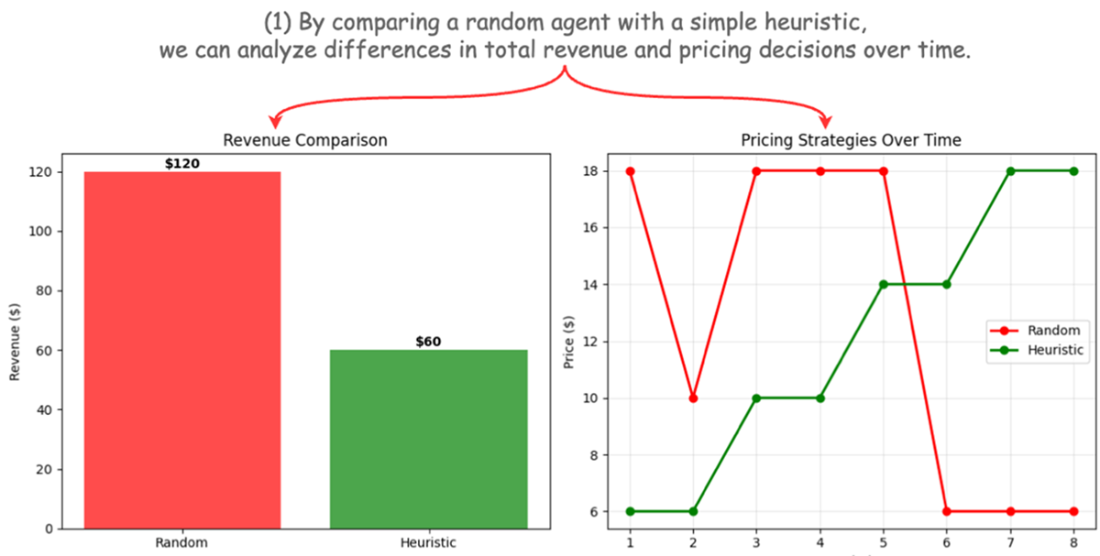
Agents’ behaviors analysis for dynamic pricing environment.
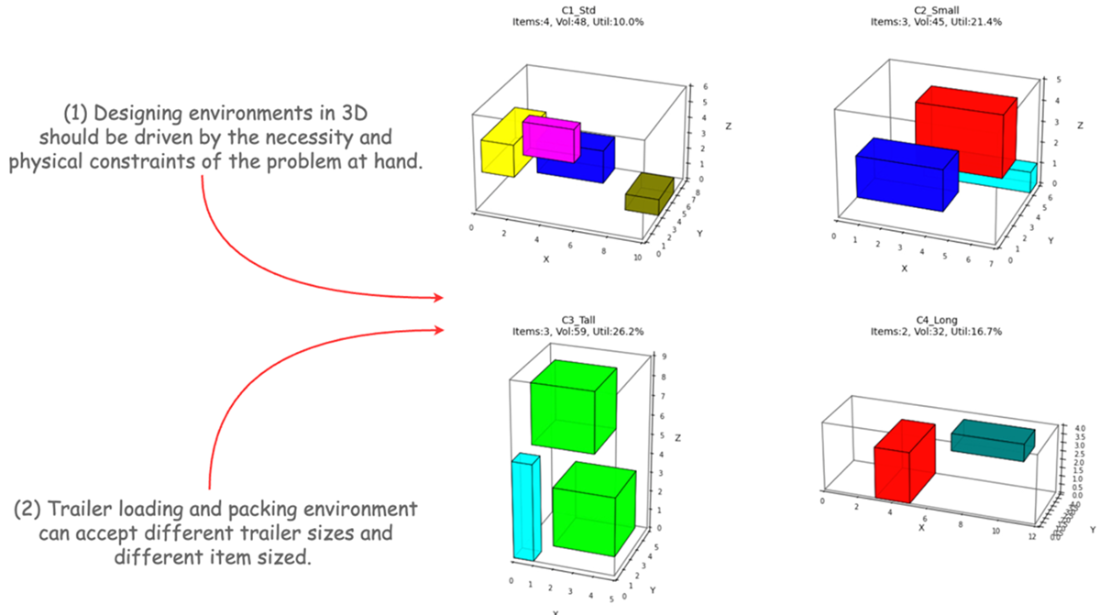
Visualization of one instance of trailer loading and packing environment.
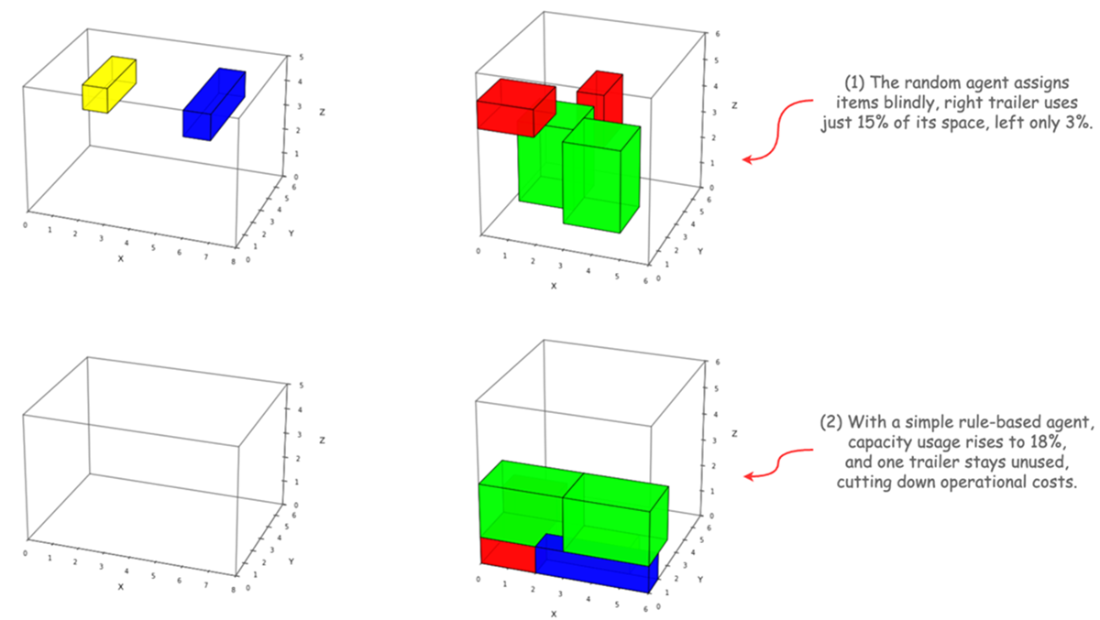
Evolution of random and heuristic agent behaviors in the trailer packing environment.
Summary
- Custom environments are essential for applying reinforcement learning to real-world business problems.
- A good environment must reflect the business process, constraints, and objectives.
- Environment design follows three key layers: business abstraction, simulation logic, and evaluation/testing.
- Clearly defining KPIs and assumptions shapes how your environment behaves.
- Breaking complex systems into smaller, focused sub-problems makes modeling and training more manageable.
- Use 2D environments when modeling decision processes over grids, time periods, or sequences—like routing, or pricing over time.
- Use 3D environments when physical space and geometry matter—like trailer packing, or spatial resource allocation.
- The state space must include all the information the agent needs to make informed decisions. It should also follow Markov property.
- The action space must reflect real decision options and adhere to domain constraints.
- The reward function translates business goals into learnable signals for the agent.
- Poorly designed rewards can lead to bad learning outcomes or agent confusion.
- Transition dynamics must realistically simulate how the system evolves after each action.
- Sanity checks using random agents help catch bugs before training real models.
- Visual debugging is often more effective than printed logs, especially in spatial tasks.
- Invalid actions should be penalized to help the agent learn feasible strategies.
- Every environment should be testable, extensible, and clear in its feedback to the agent.
- Building environments is an iterative process—design, test, adjust, repeat.
- A structured environment template (reset, step, reward, and transition logic) accelerates implementation.
- High-quality environments are the foundation for training reliable reinforcement learning agents.

 Applied Reinforcement Learning ebook for free
