9 Floyd-Warshall Algorithm
The chapter presents Floyd-Warshall as the dynamic programming solution for the all-pairs shortest path problem, especially useful when you need the exact minimum distance between every pair of nodes in a dense graph. Rather than repeatedly running a single-source algorithm from each vertex, it builds a distance matrix that starts with direct edge weights, zeros on the diagonal, and infinity for unreachable pairs. The central idea is simple but powerful: for each possible intermediate vertex, the algorithm checks whether routing through that vertex produces a shorter path than the best one known so far.
The text explains the algorithm step by step through matrix updates, showing how each phase expands the set of allowed intermediate nodes. The recurrence compares the current path from i to j against a detour through k, and the matrix is updated in place whenever the detour is cheaper. This layered process is what makes the method dynamic programming: each new matrix is built on the discoveries of the previous one, until all possible intermediates have been considered and the final table contains the optimal route cost for every source-destination pair.
It also emphasizes when Floyd-Warshall is and is not appropriate. The algorithm runs in O(V3) time and O(V2) space, so it is practical for bounded, dense graphs but inefficient for sparse or very large networks. Unlike Dijkstra’s algorithm, it can handle negative edge weights, and it can detect negative cycles by checking whether any diagonal entry becomes negative after completion. The chapter closes by highlighting real-world uses such as knowledge graphs, RAG systems, and transit analysis, where precomputing a global shortest-path table enables extremely fast O(1) lookup during query time.
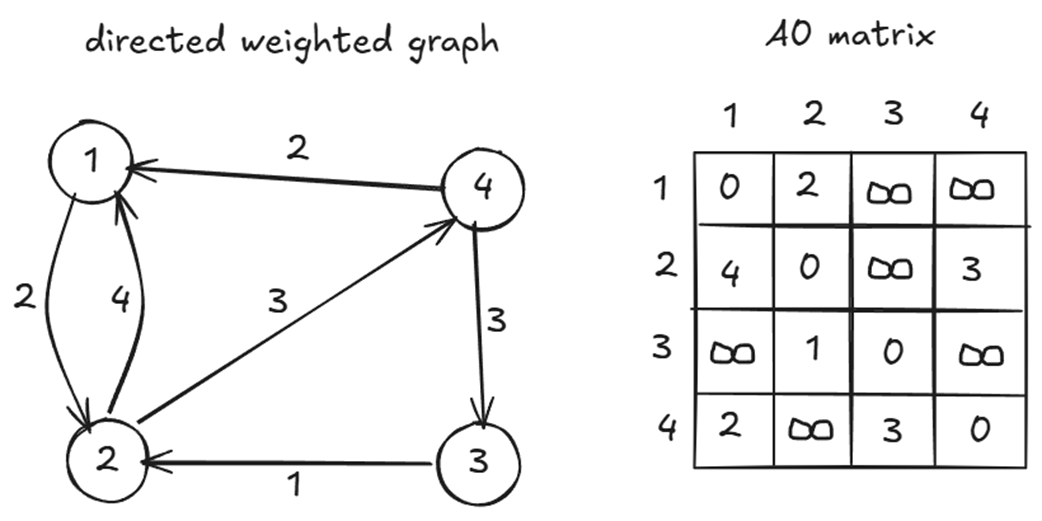
The initial state of the network. The left panel shows the directed, weighted graph. The right panel shows the baseline distance matrix (A0). Existing direct paths are recorded with their cost, while missing connections are initialized to infinity (∞). The diagonal is zero, as the distance from any node to itself is zero.
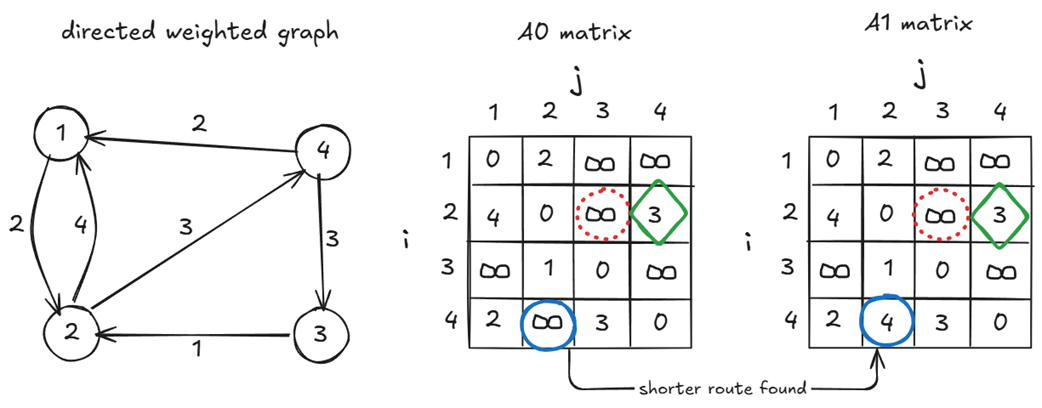
Phase one of the algorithm (k=1). Node 1 is tested as an intermediate bridge for every pair of nodes. The algorithm discovers that routing a path from Node 4 to Node 2 via Node 1 costs 4 (2 + 2 = 4). Since 4 is less than the previous cost of infinity, a shorter route is found, and the matrix is overwritten in place to form A1
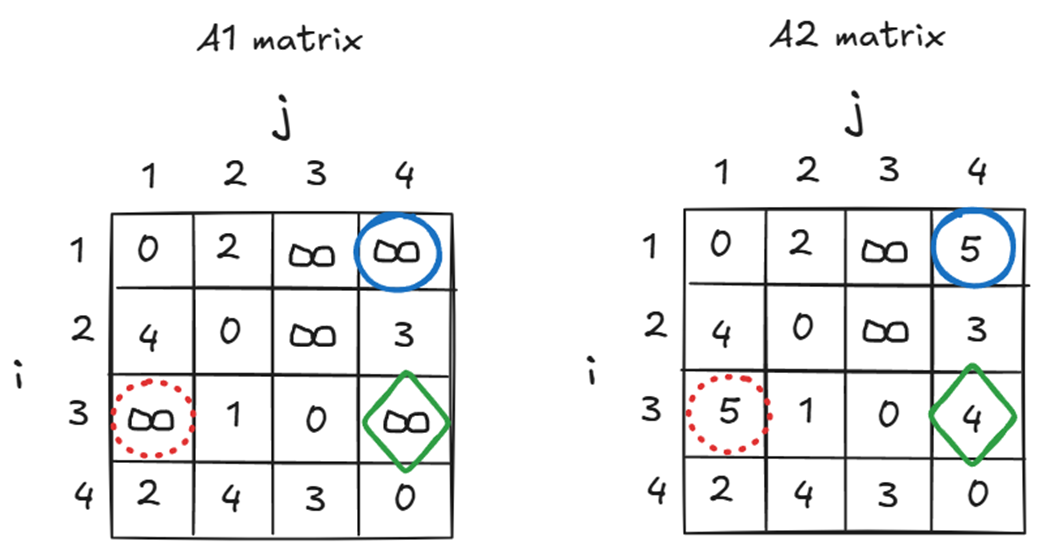
Phase two of the algorithm (k=2). Using Node 2 as the new bridge, the algorithm layers its discoveries strictly on top of the updated A1 matrix. Three new detours are found to be cheaper than their current paths, successfully connecting Node 1 to Node 4, Node 3 to Node 1, and Node 3 to Node 4.
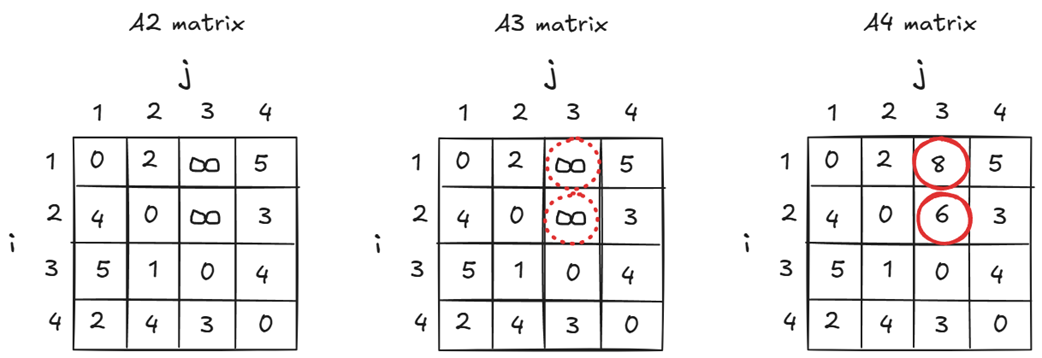
The final phases of the algorithm. Testing Node 3 as a bridge (k=3) yields no new shortcuts, meaning A3 is an identical copy of A2. Finally, testing Node 4 (k=4) resolves the final infinite paths in the graph. The completed A4 matrix represents the absolute optimal shortest path between every single combination of nodes.
Summary
- The Floyd-Warshall algorithm is a dynamic programming method used to solve the All-Pairs Shortest Path (APSP) problem on weighted graphs.
- Unlike single-source algorithms like Dijkstra’s, Floyd-Warshall computes the optimal path distance between every possible pair of vertices in a single, unified execution.
- The decision engine relies on a fundamental transition formula - Ak[i][j] = min(Ak-1[i][j], Ak-1[i][k] + Ak-1[k][j])
- The algorithm works in phases by systematically testing every vertex in the graph as a potential intermediate “bridge” node (k) to discover shortcut routes.
- It evaluates whether routing a path through an intermediate vertex (k) is cheaper than the currently known path between a starting vertex (i) and a destination vertex (j).
- The algorithm executes three nested loops (bridge k, start i, destination j), resulting in a strict cubic time complexity of O(V3).
- The runtime is unconditional with respect to edge count, Floyd-Warshall performs the exact same V3 operations on a graph with 10 edges as it does on a graph with 1,000 edges.
- The space complexity is O(V2), as it only requires maintaining a 2D adjacency matrix representing the distances between all nodes.
- Space efficiency can be optimized to update the V x V matrix completely in-place without storing historical iteration states in memory.
- Floyd-Warshall strictly trades upfront compute time for downstream speed, producing a pre-computed global matrix that enables instantaneous O(1) lookup times.
- The algorithm natively supports negative edge weights, unlike Dijkstra's algorithm which completely fails in the presence of negative costs.
- It serves as an automated diagnostic tool for detecting negative weight cycles (loops whose total cost sums to less than zero).
- A negative cycle is mathematically proven to exist if any diagonal element in the distance matrix becomes negative (D[i][i] < 0) after execution.
- Floyd-Warshall is optimal for dense graphs (E ~ V2), where high connectivity justifies the O(V3) compute expenditure.
- For sparse graphs (E << V2), running a Single-Source Shortest Path algorithm (like Dijkstra) repeatedly from each node is computationally far more efficient than Floyd-Warshall.
- Systems use Floyd-Warshall to compute all-pairs transitive closure, pre-computing proximity matrices so RAG context engines can evaluate entity reachability in O(1) time.
- Datacenter control planes periodically run Floyd-Warshall to generate pre-computed routing tables, giving servers instantaneous alternative paths if a hardware connection fails.
- Transit agencies and navigation engines model intersections and stations as dense subgraphs to analyze multi-stop routes, identify systemic traffic bottlenecks, and perform instant real-time rerouting.
- Original Paper: https://dl.acm.org/doi/10.1145/367766.368168
- Code implementation: https://github.com/aniketwattamwar/Algorithms-Every-Programmer-Should-Know

 Algorithms Every Programmer Should Know ebook for free
