8 Ant Colony Optimization Algorithm
Ant Colony Optimization is presented as a biologically inspired way to solve large, complex optimization problems when exact methods become too slow or memory-intensive. Instead of trying to compute a perfect answer, the algorithm uses a swarm of artificial ants that explore a graph, guided by two factors: the attractiveness of short paths and the accumulated success of previous routes. This makes it a practical meta-heuristic for problems where the search space explodes, such as route planning, scheduling, and other large-scale decision tasks.
The core mechanism is a repeating cycle of probabilistic path selection, pheromone evaporation, and pheromone deposit. Each ant chooses its next move using weighted probabilities based on the inverse of distance and the current pheromone level, then completes a full tour and returns home. After all ants finish, pheromones on every edge decay, while the edges used in better tours receive stronger deposits. Over many iterations, this feedback loop amplifies good routes and suppresses poor ones, causing the swarm to converge on a near-optimal solution.
The chapter also shows how ACO is implemented in practice and where it is most useful. The pseudocode and Python examples demonstrate how to initialize pheromones, select the next node, update deposits, and track the best tour found. Real-world applications include the Traveling Salesman Problem, dynamic telecommunications routing, and image edge detection. The main lesson is that ACO trades mathematical certainty for speed and adaptability, but its effectiveness depends heavily on careful tuning of parameters like pheromone influence, heuristic influence, evaporation rate, and swarm size.
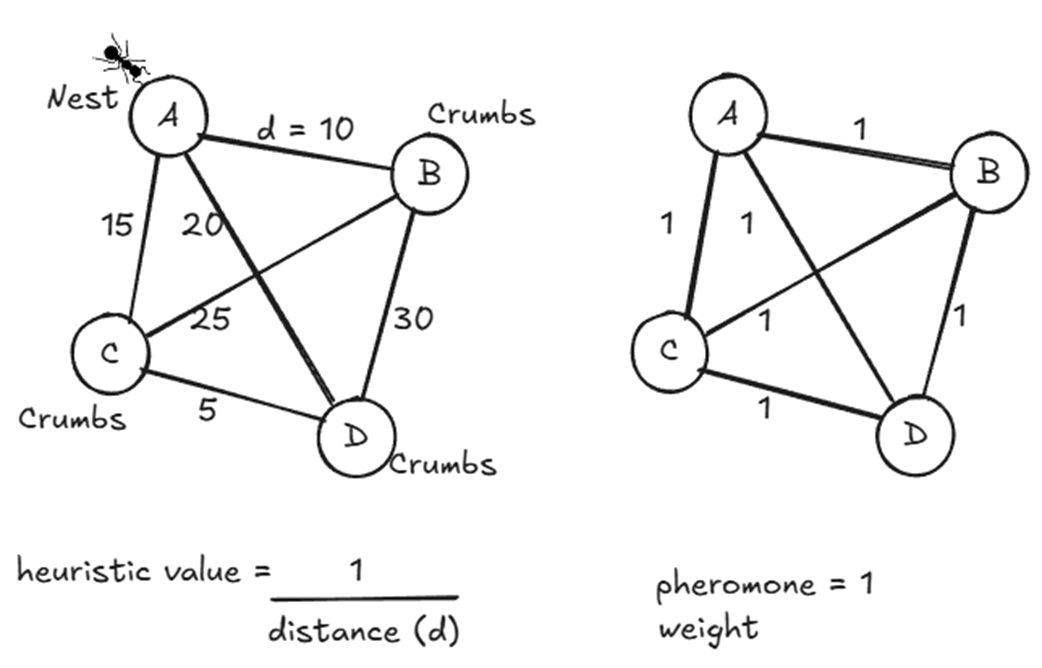
Initializing the graph for Ant Colony Optimization. The left graph shows the physical distances (d) between the Nest and the Crumbs, which determines the heuristic desirability. The right graph shows the baseline digital pheromone weights, initialized to a flat 1 across all paths before the swarm is deployed.
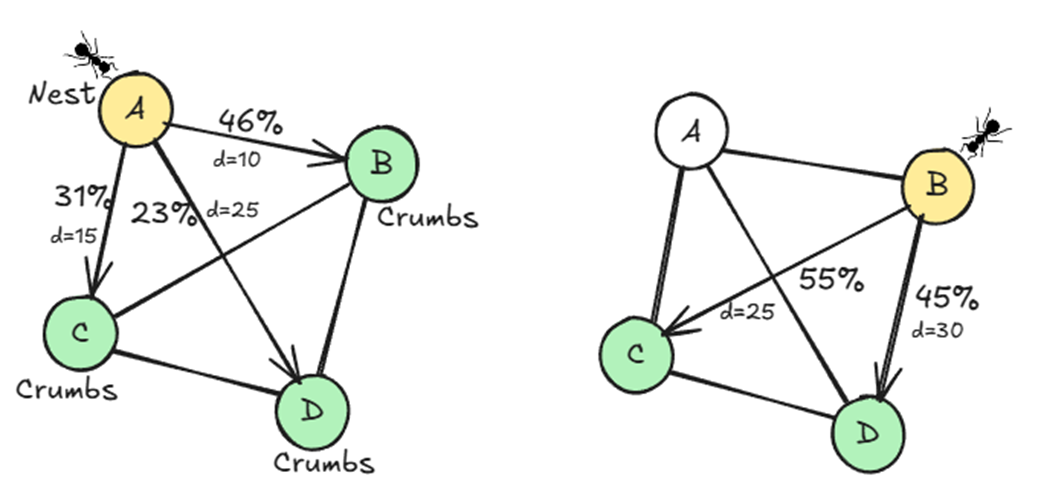
The probabilistic path selection sequence. Instead of making a blind guess, the artificial ant calculates a weighted probability for each unvisited node based on distance and historical pheromone levels. The left graph shows the initial roll at Node A, Right graph shows the recalculated local probabilities after the ant moves to Node B.
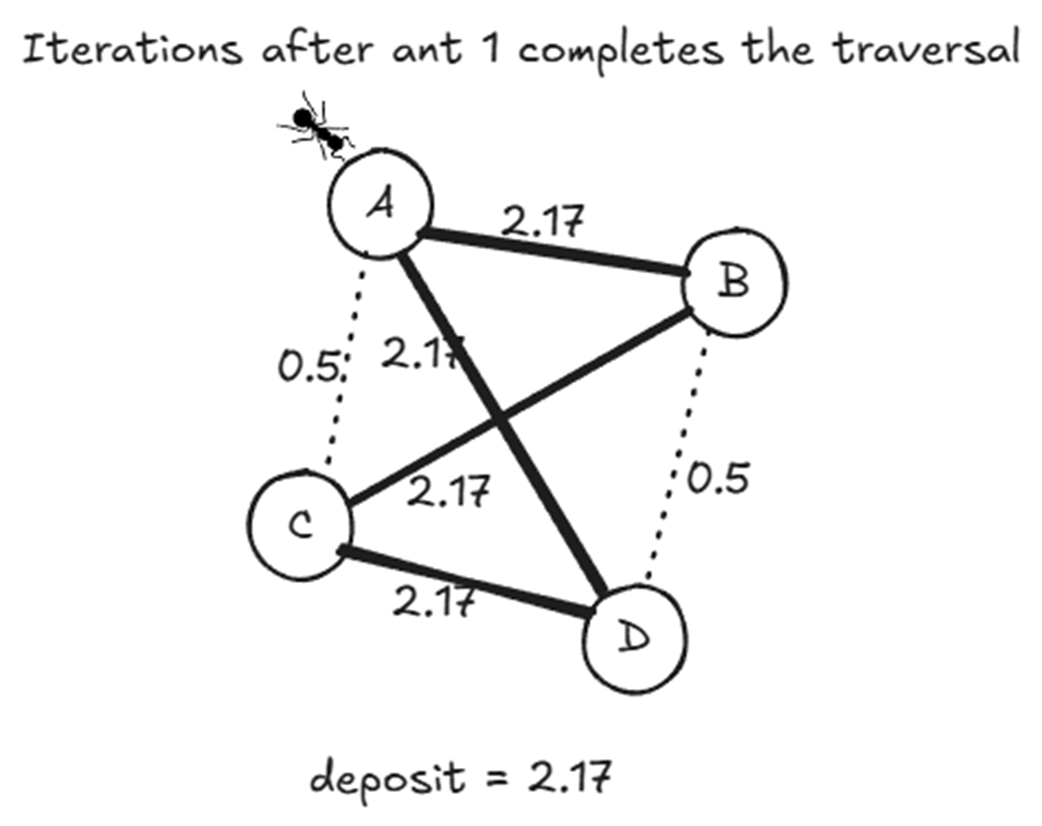
The graph state after one complete ant tour. Traversed edges (solid lines) receive a pheromone deposit, compounding their weight to 2.17. Ignored edges (dotted lines) suffer from mandatory evaporation, reducing their weight to 0.5. Over multiple iterations, the dotted lines will evaporate entirely to zero.
Summary
- Ant Colony Optimization (ACO) is a probabilistic meta-heuristic designed to find highly optimized solutions when deterministic algorithms, like Dynamic Programming, fail due to massive state spaces.
- The algorithm explicitly trades the mathematical guarantee of a perfect global optimum for extreme computational speed, prioritizing a "good enough" answer today over a perfect answer a million years from now.
- The architecture is driven by swarm intelligence, mimicking how biological ants use decentralized foraging and chemical trails to autonomously converge on optimal paths.
- ACO fundamentally solves the trade-off between exploration (searching for new, potentially better paths) and exploitation (capitalizing on the best path found so far).
- Artificial ants do not possess a global map; they make localized routing decisions by evaluating two distinct metrics for every available path: the Heuristic (η) and the Pheromone (𝜏).
- The Heuristic represents the raw, physical desirability of a path, typically calculated as the inverse of the distance (1 / d).
- The Pheromone level represents the historical success of a path, acting as a digital weight left behind by previous generations of ants.
- Ants do not blindly pick the single best path. They use the State Transition Rule to calculate a weighted probability for every available option, maintaining a degree of randomness.
- This weighted probability mathematically ensures that shorter, heavily trafficked paths have the highest odds of selection without entirely eliminating alternative routes.
- The true engine of ACO is the feedback loop triggered after a generation of ants completes their full tours, consisting of Evaporation and Deposit.
- Evaporation acts as mandatory negative feedback, artificially decaying the pheromone levels across the entire graph by a set percentage over time.
- Without evaporation, the system is highly vulnerable to premature convergence, where the swarm gets permanently trapped on the first mediocre path an ant happens to complete.
- Deposit acts as positive feedback. An ant drops a calculated pheromone payload strictly on the specific edges it traversed during its tour.
- The deposit amount is inversely proportional to the tour length (e.g., a flat reward divided by total distance), ensuring that shorter routes receive heavier compounding weights.
- As the loop iterates, the most efficient routes compound their pheromone weights massively, while suboptimal paths evaporate to zero, locking the swarm into an optimized route.
- ACO is highly effective in volatile enterprise environments, such as dynamic telecommunications routing, where network maps change faster than static algorithms can compute them.
- The algorithm can be inverted for computer vision tasks like edge detection, where ants use pixel intensity variation (contrast) as their heuristic instead of physical distance.
- The algorithm is structurally designed for discrete graphs and struggles significantly with continuous optimization problems unless fundamental architectural modifications are made.
- Code implementation: https://github.com/aniketwattamwar/Algorithms-Every-Programmer-Should-Know
FAQ
What is Ant Colony Optimization (ACO)?
ACO is a meta-heuristic algorithm inspired by how real ants forage for food. It uses artificial ants, pheromone trails, and probability to find highly optimized routes without exhaustively checking every possibility.
Why is ACO useful for large optimization problems?
ACO is useful when the search space is too large for exact methods like dynamic programming or brute force. It finds a “good enough” solution much faster, making it practical for large-scale routing and scheduling problems.
How does ACO decide which path an ant should take next?
An ant chooses its next path using weighted probabilities based on two factors: pheromone strength on the edge and heuristic desirability, which is usually the inverse of distance. Shorter, more successful paths get a higher chance of being selected.
What do pheromones represent in ACO?
Pheromones represent the historical success of a path. A stronger pheromone level means that path has been used successfully before and is more likely to be chosen by future ants.
What is the heuristic in ACO?
The heuristic is the immediate desirability of a path, usually calculated as 1 / distance. This means shorter paths have higher heuristic values and are naturally preferred during path selection.
Why does ACO use both evaporation and deposit?
Evaporation reduces pheromones on all paths over time, preventing the colony from locking into a bad route forever. Deposit adds pheromones to the paths used in successful tours, reinforcing better solutions through positive feedback.
How is pheromone deposit calculated after an ant finishes a tour?
The deposit amount is usually the reward divided by the total tour distance. Shorter tours receive a larger deposit, so efficient routes become stronger over time.
What is the role of multiple ants and multiple iterations?
Multiple ants provide diverse exploration, while multiple iterations allow feedback to accumulate and poor paths to evaporate. Together, they balance exploration and convergence toward an optimized route.
What is the time complexity of the ACO algorithm described in this chapter?
The chapter states that one ant needs O(n²) time to complete a tour, where n is the number of nodes. With m ants and I iterations, the total complexity becomes O(I × m × n²).
Where is ACO commonly applied in real-world systems?
ACO is commonly used in problems like the Traveling Salesman Problem, telecommunications routing, logistics, job scheduling, and even image edge detection. It is especially valuable in dynamic or massive systems where exact optimization is too slow.

 Algorithms Every Programmer Should Know ebook for free
