4 Rabin–Karp Algorithm
Rabin–Karp is presented as a practical string-matching algorithm that finds a pattern inside a larger text by turning strings into numeric hashes instead of comparing characters one by one at every position. This makes it much faster than brute-force matching in typical cases, especially when searching through long texts. The chapter introduces the basic idea through a simple example: compute a hash for the pattern, compute hashes for text windows of the same length, and compare those values first to decide where a real match might exist.
The key optimization is the rolling hash, which updates the hash of a sliding window in constant time rather than recalculating it from scratch each time the window moves. The text also explains that hashing is not perfect: different substrings can produce the same value, causing collisions or spurious hits. To reduce this risk, the chapter emphasizes using a stronger hash function, such as one that weights character positions with powers of a base value, and then verifying actual characters only when hash values match. This preserves efficiency while protecting correctness.
The chapter also discusses performance and real-world use. With a good hash function, Rabin–Karp runs in linear time on average, O(n + m), but it can degrade to O(n × m) when collisions happen frequently. Because of its simplicity and ability to handle repeated or multiple-pattern searches efficiently, it is useful in areas like plagiarism detection and bioinformatics, where enormous text or sequence datasets must be scanned quickly. In these domains, Rabin–Karp serves as a foundation for larger systems that combine indexing, distributed processing, and other advanced techniques to handle scale.
The pattern COOL is to be matched with the text “ALICEANDJOEBAKEDCOOKIES”. Each character is checked one by one. The first box shows that A and C are compared. With no successful match, we move the pattern forward by one character and continue comparing. The second box shows three characters matched, and the last character doesn’t, concluding the pattern is not in the text only after checking the first three characters.

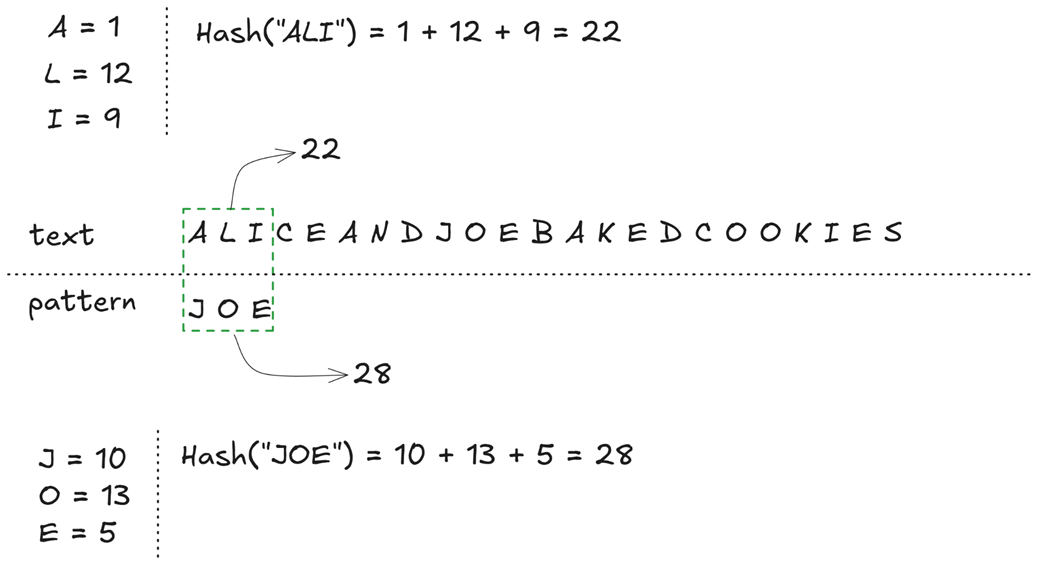
The pattern is JOE. Based on the character mapping table, the hash value of the pattern JOE is 28, and that of ALI is 22. Compare the entire values instead of characters.
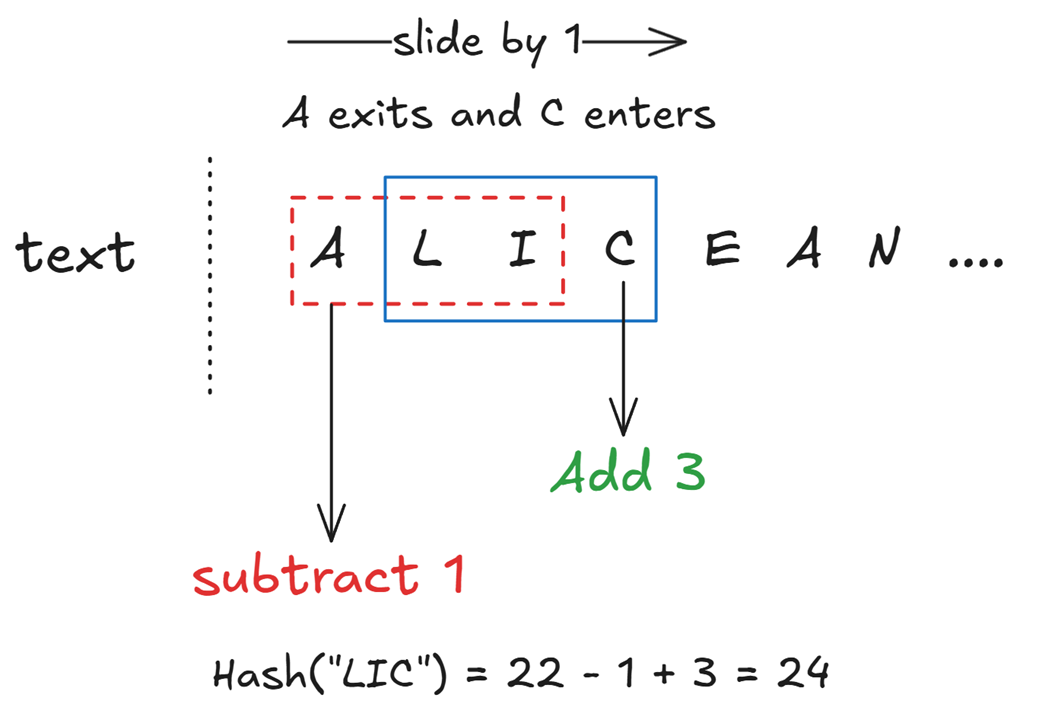
A sliding window of size equal to the size of the pattern. The window slides by one character. The character A exits from the left, and the character C enters.
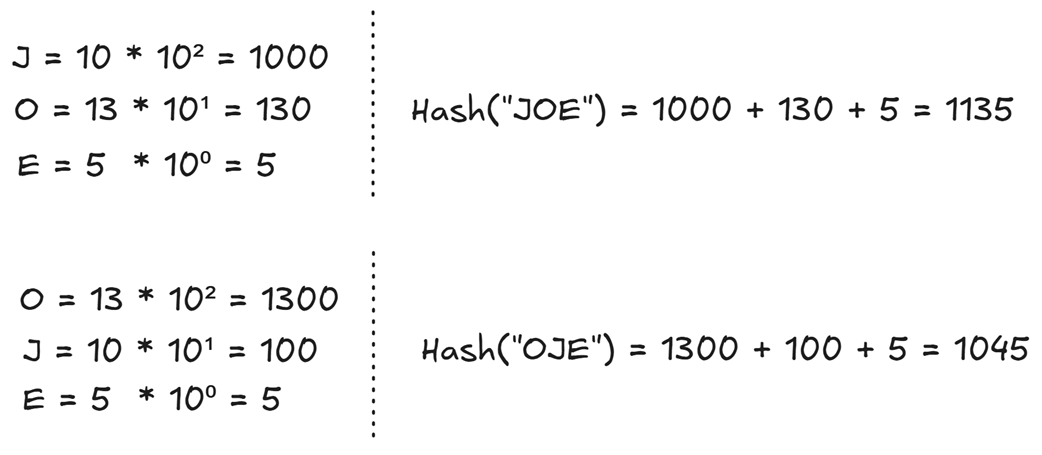
Two substrings previously with a simple hash function yield the same hash value. When the hash function is changed using powers of 10, the same two substrings yield different hash values. This reduces the problem of collision.
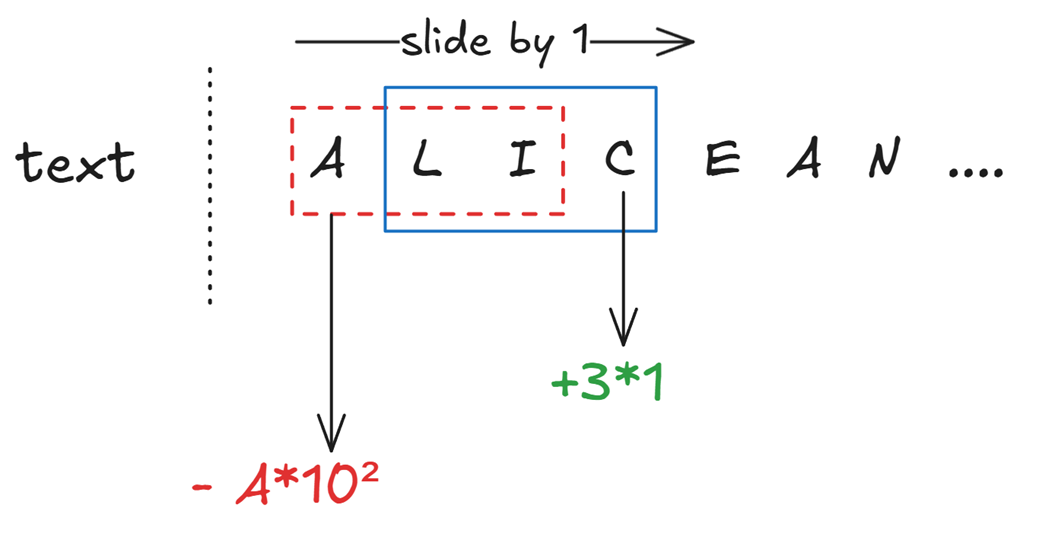
Rolling hash working with an improved hash function. The new value of the hash is obtained by subtracting the previous hash value with the character exiting the window multiplied by 10 and adding the new character. Calculation of the new hash is performed with efficiency.
Summary
- Rabin-Karp algorithm is a string matching algorithm that utilizes a rolling hash function to perform efficient string searches in text
- Character-by-character matching is highly inefficient and computationally expensive with O(n x m) time complexity.
- The hash function in Rabin-Karp converts the pattern into a numeric value for comparison of the entire pattern as a single unit. Comparing integers is significantly faster than iterating through and comparing each individual character of the string.
- Simple addition-based hash functions are fundamentally flawed because anagrams, such as ‘ACT’ and ‘CAT’, will produce the exact same numeric value, creating a high volume of false positives.
- A collision or a spurious hit means that different substrings generate the same hash value. Collisions degrade the performance, and frequent collisions indicate a poorly defined hash function.
- A poorly defined hash function will generate frequent collisions, forcing constant character verification and degrading the algorithm's performance from its average linear time to its worst-case scenario of O(n x m).
- Collisions can be reduced by developing a better hash function that generates unique hash values for multiple substrings. A rolling hash function with base 10 powers means each character has a different value in cases such as “ACT” and “CAT”.
- To ensure accuracy and rule out false positives from collisions, the algorithm must strictly perform a character-by-character verification every time a hash match occurs.
- Sliding window is a technique to avoid recalculating the entire hash value by sliding the window by one space but at the same time subtracting the value exiting the window and adding the new value entering the window.
- The rolling hash mechanism calculates the hash of the next text window in O(1) time.
- Plagiarism and bioinformatics are two key domains where Rabin-Karp algorithms work well. Text like research papers and assignments for plagiarism and DNA/RNA sequences for bioinformatics help in identifying exact or near-exact matches.
- Scaling the system requires core engineering, parallel processing, and distributed architecture approaches.
- The average time complexity of the Rabin-Karp algorithm is O(n+m), where n is text length and m is pattern length, while the worst-case time complexity is O(nxm).
FAQ
What is the Rabin–Karp algorithm used for?
Rabin–Karp is a string-matching algorithm used to find whether a pattern exists inside a larger text. It does this efficiently by comparing hash values of the pattern and text windows instead of checking every character one by one.
How does Rabin–Karp improve on brute-force string matching?
Brute-force matching compares characters repeatedly at each position, which is slow for long patterns. Rabin–Karp converts the pattern and each text window into numeric hash values, making comparisons much faster and reducing unnecessary character-by-character checks.
What is a rolling hash in Rabin–Karp?
A rolling hash is a technique that updates the hash of a sliding text window in constant time. Instead of recalculating the entire hash from scratch, the algorithm removes the leftmost character’s contribution and adds the new rightmost character’s contribution.
Why are hash collisions a problem in Rabin–Karp?
A collision happens when different strings produce the same hash value. This can cause false matches, also called spurious hits, so Rabin–Karp must verify the actual characters whenever hashes match.
How does Rabin–Karp avoid false matches caused by collisions?
When the hash of a pattern matches the hash of a text window, the algorithm performs a direct character-by-character comparison. This extra verification ensures that a hash match really corresponds to the same substring.
What is the time complexity of Rabin–Karp?
The best and average time complexity is O(n + m), where n is the text length and m is the pattern length. In the worst case, when many collisions occur, it can degrade to O(n × m).
Why is a weak hash function bad for Rabin–Karp?
A weak hash function creates too many collisions. That forces the algorithm to repeatedly do full character comparisons, which slows performance and can make the algorithm behave close to brute force.
How is a better hash function designed for Rabin–Karp?
A better hash function uses character positions, often by multiplying characters by powers of a base such as 10. This makes the hash sensitive to order, so different permutations of the same characters are less likely to collide.
What kinds of problems is Rabin–Karp especially useful for?
Rabin–Karp is especially useful for plagiarism detection, finding repeated substrings, searching large text files, and bioinformatics tasks such as matching DNA, RNA, or protein sequences.
Why is Rabin–Karp practical in real-world applications?
It is simple, efficient on average, and works well for large-scale searching. With rolling hashes and improved hash functions, it can quickly scan massive datasets and support applications like document comparison and genome analysis.

 Algorithms Every Programmer Should Know ebook for free
