9 LLM-as-a-judge fundamentals
LLM-as-a-judge is presented as a practical way to evaluate model outputs when traditional deterministic metrics fall short, especially for open-ended, subjective, or context-dependent tasks. The chapter frames the judge model not as an objective authority, but as a programmable evaluation instrument that can scale human-like judgment across large datasets. Its main value is in capturing nuance such as factuality, coherence, tone, relevance, helpfulness, and safety, while its main risk is that it can sound confident even when it is biased, inconsistent, or under-informed.
The text emphasizes that good evaluation starts with clarity: define the goal, choose representative data, and decide what the judge should produce before writing prompts. A strong judge setup requires an explicit task, a clear rubric, sufficient context, and a structured output format, often JSON, so results can be analyzed automatically. The chapter also explains that scoring, ranking, and pairwise comparison each fit different needs, and that the evaluator model should be selected for instruction-following ability, stability, cost, latency, and domain fit.
To make LLM judging trustworthy, the chapter recommends an iterative feedback loop of prompt design, versioning, controlled testing, comparison to human or gold labels, and calibration with examples. It warns about common failure modes such as position bias, verbosity bias, style preference, context insufficiency, prompt injection, and overconfident explanations, and stresses that validation is essential before scaling. Finally, it argues that LLM-as-a-judge should not be used when deterministic checks, trusted labels, missing context, high-stakes decisions, or simpler alternatives are better suited, and that engineering discipline around observability, reproducibility, and documentation is what turns the approach into a reliable production system.
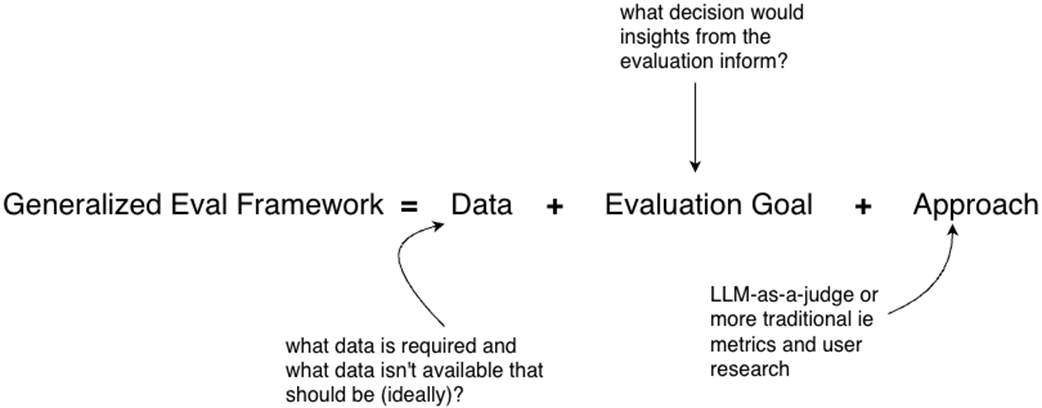
The three essential components of an evaluation system are goal, data, and evaluator. They work together to determine how reliable and actionable your results are. Each term in this equation carries equal weight. The goal defines what decision the evaluation is meant to inform. The data determines the evidence available to answer that question, from offline samples to live production logs. The evaluator, whether human, metric-based, or an LLM-as-a-judge, applies criteria and interpretation to that evidence. Getting the goal and data right upfront keeps the rest of the design process (prompting, calibration, engineering) on solid ground.
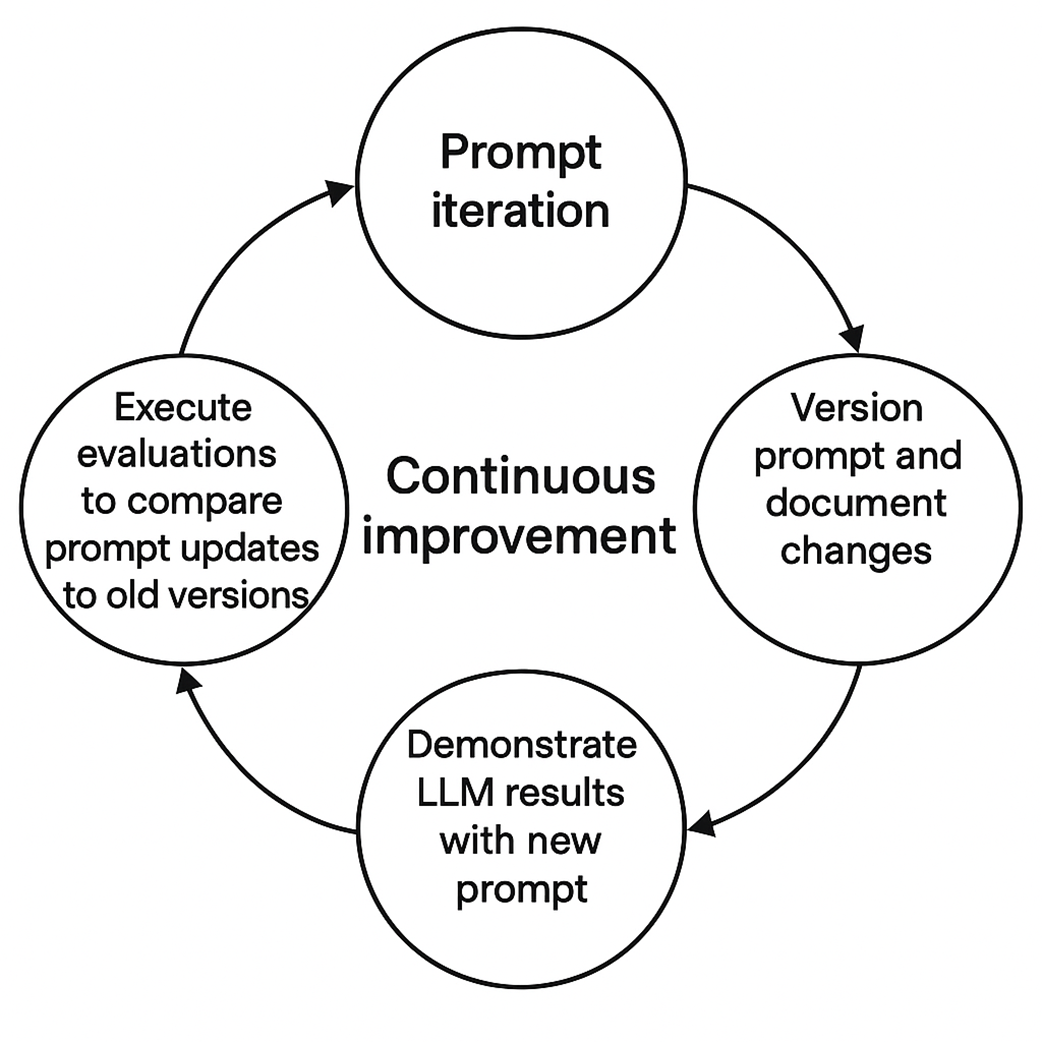
The prompt evaluation lifecycle is iterative, not linear. Each cycle refines prompt clarity, evaluates LLM behavior, compares performance against earlier versions, and feeds learnings back into the next iteration, bringing the same rigor to prompt design that engineering teams apply to code or any other software component.
Summary
- The best use case for LLM-as-a-judge is not “we don’t know how to evaluate this.” The best use case is “we know what quality means, but applying that judgment manually at scale is too slow, expensive, or inconsistent.”
- LLM-as-a-judge is an evaluation methodology where a large language model assesses, scores, ranks, or compares model outputs against defined criteria.
- LLM judges are most useful when the evaluation task requires semantic judgment, contextual reasoning, qualitative comparison, or assessment of open-ended outputs.
- Deterministic metrics still matter. If the output can be evaluated with exact matching, rule-based checks, labels, or simpler metrics, use those first.
- An LLM judge should be treated as an evaluation instrument, not an objective truth machine. It needs clear goals, representative data, explicit rubrics, validation, and monitoring.
- A good LLM-as-a-judge setup starts with goal clarity: what decision will this evaluation inform, what criteria define quality, and what context does the judge need?
- Prompt design matters because the prompt defines the judge’s task, reasoning boundaries, rubric, and output schema.
- Common judge formats include scoring, ranking, and pairwise comparison. The right format depends on the decision you need to make.
- Calibration with gold examples can anchor the judge’s scoring behavior, but calibration is not the same as full validation.
- Validation compares judge outputs against human ratings, gold labels, known examples, or canary sets to determine whether the judge is reliable enough for the decision.
- Common LLM judge failure modes include position bias, verbosity bias, style bias, context insufficiency, prompt injection, and overconfident explanations.
- LLM-as-a-judge should not be used when the answer is deterministic, when trusted ground truth is available, when the judge lacks necessary context, or when the decision is high-impact without human or domain-specific review.
- Engineering practices such as prompt versioning, model version logging, cost tracking, latency monitoring, malformed-output detection, and result drift monitoring are essential for scaling LLM-based evaluations responsibly.
- LLM judges should amplify human judgment, not replace it. Humans define the rubric, inspect disagreements, validate the judge, and decide how much trust the system deserves.
FAQ
What is LLM-as-a-judge in model evaluation?
LLM-as-a-judge is an evaluation method where a large language model assesses, scores, or ranks another model’s outputs against defined criteria. It is used for semantic, contextual, or subjective tasks where deterministic metrics may miss quality or intent.
Why are deterministic metrics sometimes not enough for AI evaluation?
Deterministic metrics work well for clear, bounded outcomes like accuracy or precision, but they break down on open-ended tasks such as summarization, reasoning, or conversation. These tasks often require judging multiple dimensions at once, including factuality, coherence, tone, relevance, and safety.
What kinds of evaluation goals should be clarified before using an LLM judge?
You should define whether the goal is descriptive or evaluative. Descriptive goals build understanding of model behavior, while evaluative goals compare systems to guide decisions on dimensions like helpfulness, factuality, or bias.
What data should an LLM judge receive for a reliable evaluation?
The judge should receive representative, contextualized data that matches the real task. The prompt and inputs should reflect realistic user scenarios and include the evidence needed for the judgment, such as source text, user history, tool output, or retrieved context.
What are the key parts of a good LLM-as-a-judge prompt?
A strong prompt includes context, a clear role or instruction, a rubric, and an output schema. It should tell the model exactly what to evaluate, what criteria to apply, and how to return the result in a machine-readable format.
When should you use scoring, ranking, or pairwise comparison?
Use scoring when you need numerical trends across many examples, ranking when comparing multiple candidates for the same input, and pairwise comparison when choosing between two outputs. Pairwise comparison is often more stable, while scoring is useful for aggregation and monitoring.
How do you choose an evaluator model for LLM-as-a-judge?
Choose a model with strong instruction following, stable structured-output behavior, low variance, and enough reasoning ability for the task. The best choice also depends on cost, latency, privacy, and whether the judge needs domain adaptation or a large context window.
What are common failure modes of LLM judges?
Common failure modes include position bias, verbosity bias, style or self-preference bias, context insufficiency, prompt injection, and overconfidence. These can make the judge look consistent while still producing unreliable or misleading scores.
How do you validate an LLM-as-a-judge before using it at scale?
Start with a small validation set, compare the judge against human ratings or gold labels, measure agreement, and inspect disagreements. Then lock the prompt and model version, maintain a canary set, and re-run checks whenever the system changes.
When should you not use LLM-as-a-judge?
Do not use it when the answer can be checked deterministically, when trusted ground truth labels already exist, when the judge lacks necessary context, or for safety-critical decisions without human review. It is also a poor choice if the evaluated content can easily manipulate the judge or if cost and latency outweigh the value of the signal.

 AI Model Evaluation ebook for free
