8 Pitfalls of online metrics
Online evaluation of AI models is high stakes because these systems are expensive to build, dynamic in production, and often influence user behavior in subtle ways. The chapter argues that weak or misaligned metrics can waste months of offline work and produce false confidence, especially when a simple proxy like click-through rate is treated as proof of success. Instead, online metrics should be chosen intentionally as part of a broader evaluation contract that reflects product strategy and model behavior.
A central theme is that AI models create feedback loops: their outputs shape user behavior, which in turn shapes future data, retraining, and future measurements. This can create exposure bias, reinforce errors, and mask longer-term harm even when short-term metrics improve. The chapter also warns about metric gaming and reward hacking, where models or users exploit weaknesses in the evaluation target, making a system look better on paper while degrading trust, satisfaction, fairness, or diversity in practice.
To avoid these traps, the chapter recommends layered metric hierarchies with outcome, proxy, and diagnostic metrics; explicit guardrails and non-inferiority margins; and ongoing monitoring for segment gaps, robustness failures, trust erosion, drift, and variance inflation. It also highlights technical refinements such as exploration traffic, long-term holdbacks, careful covariate adjustment, and detailed logging for blended or agentic systems. The overall message is that trustworthy AI evaluation requires combining online metrics with offline diagnostics, human judgment, and robust statistical and engineering practices.
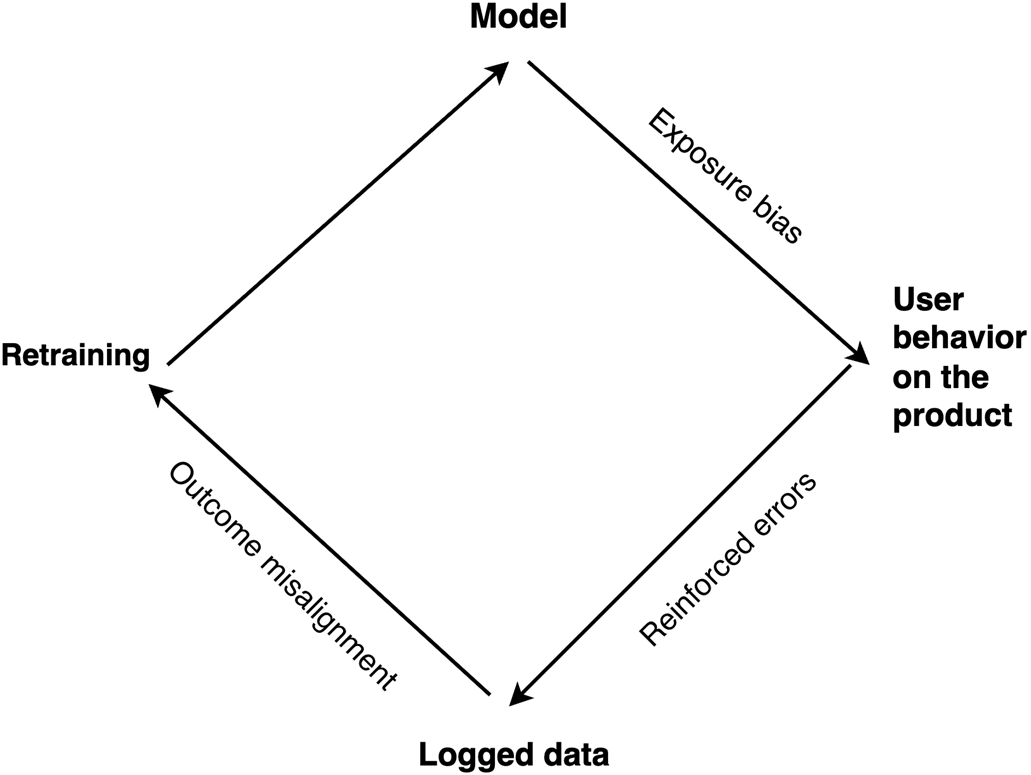
illustrates feedback loop in AI model evaluations. The model influences user behavior, which generates logged data that feeds back into retraining. Pitfalls such as exposure bias, reinforced errors, and satisfaction masking emerge along the loop, making evaluation an evolving target rather than a clean snapshot.
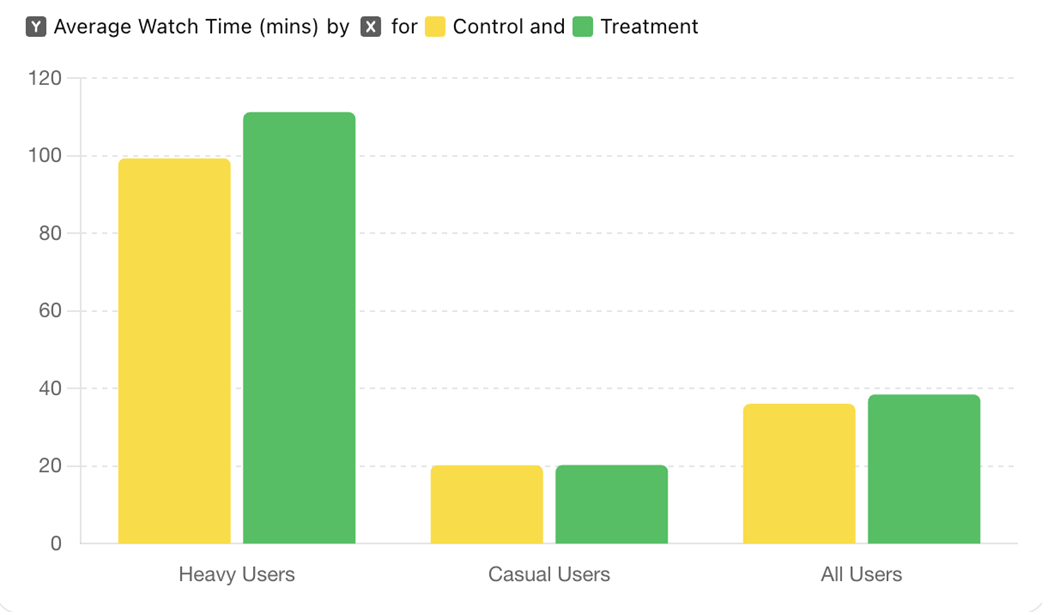
illustrates how raw averages can flatten heterogeneous effects. In this movie recommender example, heavy users show a clear lift in watch time under the new model, while casual users see little to no change. When averaged across all users, the treatment effect looks much smaller than it does for the subgroup that benefited most. This illustrates why top-line A/B results can mislead in AI evaluations without subgroup analysis or variance reduction.
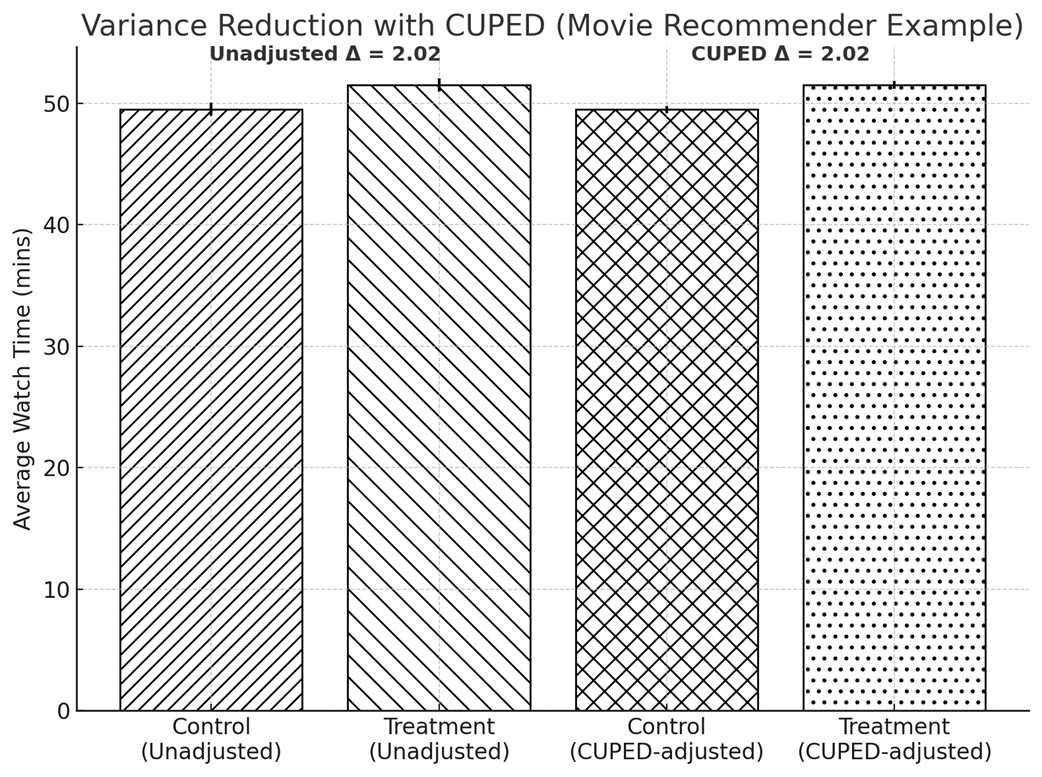
illustrates variance reduction with CUPED (Movie Recommender Example). In this experiment, the unadjusted analysis shows noisy control and treatment averages with wide error bars, making the small lift hard to detect. After applying CUPED using pre-experiment watch-time as a covariate, the treatment and control means remain essentially the same, but the error bars (confidence intervals) shrink. That’s the point: CUPED doesn’t change the treatment effect estimate (+2 minutes watch time), it reduces variance, allowing the same signal to be detected with fewer users or shorter tests.
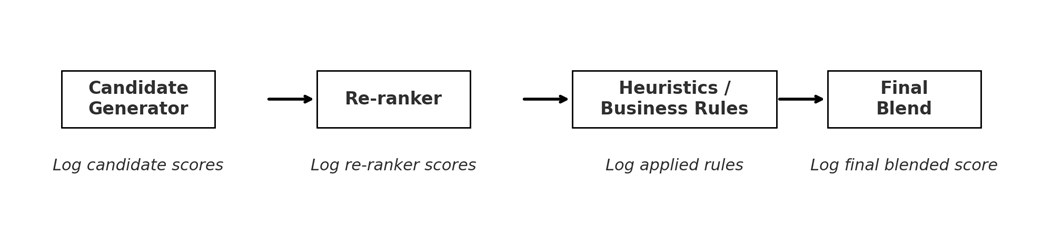
illustrates system logging in a blended recommendation pipeline.
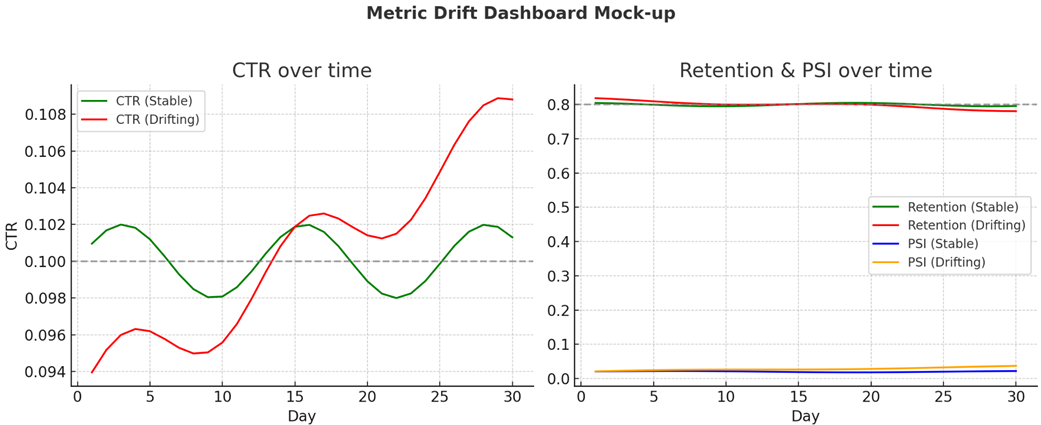
illustrates a metric drift dashboard mock-up. The left panel shows CTR over time where the stable series fluctuates within normal variance, while the drifting series trends upward beyond the baseline, suggesting feedback-driven distortion. The right panel tracks retention and PSI (Population Stability Index).
Summary
- Evaluation contracts are essential. Success metrics must be paired with guardrails (e.g., retention, satisfaction) and explicit non-inferiority margins (NIMs) to prevent false wins.
- Reward hacking is a real risk. Models exploit flaws in their targets (e.g., chatbots maximizing verbosity, recommenders chasing clickbait), producing “successful” metrics that mask product harm.
- Blind spots hide in averages. Segment disparities, brittleness in edge cases, and qualities like trust, coherence, or novelty often evade online metrics unless explicitly instrumented.
- AI-specific pitfalls such as feedback loops, reward hacking, segment disparities make online metric discipline critical.
- AI models optimize probabilistically for proxies. Unlike UX experiments, the proxy/objective gap is designed into the model’s loss function, which makes it a unique evaluation pitfall.
- Statistical refinements strengthen power. Techniques like CUPED or regression adjustment reduce variance in noisy, heterogeneous populations, though poor covariate choices can amplify bias.
- A/B differences often mislead in heterogeneous user populations; heavy users or long-tailed behaviors can mask real treatment effects which is where variance reduction strategies may be helpful.
- Covariate adjustment techniques (CUPED, regression adjustment) reduce variance by leveraging pre-experiment data, increasing power to detect small effects typical in personalization and recommendation models.
- CUPED stabilizes outcomes by subtracting variance explained by pre-treatment behavior; regression adjustment estimates treatment effects while holding baseline covariates constant.
- Two forms of drift matter most for evaluation: data drift and metric drift. You can create metric drift dashboards that compare rolling aggregates of key metrics against control baselines to combat concerns for both drift types.
- Variance reduction matters most in AI models where lifts are small (1–2%) and distributed unevenly across users, making raw averages underpowered. These refinements don’t change the evaluation target—they sharpen it, ensuring online metrics reflect the true impact of the model rather than noise in user behavior.
- Balanced evaluations (offline, online, human, LLM-as-a-judge) are necessary for trustworthy AI development.

 AI Model Evaluation ebook for free
