Overview

7 From offline evaluation to live experiment

The chapter explains that A/B testing should be treated as one part of a larger evaluation system rather than a standalone launch tactic. To move models from offline work into live experiments responsibly, teams need a model selection playbook that clarifies the user problem, summarizes offline wins and weaknesses, records risks from sandbox or beta testing, defines online watchpoints, and states the decision rule for shipping, iterating, rolling back, or retesting. This keeps online testing focused on strong, well-motivated variants instead of wasting time and resources on models that are not ready or not meaningfully different.

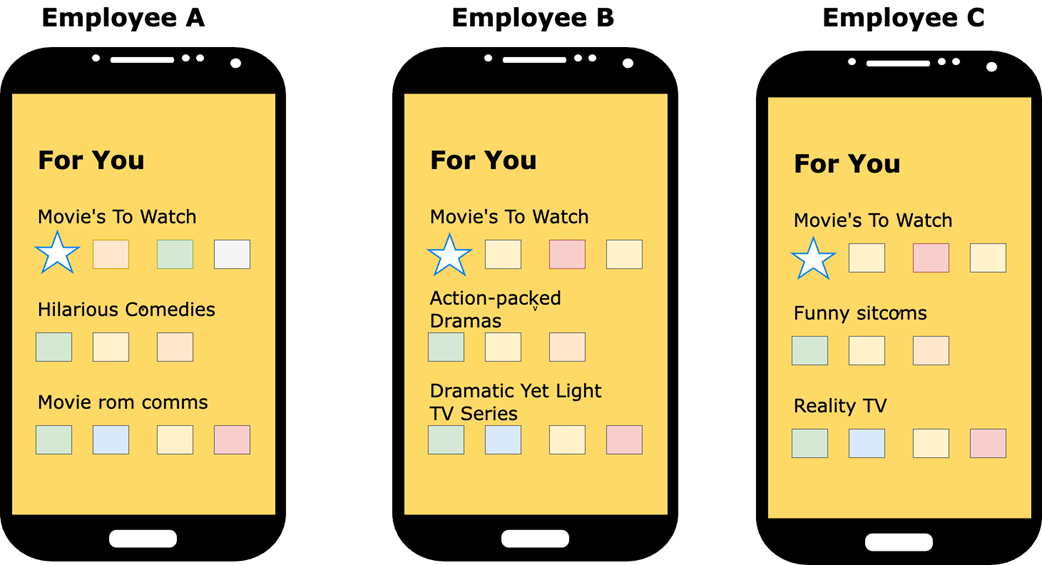
A major theme is the value of internal beta testing before exposing users to a model. Employee testing in a controlled environment can uncover obvious defects, skewed rankings, safety issues, and operational problems that might not appear in offline metrics alone. The chapter uses a recommendation example to show how internal reviewers can catch a hidden popularity bias, where one title repeatedly dominates top results, allowing the team to adjust model weights, add diversity constraints, and re-run offline checks before any live rollout. The chapter also stresses that beta feedback is only a readiness signal and must be structured carefully so it is useful rather than noisy.

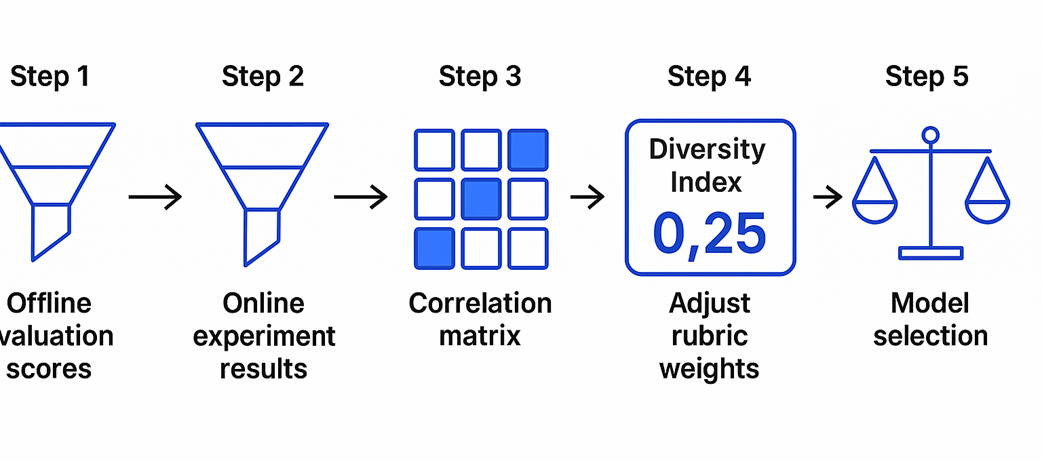
Finally, the chapter argues that offline findings should directly shape online monitoring and future decisions. Teams should translate known offline failure modes into specific live watchpoints, build metric mirror tables that connect offline metrics to their online proxies, and maintain a rolling dataset that tracks how offline scores relate to online outcomes over time. This lets teams identify which offline metrics are actually predictive, refine the scoring rubric, and set better thresholds for future tests. The overall message is that the transition from offline evaluation to live experimentation is a continuous, well-instrumented loop involving engineering, communication, and learning, not a one-time handoff.

illustrates an example of a systemic ranking bias caught during internal beta testing: The same popular title (represented as a star) repeatedly appears in the top position of the 'Movies To Watch' row across different users and segments. This pattern, observed before launch, indicates an overweighted popularity feature in the re-ranking stage which is a problem that could influence engagement metrics if not caught before.
illustrates the offline to online correlation feedback loop.
Summary

  • Before exposing a model to real users, enable a sandbox environment for employees to compare model variants to identify issues that may have gone unnoticed during the offline evaluations stage.
  • Create a model selection playbook for deciding which models to include in an A/B test. Use a weighted scoring rubric: offline performance, product heuristics, risk, strategic alignment.
  • Model maturity influences both selection playbook thresholds and in-test monitoring intensity.
  • Stakeholder alignment matters because building AI models is costly, the details matter, and you don’t want to A/B test something that’s out of sync with product requirements or stakeholder expectations.
  • Identify offline weaknesses and turn them into specific live monitoring points during the A/B test (i.e. bias gaps, recall drops).
  • Use concrete examples that correlate to product requirements to guide online experimentation monitoring, like tracking diversity per segment online if it dropped offline, with clear alert thresholds.
  • Maintain a metric mirror table that maps each offline metric to its online equivalent, including formulas and alert triggers.
  • Continuously track how offline metrics correlate with online results and adjust your model selection rubric to prioritize metrics with stronger predictive power.
  • Invest in building side-by-side model comparison tools to use during beta testing.
  • Offline evaluation weaknesses (like bias, diversity drops, or latency risks) should translate into live A/B test watchpoints with alerting thresholds. Build metric mirrors that pair each offline metric with an online counterpart, then track correlations over time to refine which offline metrics are the best predictors of real-world outcomes

FAQ

What is a model selection playbook, and why do teams need one before running an A/B test?A model selection playbook is a lightweight rubric for deciding which model variants are ready to enter online evaluation. It helps teams avoid wasting test capacity, misaligning with stakeholder expectations, and testing variants without a clear hypothesis, known risks, and monitoring plan.
What core components should a model selection playbook include?A solid playbook should include an offline evaluation summary, sandbox or beta testing feedback, and a model selection rubric that brings together metrics, product heuristics, operational readiness, and other decision factors.
What questions should a model selection playbook answer before a model goes into an A/B test?It should answer: what problem the model is solving, which offline metrics improved or degraded, what risks were found, what online watchpoints will monitor those risks, and what the decision rule is for shipping, iterating, rolling back, or retesting.
Why is internal beta testing useful before exposing a model to real users?Internal beta testing lets employees stress-test the model, uncover obvious failure modes, and catch edge cases in a low-risk environment. It is best for finding defects and qualitative issues, not for estimating user impact.
How should feedback from internal beta testers be interpreted?It should be interpreted carefully because employees are often not representative of real users. They may be more technical, more familiar with the product, and more likely to test unusual scenarios, so their feedback is useful for readiness and bug detection, not for declaring success.
What was the “Batman problem” example meant to show?It showed how a recommendation model can over-weight popularity and repeatedly surface the same title in top positions, even when it is not relevant to the user. Beta testing caught the issue early, allowing the team to adjust feature weights and add diversity constraints before launch.
What does a model selection scoring rubric do?The scoring rubric consolidates offline performance, product heuristics, model maturity, strategic alignment, operational readiness, and sandbox feedback into one transparent decision framework so that model advancement is repeatable and defensible.
How does model maturity affect selection decisions?Model maturity changes how strict the selection thresholds should be. Early-stage models may get more flexibility on trade-offs like latency or cost, while mature models usually need stronger evidence and more stringent readiness checks before being fast-tracked to production.
How do offline evaluation results become online watchpoints?Teams identify offline failure modes, map them to equivalent live metrics, and set alert thresholds tied to known risks. This creates a metric mirror table that links offline metrics to online monitoring, helping catch problems early in the experiment.
Why track correlation between offline and online metrics over time?Tracking correlation helps teams learn which offline metrics are actually predictive of online success. By maintaining a rolling dataset and updating correlations after each experiment, teams can weight their selection criteria based on real historical evidence instead of assumptions.

pro $24.99 per month

  • access to all Manning books, MEAPs, liveVideos, liveProjects, and audiobooks!
  • choose one free eBook per month to keep
  • exclusive 50% discount on all purchases
  • renews monthly, pause or cancel renewal anytime

lite $19.99 per month

  • access to all Manning books, including MEAPs!

team

5, 10 or 20 seats+ for your team - learn more


choose your plan

team

monthly
annual
$49.99
$499.99
only $41.67 per month
  • five seats for your team
  • access to all Manning books, MEAPs, liveVideos, liveProjects, and audiobooks!
  • choose another free product every time you renew
  • choose twelve free products per year
  • exclusive 50% discount on all purchases
  • renews monthly, pause or cancel renewal anytime
  • renews annually, pause or cancel renewal anytime
  • AI Model Evaluation ebook for free
