6 Evaluating models in an A/B test
Offline evaluation can show whether a model looks promising, but it cannot reveal its real effect on users once it is exposed in a live product. The chapter argues that AI model evaluation must include online controlled experiments because real-world behavior, latency, feedback loops, and product context can all change outcomes in ways offline metrics miss. A/B testing is framed not as a perfunctory launch check, but as a way to learn whether a model truly improves the user experience and product results.
The chapter explains that the timing and style of an A/B test should depend on model maturity, confidence in offline results, and the risks involved. Early-stage models are best tested with small, short experiments and sensitive feature-level metrics to learn whether the direction is viable, while mature models justify more rigorous tests with top-line and guardrail metrics. Strong offline evaluation lowers risk and supports earlier online testing, whereas weak offline evaluation requires tighter observability, fallback plans, and caution when interpreting results.
It also lays out the structure of a good model experiment: define the model’s purpose, form a clear hypothesis, choose appropriate variants and randomization units, set success and guardrail metrics, and verify that the experiment is valid before trusting results. The chapter emphasizes practical pitfalls such as novelty effects, cold starts, high variance, model drift, multiple comparisons, and mismatches between offline and online performance. When results are ambiguous or low-signal, the right response is to return to the original hypothesis, inspect segments and logs, and decide whether to launch, iterate, or stop based on product value rather than metric movement alone.
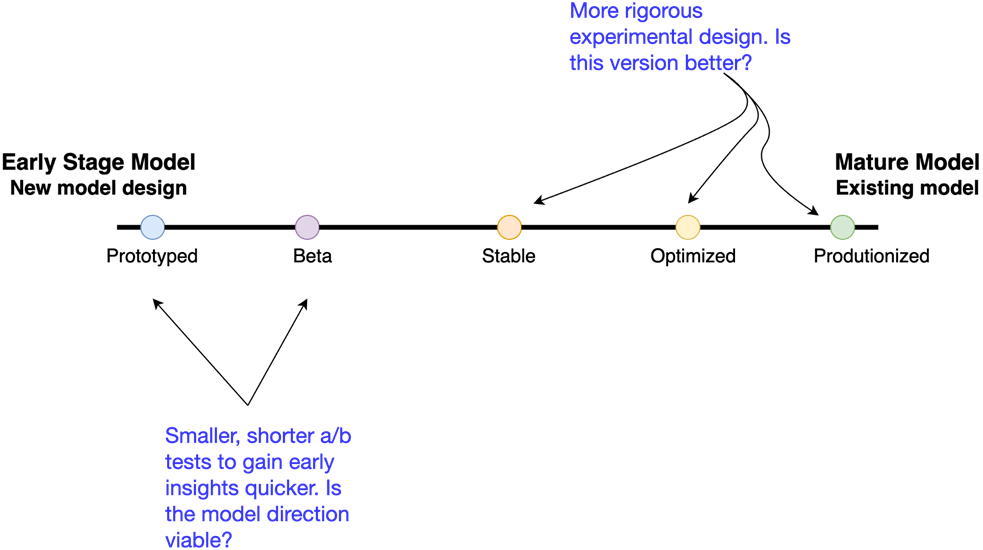
model ai maturity model illustrating the questions to answer for an early stage model in comparison to a model that is more mature, already in production. For an early stage model the A/B testing approach should include smaller, shorter tests measuring effect with feature-level metrics. For more mature models, the approach should include A/B tests with both top-line and feature-level metrics.
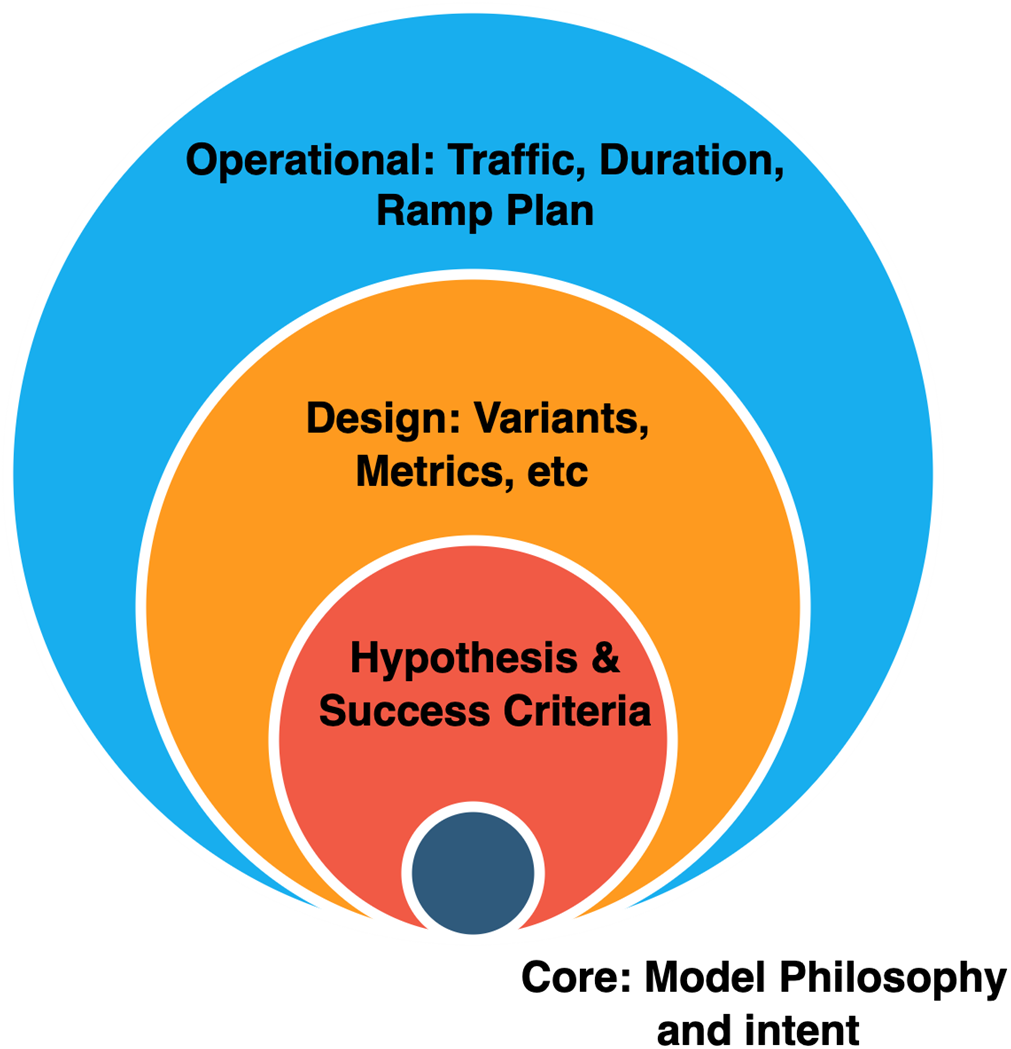
A/B testing design layers, organized from outer to inner circles. The closer to the core, the more foundational and irreversible the decisions tend to be: the outer execution layer covers operational factors like test duration, rollout timing, and sample size; the middle experimental design layer defines how the test is structured, including variants, metrics, and assignment logic; and the inner core layer captures the underlying purpose of the model and the user or product behavior it’s intended to influence.
Summary
- A/B testing is one of the most important ways product teams learn whether a change actually improves the user experience.
- When you run an A/B test depends heavily on model maturity. Early-stage models benefit from lightweight, iterative tests focused on directional insights, while mature models demand more rigorous evaluations using top-line and feature-level metrics.
- A/B test design can be thought of in layers; from flexible execution details, to structured experimental design, down to the core intent behind the model and what behavior it's meant to influence.
- The right time to run an online evaluation of a model is nuanced because it depends on the maturity of the model, timeline and offline evaluation suite.
- Ambiguous or low-signal results require careful interpretation, not just p-value hunting.
- A/B tests evaluating AI models typically have more test variants due to model tuning such as varying feature weights but this increases testing complexity (configuration wise) and demands larger sample sizes or longer test durations.
- Discrepancy between offline and online metrics can be caused by misaligned evaluation goals, stale feature usage, or inference behavior differing from training setup.
- Feature drift can cause models to perform worse over time and is one of the key reasons to monitor models once the A/B test has started.
- Model cold-start effects can skew early results; giving models time to “warm up” before interpreting metrics is often necessary. Similarly, high variance and subtle user behavior shifts mean metric selection and experiment duration must be carefully considered in AI model tests.
- Bias from training data can cause offline/online mismatch.
- The novelty effect can inflate early treatment metrics; letting an experiment run until behavior stabilizes is essential before making a decision on the effectiveness of the model being tested.
- Even without an A/B testing platform, it's still possible to evaluate online impact; it's just a lot harder and not ideal. If you don't have the capability today, then try to build a very simplistic minimal solution that resembles the beginnings of an A/B testing platform.
- Engineering considerations such as model latency and infra reliability can significantly affect user experience and, thus, test outcomes.
FAQ
What is the main purpose of using an A/B test for AI model evaluation?
The main purpose is to measure what actually happens when a model is exposed to real users in a real product setting. Unlike offline evaluation, an A/B test shows the model’s real impact on user behavior, product metrics, latency, and possible trade-offs.
How is an A/B test different from an offline model evaluation?
Offline evaluation predicts how a model might perform, while an A/B test measures its real-world behavior with actual users. A model can look strong offline and still underperform online, or look only modest offline and still create meaningful product gains.
When is the right time to A/B test a model?
The right time depends on model maturity, offline confidence, product timelines, and risk tolerance. Early-stage models may be tested with small, short experiments for directional learning, while mature models usually need more rigorous tests with stronger evidence and guardrails.
What are offline exit criteria before running an online test?
Offline exit criteria are the minimum conditions a model should meet before becoming a candidate for A/B testing. These often include beating the baseline offline, staying within guardrails such as latency and safety, showing no major segment regressions, and having a clear hypothesis for the online test.
What should be included in the operational setup of an AI model A/B test?
The operational setup includes sample size, duration, traffic allocation, exposure rules, and ramp-up strategy. These choices determine how the experiment runs in practice and help ensure the test is controlled and interpretable.
Why are hypotheses and success criteria important in model experiments?
They define what the experiment is trying to learn and what outcome would count as success. Without them, it becomes hard to choose metrics, set exposure rules, or interpret results without bias.
Why does logging matter so much in AI model A/B testing?
Logging is essential because AI serving paths can be complex. You need to know assignment, exposure, model version, outputs, fallbacks, latency, errors, and downstream behavior so you can trust the results and debug what really happened.
What are some quirks unique to A/B testing AI models?
AI experiments often involve multiple variants, novelty effects, warm-up or cold-start behavior, high-variance metrics, and offline-online mismatch. These can make results harder to interpret than standard product tests like button or layout changes.
How should ambiguous or low-signal A/B test results be interpreted?
Low-signal results may mean the effect is small, the metric is poorly matched to the model’s purpose, the test was underpowered, or segment differences are being hidden. The right response is to revisit the hypothesis, check validity, analyze segments carefully, and decide whether to iterate, launch, or stop.
What engineering prerequisites are important before running an AI model A/B test?
Key prerequisites include latency monitoring, feature drift monitoring, and reliable logging. You also need infrastructure that can serve the model without causing errors or excessive cost, plus an experimentation platform or equivalent tooling to randomize traffic and measure outcomes.

 AI Model Evaluation ebook for free
