2 Anatomy of an offline evaluation
Offline evaluation is presented as a safe, disciplined way to check model behavior before users ever see it. The chapter frames it as a pre-flight or sandbox-like process that helps teams understand how a model performs, where it fails, and whether it is ready to move into online testing or production. It emphasizes that responsible AI development depends on these checks because teams need to catch harm, bias, edge-case failures, and deployment risks early.
The chapter then breaks offline evaluation into a simple anatomy: input data, evaluation design, and outputs. Data can include historical interactions, labels, logs, prompts, tool traces, and contextual metadata; design determines what is being tested, at what unit, against what baseline, with what metrics, scenarios, thresholds, and reproducibility practices; and outputs include not only scores but also diagnostics, failure categories, dashboards, and recommendations. It also explains that most real-world evaluation strategies combine several lenses, including performance, diagnostics, and simulation-based testing, rather than relying on a single metric.
Finally, the chapter warns about common pitfalls that can make offline results misleading, such as lack of trust, unclear success thresholds, friction between offline and production systems, poor generalization, overfitting to historical data, metric misinterpretation, and data leakage. It argues that careful engineering is essential: versioned datasets and prompts, shared metric libraries, reliable logging, reproducible runs, and scalable tooling turn evaluation from an ad hoc script into a dependable part of the development cycle. In that sense, offline evaluation is not just a measurement step but a foundation for faster iteration, better decisions, and safer deployment.
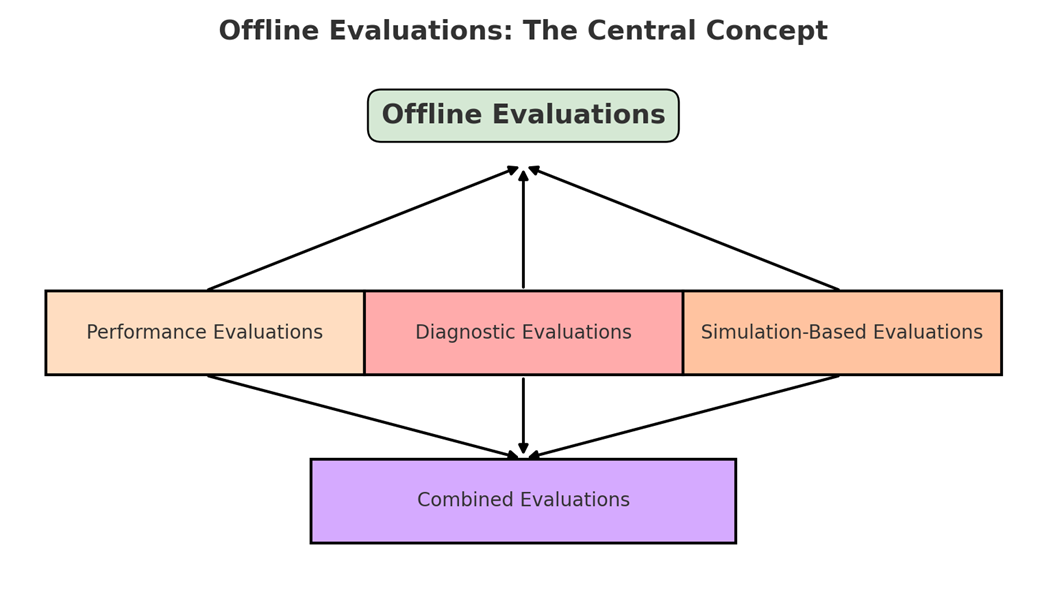
visualizes how offline evaluations serve as the central concept, with three key categories—performance evaluations, diagnostic evaluations, and simulation-based evaluations—contributing independently. These categories feed into combined evaluations, which integrate insights from all three to provide a holistic view of model behavior.
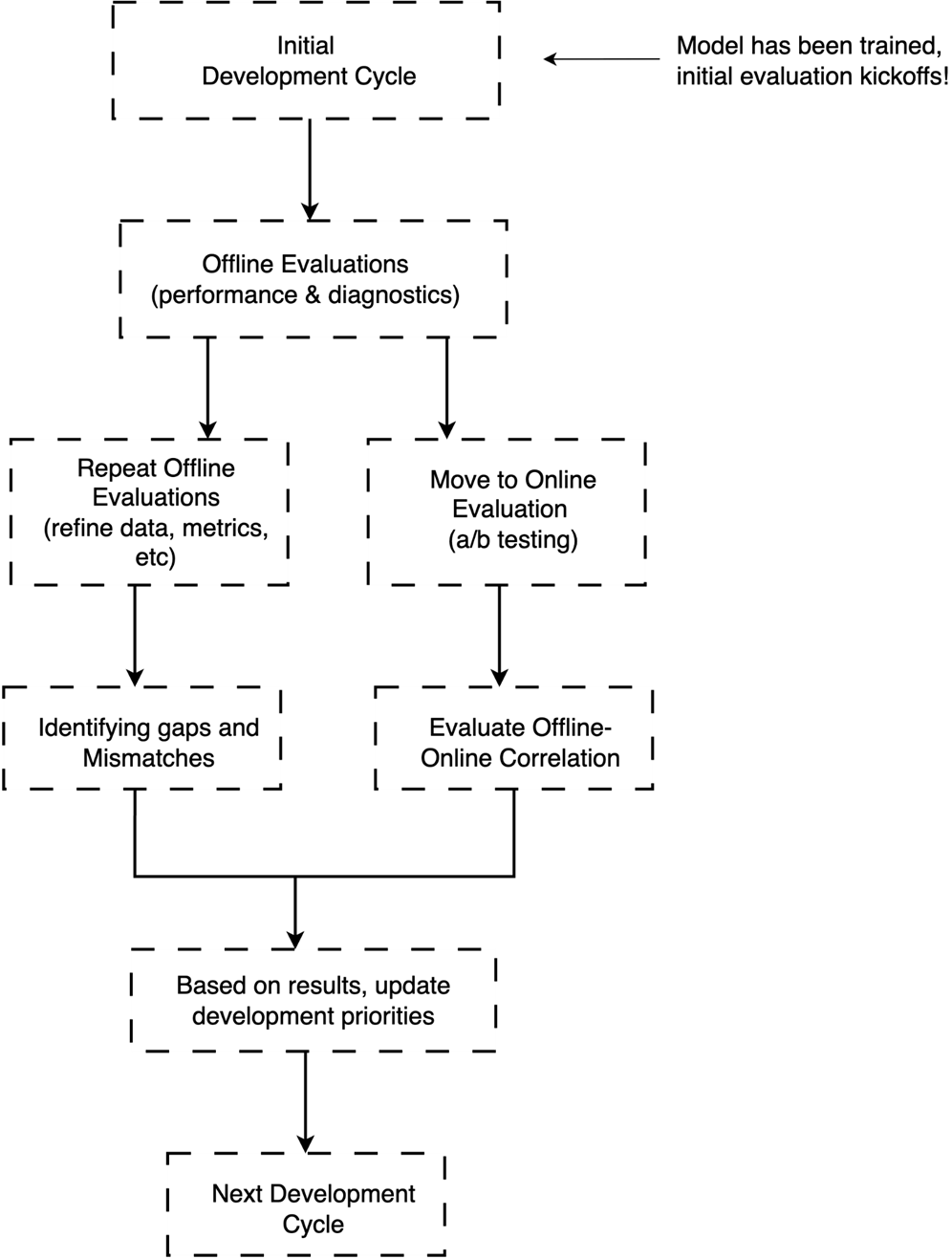
flow captures how evaluation results can guide decisions that influence a team’s roadmap and time spent. Teams often go through multiple rounds of offline evaluation before moving to online testing. After each development cycle, the next step can vary, whether it's rerunning evaluations, retraining the model, or shifting to the online evaluation phase.
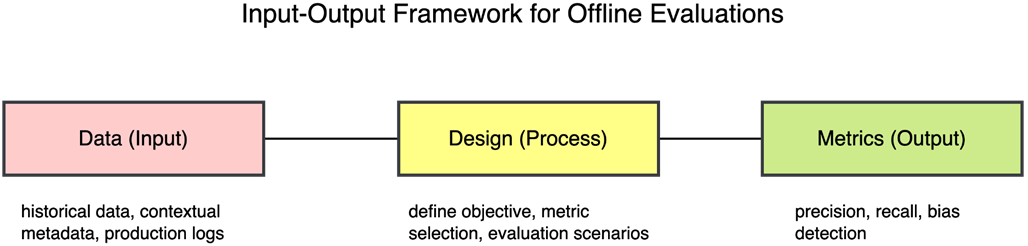
illustrates the input-output framework for offline evaluations. The process begins with data as the input, including historical interactions, ground truth labels, and contextual metadata. Through the design phase, which involves selecting metrics and structuring evaluation scenarios, the evaluation produces metrics and insights as the output, such as precision, recall, bias detection, and robustness analysis.
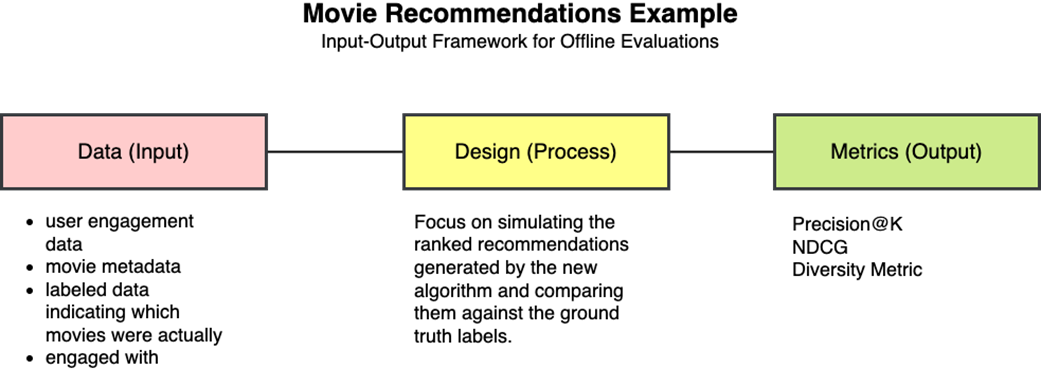
illustrates the input-output framework for the movie recommendations example. Data, such as user interactions and movie metadata, feeds into the design process, where the evaluation is structured to test the algorithm’s ranking performance. Metrics such as Precision@K and NDCG provide insight into how effectively the algorithm ranks movies, while additional metrics such as diversity or coverage can help reveal whether the recommendations are too narrow or repetitive.
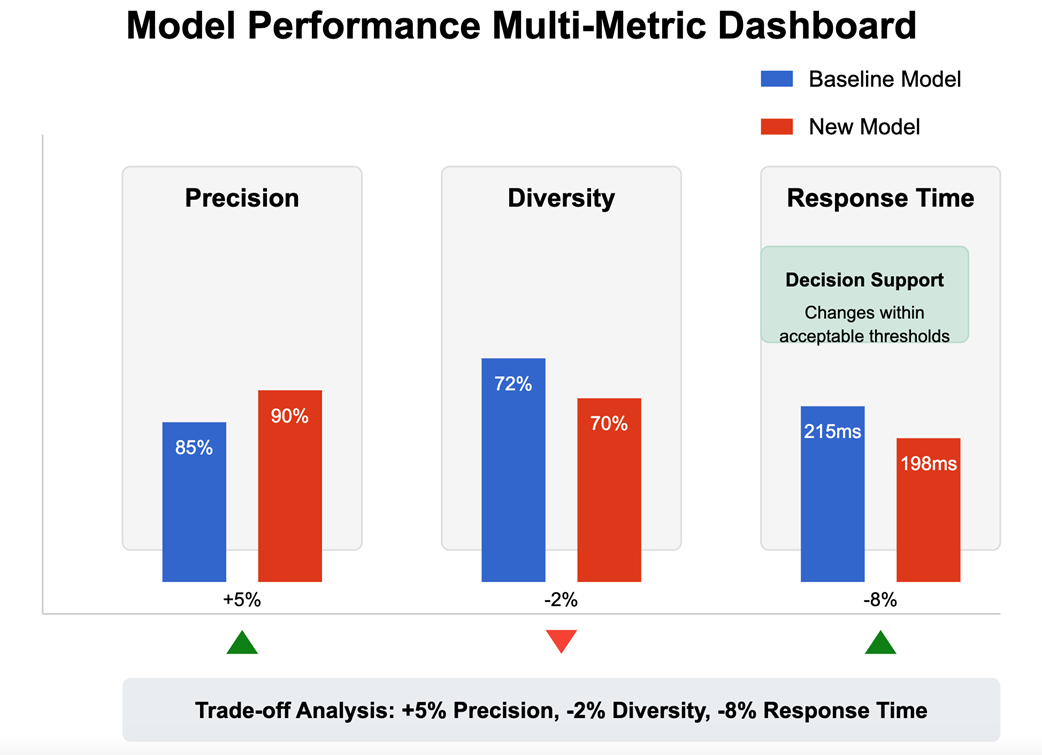
illustrates a dashboard that displays multiple metrics simultaneously, enablings engineers to see how changes to a model affect different performance aspects at once. Key features include side-by-side comparisons between baseline and new model performance and visual indicators showing whether changes are positive or negative, based on acceptable thresholds to avoid interpretation errors.
Summary
- Offline evaluations are a foundational step in building confidence in machine learning models before enabling the model in a production user-facing setting.
- The anatomy of an offline evaluation includes data, evaluation design, and metrics.
- The output of an offline evaluation is a set of metrics—quantitative results like precision or recall, diagnostic findings like bias detection, or robustness analysis. These outputs inform how well the model meets its objectives, highlights areas for improvement, and guides the next steps before deploying the model.
- Defining the right metrics are important for your evaluations to be effective because metrics are the tools used to measure the objective at hand.
- Simulation-based evaluations provide a way to test “what if” scenarios and mimic real-world conditions offline.
- A robust offline metrics suite accelerates model iteration and reduces the common logic that engineers would replicate if there wasn’t a shared library or framework in place that encapsulated the core metric computation logic.
- The most common pitfalls for offline evaluation include mistrust in results, misalignment with production, and inadequate tooling.
- Offline evaluations can be misleading when evaluation data leaks into training, prompts, features, or labels. Preventing leakage requires careful data splits, time-aware design, and versioned evaluation artifacts.
- Logging is important and the details matter. For instance, without proper randomization keys, counterfactual evaluation can introduce bias, especially when simulating alternative scenarios in logging-based replays.
- Offline evaluations are a bridge between theory and practice, ensuring responsible and effective deployment of machine learning models. To really scale your offline evaluation practices it requires consistent and shareable frameworks, strong engineering practices, and versioning to ensure reproducibility.

 AI Model Evaluation ebook for free
