Appendix C. Choosing an LLM
This appendix presents a concise survey of the modern large language model landscape and a pragmatic guide to selecting the right model for a given application. It contrasts proprietary and open-source options, explains how capabilities like multimodality, long context, and advanced reasoning shape use cases, and frames model choice as a set of trade-offs among performance, latency, privacy, and cost. Throughout, it emphasizes practical evaluation with relevant benchmarks and the importance of safety and bias mitigation for responsible deployment.
The model overview spans leading families and their distinguishing strengths. OpenAI’s line progresses from GPT-4 and GPT-4o/4.1 to a unified GPT-5 family that dynamically balances instruction following and deeper reasoning. Google’s Gemini evolves from 1.5 to 2.0 and 2.5, highlighting multimodal I/O, native tool use, and very large context windows, while Gemma offers lightweight open-source variants. Anthropic’s Claude series (through 3.7 Sonnet and Haiku) emphasizes honesty, safety, and strong general performance; Cohere targets enterprise reliability; and Meta’s Llama 2/3/4 advances open-weight options with new multimodal and reasoning-oriented variants under licensing constraints. Competitive open models include Falcon 3, Mistral and Mixtral MoE lines, Alibaba’s Qwen family (with coder and math specializations), xAI’s Grok with new reasoning modes and real-time retrieval, Microsoft’s Phi small-model series including Phi-3.5-MoE, and DeepSeek’s cost-efficient, high-performing V3 and reasoning-focused R1. Across this ecosystem, integration is facilitated by LangChain connectors for major providers and wrappers for open models.
The selection playbook centers on aligning the model with purpose and constraints: generalist versus specialized models, proprietary cloud APIs versus open-source deployments, parameter count and latency, context window needs, multilingual coverage, and the balance of accuracy against speed and cost or hardware. Task suitability is assessed with established benchmarks such as IFEval, BBH, MATH, GPQA, MuSR, and MMLU-Pro, while safety and bias controls remain essential. A practical example—an internal Python coding assistant for a financial firm—illustrates the process: privacy mandates an open-source, code-specialized model hosted in-house; a medium size balances responsiveness and quality; and head-to-head evaluation on coding metrics leads to selecting Qwen2.5-Coder-32B as a top candidate while validating close alternatives. The appendix underscores that final choices are iterative and context-dependent, often combining careful testing with appropriate hosting—self-managed or via managed platforms—to meet technical, compliance, and business goals.
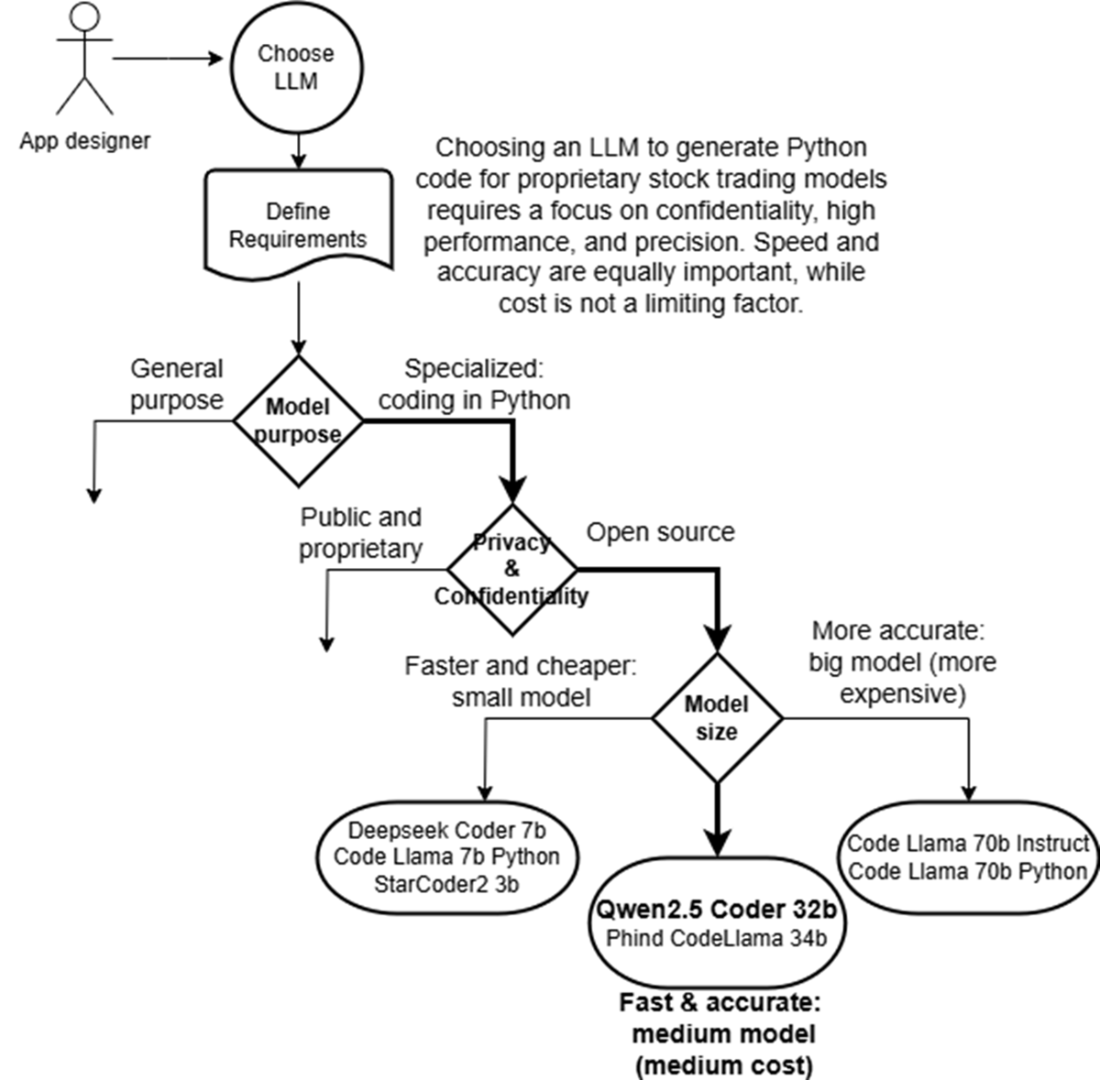
Figure C.1 Flowchart for selecting an LLM for a Python coding assistant designed to generate code for trading strategies. The process begins with choosing between a general-purpose and a specialized model, with a preference for LLMs tailored for code generation, particularly in Python. The next step focuses on selecting open-source models to comply with strict IT policies requiring all proprietary code to remain confidential. The final decision balances speed and accuracy, leading to the selection of Qwen2.5 Coder 32b based on its strong performance, including a high Python HumanEval score for accurate Python code generation.
C.3 A Word of Caution
LLMs Large Language Models (LLMs) have revolutionized natural language processing, but they come with limitations and risks you need to understand.
- Bias: LLMs can inherit and reproduce biases present in their training data, which may result in harmful stereotypes or unfair outcomes. Addressing these issues is crucial for building ethical and trustworthy AI systems. If your application involves sensitive user profiles, it's important to implement guardrails—such as content filtering, human oversight, or prompt engineering—and to evaluate multiple LLMs to identify the one that exhibits the least bias in your specific use case.
- Privacy and Security: Proprietary LLMs may use prompt data for model improvement, which can raise privacy and confidentiality concerns. To mitigate this risk, consider deploying open-source models in a private environment where you retain full control over data handling. Some providers, such as OpenAI, offer enterprise plans that guarantee prompt data will not be used for training. However, it ultimately comes down to whether you trust the provider to uphold their data privacy commitments.
- Hallucinations: LLMs sometimes produce incorrect or fabricated answers, known as hallucinations. Transparency and explainability are key when users question an output. Tools like LangChain’s evaluation framework help reduce hallucinations by improving response accuracy.
- Responsibility and Liability: The legal landscape for LLMs remains unclear. Determining who is responsible for errors or harm caused by LLM outputs is complex. Providers often include disclaimers in their terms and chatbot interfaces to limit liability. When deploying an LLM, consider accountability standards and define clear usage guidelines.
- Intellectual Property (IP) Rights: LLMs trained on unrestricted data can inadvertently generate content that violates IP laws. Some models address this by training exclusively on public domain material to avoid legal issues. If your application requires strict IP compliance, verify that your chosen LLM avoids proprietary or copyrighted content.
- Understanding these challenges ensures you deploy LLMs responsibly and avoid unintended risks.
FAQ
How do I choose the right LLM for my project?
Start from the use case and narrow down with these criteria:
- Model purpose (generalist vs task‑specialized)
- Proprietary vs open source (privacy, control, fine‑tuning)
- Model size (parameters, latency, hardware)
- Context window size (short vs long inputs)
- Supported languages (multilingual needs)
- Accuracy vs speed (real‑time vs deep reasoning)
- Cost and hardware requirements (cloud spend vs GPU hosting)
- Task suitability (benchmarks/leaderboards)
- Safety and bias (risk, governance)
What’s the difference between proprietary and open‑source LLMs?
Proprietary models (e.g., OpenAI, Gemini, Cohere, Anthropic) are accessed via cloud APIs, with pricing based on tokens and accuracy tiers. They’re convenient but may retain/process submitted data, which is a concern for sensitive workloads. Open‑source models provide transparency, private deployment, and fine‑tuning freedom but require you to provision GPUs, manage uptime, and scale infrastructure. If you want managed hosting for open models without running your own stack, consider platforms like IBM Watsonx, Amazon Bedrock, Azure AI Studio, or Google Vertex AI.
Why does model size (number of parameters) matter?
Parameter count correlates with capacity to model complex patterns and often with accuracy—yet larger models cost more to run and respond slower. Expect higher GPU memory, compute, and latency as size increases. Compression and optimization can shrink models with minimal quality loss, improving latency and cost.
What is a context window and why is it important?
The context window is the maximum tokens a model can process at once (prompt + response). Small windows suit concise prompts; large windows handle long documents, codebases, or multimodal inputs. Models vary widely—from tens of thousands of tokens to around a million—so match the window to your task’s longest realistic input.
Which popular LLM families should I consider and their highlights?
- OpenAI GPT series: Frontier reasoning, multimodality; evolved from GPT‑4/4o/4.1 and reasoning models into a unified GPT‑5 family.
- Gemini: Strong multimodal reasoning and long context; 2.0 and 2.5 improve speed, tool use, and real‑time capabilities.
- Gemma: Lightweight open models (≈2B–27B) optimized for NVIDIA/TPU; fine‑tuning friendly.
- Claude: Safety‑focused, strong summarization/coding; latest Sonnet/Haiku tiers balance accuracy and speed.
- Cohere: Enterprise‑oriented, precision and consistency; higher cost trade‑off.
- Llama: Open‑weight ecosystem with multiple sizes and vision variants; broad community tooling and derivatives.
- Falcon: Competitive open models; Falcon 3 shows solid benchmark performance for its size.
- Mistral: Efficient open models and MoE (Mixtral) variants; good cost‑performance.
- Qwen: Wide size range with task‑tuned variants (Coder, Math); strong English/Chinese.
- Grok: Conversational + reasoning modes, large contexts, real‑time retrieval.
- Phi: Small language models (SLMs) with strong reasoning per parameter; Phi‑3.5‑MoE focuses on code/math/logic.
- DeepSeek: Efficient large MoE models (V3, R1) with strong reasoning and coding; open‑source focus.
How can I compare models fairly for my task?
Use standardized benchmarks and community leaderboards:
- Leaderboards: Hugging Face Open LLM Leaderboard; LMSYS Chatbot Arena
- Benchmarks: IFEval (instruction following), BBH (hard reasoning tasks), MATH L5 (mathematical problem solving), GPQA (expert‑level STEM QA), MuSR (multistep reasoning in narratives), MMLU‑PRO (robust multitask reasoning)
Check the latest scores for the specific model versions you plan to deploy.
How should I balance accuracy and speed?
Larger models usually deliver better reasoning and nuance but are slower and more expensive. Smaller models respond faster and suit real‑time UX but may miss edge cases. Consider compression/optimization, which narrows the gap and lets compact models approach larger‑model quality for many tasks. Choose based on latency targets and task complexity.
What are the cost and hardware considerations?
Cloud APIs: Pay per token and capability tier; minimal ops burden. Open‑source/self‑hosting: Lower licensing costs but you’ll fund GPUs/VMs, memory, networking, and skilled ops for deployment, monitoring, and scaling. Pick the model/deployment path that fits both budget and reliability goals.
What safety and bias practices should I follow?
- Minimize harmful content: filter prompts/outputs; set policies against hateful or abusive generations.
- Mitigate bias: audit outputs for stereotypes; refine data/fine‑tune to improve fairness.
- Monitor in production: log, review, and iterate on safety guardrails.
- Prioritize high‑stakes domains (healthcare, finance, education) for extra oversight and testing.
How do I integrate these models with LangChain?
Use model‑specific packages and OpenAI‑compatible wrappers:
- OpenAI: langchain-openai (also works with OpenAI‑compatible endpoints; see Appendix E)
- Google Gemini: langchain-google-genai
- Anthropic Claude: langchain-anthropic
- Cohere: langchain-cohere
- Open‑source engines: wrappers like Ollama and other OpenAI‑REST‑compatible servers
Example: How would you pick a model for a private Python code assistant?
Steps from the appendix’s example:
- Choose a specialized code model (Python‑focused) over a generalist.
- Require open‑source to keep proprietary trading libraries private (no external exposure).
- Pick a medium size to balance accuracy and latency (cost not a constraint).
- Evaluate with Python HumanEval; select the best trade‑off.
Outcome: Qwen2.5‑Coder‑32B is chosen for accuracy/speed balance (top HumanEval among the shortlist). Also consider Phind‑CodeLlama‑34B, DeepSeek‑Coder‑7B, and CodeLlama‑7B‑Python as alternatives.

 AI Agents and Applications ebook for free
