6 Voter: Leveraging stochasticity for improved outputs
The chapter explains that language models are probabilistic rather than purely deterministic, so repeated runs on the same prompt can yield different reasoning paths and answers. In ordinary chat use, that variability is often a drawback, but in agentic workflows it can be exploited instead of feared. By treating multiple runs as samples from a distribution, the system can search across possible outcomes, reduce the impact of one bad reasoning chain, and estimate how confident the agent should be in a given result.
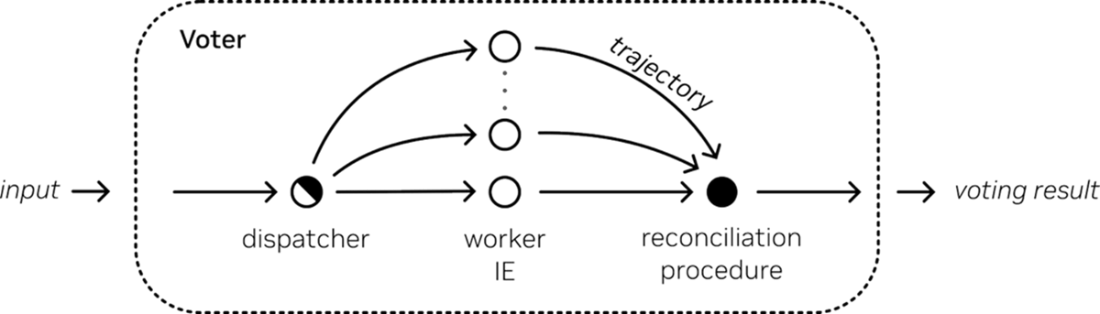
The core idea of the Voter pattern is to invoke the same worker multiple times, usually in parallel, and then reconcile the outputs with a simple aggregation rule such as majority vote, mode selection, averaging, or union. The architecture centers on a dispatcher that creates distinct voting trajectories, a worker IE that produces each vote, and a reconciliation step that normalizes and combines the results. Because the reconciliation is intentionally simple, the pattern assumes the worker is independently capable of finding correct solutions when sampled repeatedly, while the ensemble dampens noise and exposes uncertainty through measures like vote frequency, entropy, or semantic variance.
The chapter also presents variants and applications. A committee uses different worker IEs, often to reduce bias or create a diverse panel of judges, while a divergent committee is deliberately designed to surface different outcomes and map an answer space. Example uses include test-time compute scaling for math reasoning, committees of judges for subjective evaluation, and safety analysis where distinct specialists contribute complementary risk findings. Across these cases, the main tradeoff is clear: better robustness and richer insight come at the cost of greater compute and coordination overhead.
The sketch AFD of the Voter pattern. The input initially makes its way through the dispatcher, which starts multiple instances of the worker IE. Each worker IE instance produces an intermediate “voting trajectory'” output, which is then gathered by a reconciliation procedure such as majority voting. The reconciliation procedure then yields the final output (the “voting result”).
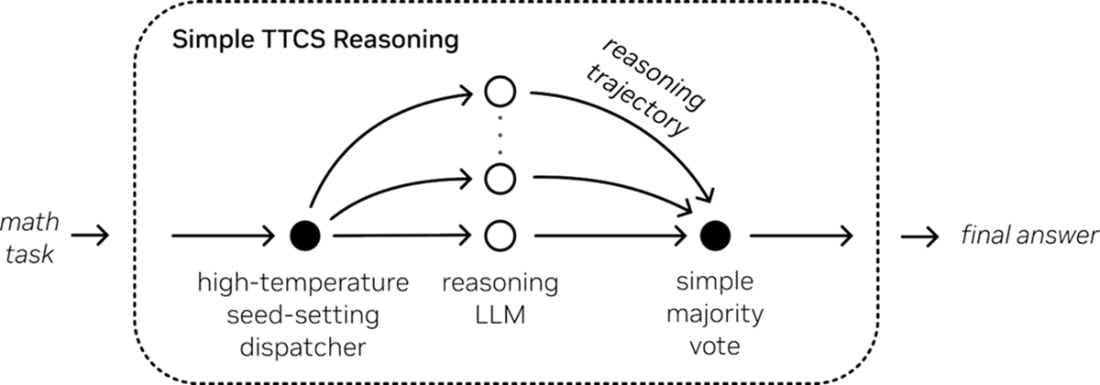
The AFD of the simplest possible TTCS math reasoner. The dispatcher launches multiple parallel instances of the same solver IE with identical inputs but different random seeds. The reconciliation unit extracts the numerical answer from each trajectory and returns the mode (most frequent) value.
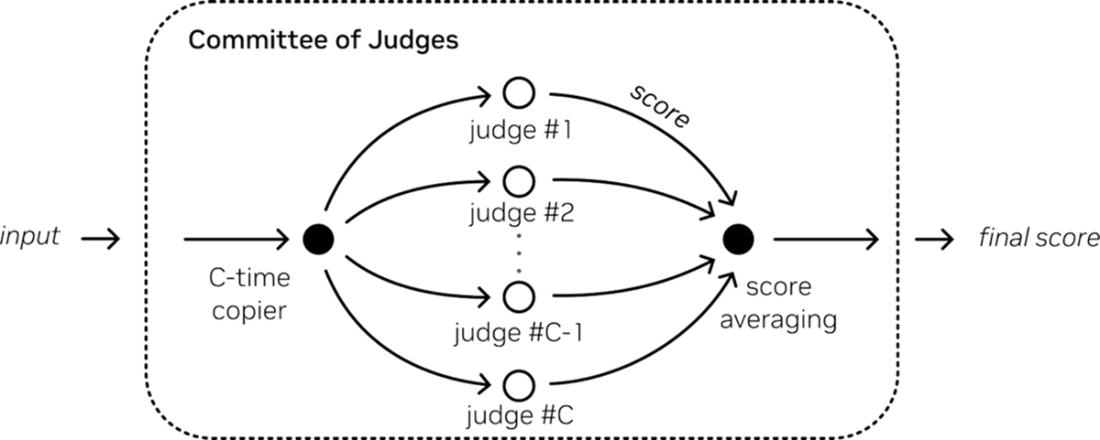
The AFD of a committee of judges. The dispatcher routes the input content to C distinct IEs, each representing a different judge. The reconciliation element aggregates their individual numerical scores into a final average.
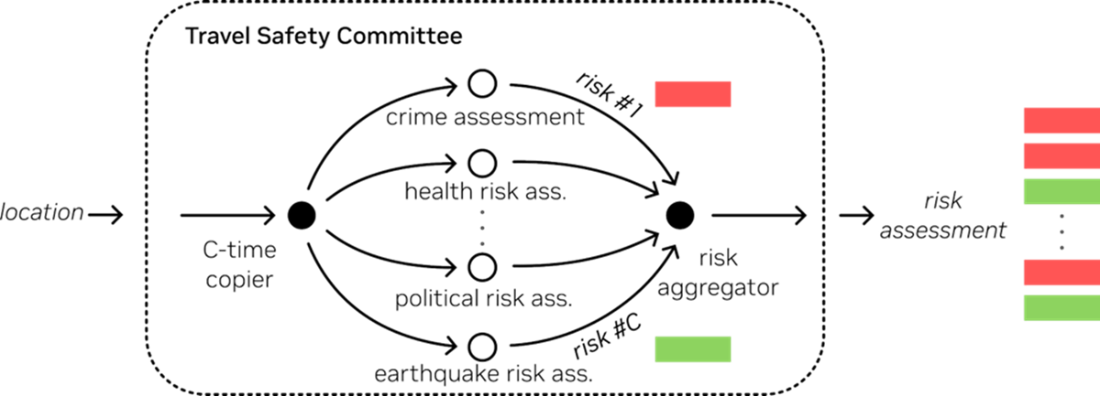
The AFD of the travel safety committee example. Note that the worker IEs are intended to be distinct specialists (Crime IE, Health IE, etc.). The reconciliation element is non-reductive: it aggregates the outputs of all workers into a single list rather than selecting a single majority winner.
Summary
- The natural stochasticity of probabilistic engines can lead to logic flaws and failures, but an ensemble of such trajectories can be leveraged as a benefit within agentic workflows.
- The Voter pattern is a sampling mechanism consisting of a dispatch element, a worker IE, and a reconciliation procedure that invokes a process multiple times in parallel and aggregates the diverse outputs.
- The Voter pattern can be used to reconcile different answers into a single robust prediction, explore the space of possible outcomes, or quantify an agent’s internal confidence through distribution entropy.
- Voters depend on the independence of IE invocations and typically utilize an unintelligent reconciliation mechanism, making them effective at dampening noise at the cost of increased inference compute.
- Two practical variants, Committee and Divergent Committee, utilize distinct models, personas, or objectives to reduce bias and map out complex outcome spaces.
- Practical applications of Voter include test-time compute scaling for math reasoning, committees of judges for text evaluation, and aggregative travel safety assessments, showing how Voter can be an essential design pattern for turning stochastic variability into a source of robustness and interpretability.

 Agent Design Patterns ebook for free
