4 Guardrail: A gating mechanism to boost reliability
This chapter explains guardrails as gating mechanisms that sit at the boundaries of agentic systems and decide whether information is allowed to pass or must be blocked. Because AI models can be pushed into unsafe, ungrounded, insecure, or inappropriate behavior, guardrails provide a practical layer of defense that helps keep outputs aligned with safety, compliance, and trustworthiness goals. They are especially useful because they can be specialized, inexpensive, and updated independently of the main model, making them a modular way to reduce risk across user-facing outputs, internal agent steps, and external tool interactions.
At a high level, a guardrail works by first evaluating content with a dedicated assessment component and then applying a binary decision: forward the information if it passes, or replace it with a generic refusal if it fails. The chapter distinguishes between internal, external, and response guardrails, and emphasizes that different implementations trade off safety, latency, and cost. Sequential guardrails inspect content after it has been produced, parallel guardrails evaluate input while output is still being generated, buffered guardrails wait for complete content, stream guardrails inspect partial content as it arrives, and resampling guardrails try again rather than simply rejecting the result.
The chapter also shows how guardrails are used in practice, such as blocking unsafe image generation requests, preventing harmful intermediate reasoning from continuing in sensitive business workflows, and stopping confidential search queries from reaching external tools. Across these examples, guardrails are framed as a last line of defense rather than a substitute for careful system design: reliability, quality, safety, and security should be considered throughout the whole agent architecture. Their main value is that they protect both users and organizations by limiting reputational, legal, and operational harm when agent behavior goes wrong.
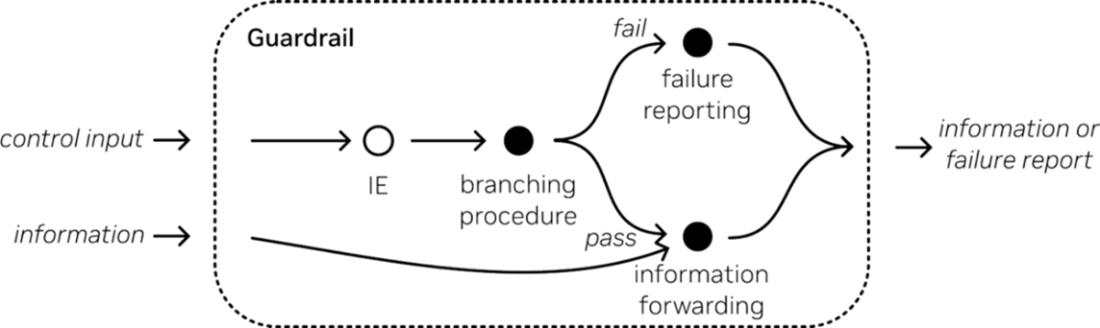
A generic instance of the Guardrail pattern. The IE performs the guardrailing assessment on the control input, and the result is then processed. If the control input passes, the guardrailed information is forwarded as the guardrail's output. If it fails, a generic placeholder or an apology message is produced as the output.
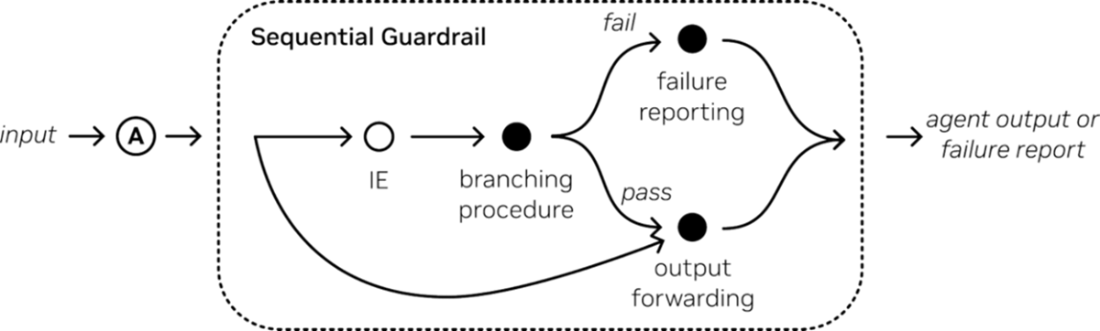
A generic sequential guardrail. Information flows from left to right: the IE performs the guardrailing assessment, followed by processing and branching. The sequential guardrail gates the agent’s output based only on the nature of that output.
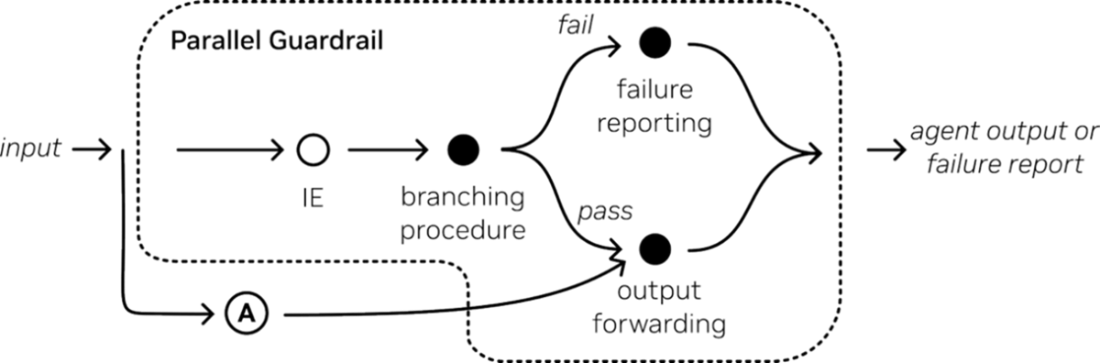
A generic parallel guardrail. Information flows from left to right: the IE performs the guardrailing assessment, followed by processing and branching. In this sketch, the parallel guardrail gates the output based on the input the guardrailed agent used to produce it.
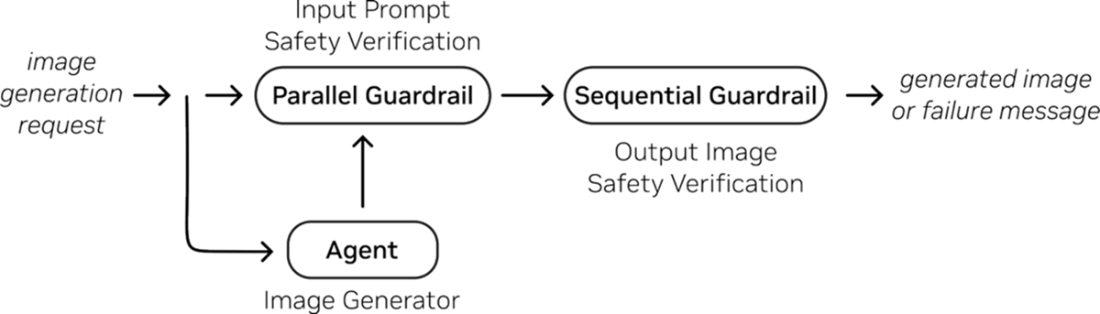
AFD for the image generator agent example. A parallel guardrail assesses the agent’s input, and a sequential guardrail assesses the generated output, if any.
AFD of the restructuring agent example. A sequential guardrail appended after the restructuring ideation subagent ensures that no plan is formulated if the ideation result does not comply with accounting principles. The subagent that formulates the restructuring plan can still provide a short, informative report if the guardrail's assessment returns a failure verdict.

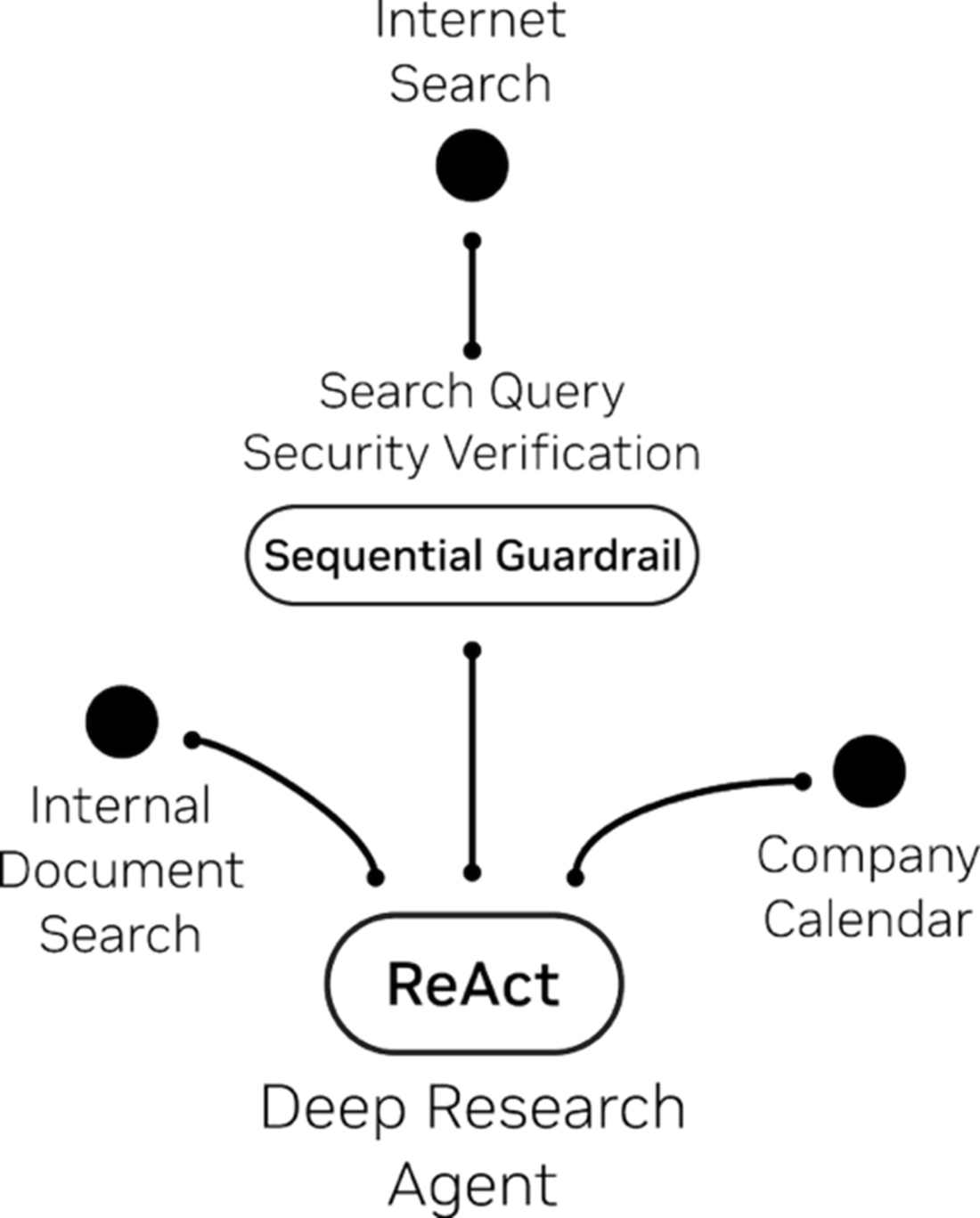
AFD of a deep research agent guardrail. The deep research agent’s ReAct core has three tools at its disposal. Two are purely internal and do not require guardrailing. But the third, the internet search, sends query information out of the agent and must be guardrailed to prevent information leaks.
Summary
- Although model post-training helps align general-purpose AI systems with human preferences, it cannot reliably prevent all unsafe or undesirable behaviors. This is where guardrails help.
- Guardrails act as gates at the boundaries of agents and their components, forwarding or blocking information based on a dedicated IE's assessment.
- Guardrails come in several forms (internal, external, and response-facing), each designed to intercept undesirable, unsafe, or ungrounded information before it crosses a system boundary.
- Guardrails can be organized sequentially or in parallel, depending on whether they evaluate the output itself or the input that leads to it. Buffered and streaming variants balance latency and cost.
- Practical implementations range from security guardrails for language output to compliance guardrails in internal agent workflows and tool-level guardrails that prevent unsafe external actions.
- Although guardrails should be thought of only as the final line of defense, their modularity, simplicity, and transparency make them essential for protecting the reliability, security, and reputation of agentic systems.

 Agent Design Patterns ebook for free
