Apache ActiveMQ is introduced as an open source, JMS 1.1-compliant message-oriented middleware designed to help applications communicate asynchronously and with loose coupling. The chapter explains that messaging is valuable both for notification and for integration, and positions ActiveMQ as a flexible broker that can mediate events and messages across distributed systems while supporting high availability, performance, scalability, reliability, and security.
The text highlights the main strengths that make ActiveMQ broadly useful: standards compliance, broad protocol connectivity, pluggable persistence and security, Java and non-Java client APIs, broker clustering, advanced broker and client features, and simplified administration. It also emphasizes why messaging matters in real systems, especially where synchronous RPC creates tight coupling, maintenance challenges, and scaling limits, while asynchronous messaging enables systems to be more resilient, adaptable, and easier to evolve.
The chapter then moves into practical setup, describing how to install the required Java environment, download ActiveMQ, examine its directory layout, and start the broker. It closes by walking through simple producer and consumer examples that confirm the broker can send and receive messages, giving readers a hands-on first success with ActiveMQ and preparing them for deeper exploration of messaging patterns and configuration in later chapters.
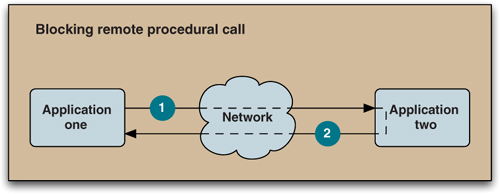
Two tightly coupled applications using remote procedure calls to communicate
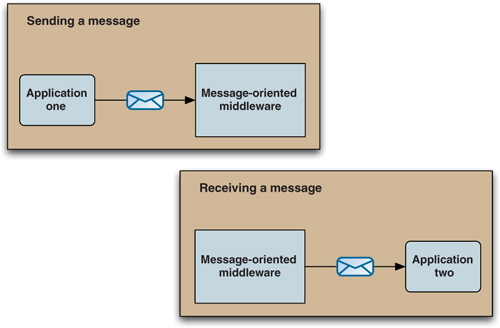
Two loosely coupled applications using JMS messaging to communicate
FAQ
What is Apache ActiveMQ?Apache ActiveMQ is an open source, JMS 1.1–compliant message-oriented middleware (MOM) from the Apache Software Foundation. It helps applications communicate asynchronously and in a loosely coupled way, while providing availability, performance, scalability, reliability, and security.Why would a business use ActiveMQ instead of a commercial messaging product?ActiveMQ is licensed under the Apache License, which is business-friendly and allows anyone to use or modify it without restrictions on redistributing changes. It offers a strong open source alternative to commercial MOMs, which can be costly to buy and support.What are the main benefits of using ActiveMQ in distributed applications?ActiveMQ supports loose coupling and asynchronous communication, which reduces dependencies between systems, improves maintainability, and allows applications to continue operating even when other parts of the system change or move.What does JMS compliance mean in ActiveMQ?JMS compliance means ActiveMQ implements the JMS 1.1 specification. This gives applications standard messaging features such as synchronous or asynchronous delivery, durable subscriptions, and once-and-only-once message delivery guarantees.What kinds of protocols and client languages does ActiveMQ support?ActiveMQ supports many protocols, including HTTP/S, SSL, STOMP, TCP, UDP, XMPP, and multicast. It also provides client APIs for multiple languages such as Java, C/C++, .NET, Perl, PHP, Python, and Ruby.When should ActiveMQ be used?ActiveMQ is a good fit when you need heterogeneous application integration, want to replace RPC-style synchronous communication, need to loosen coupling between systems, or want to build event-driven and scalable architectures.How does ActiveMQ help with scalability?ActiveMQ helps scalability by enabling asynchronous processing and event-driven architectures, where multiple consumers can process messages concurrently. It also supports broker clustering through a network of brokers, which can increase system capacity and flexibility.What do you need before installing ActiveMQ?You need Java SE installed first; the chapter notes that Java 1.5 or later is required, with 1.6 preferred. Ant is also needed to build and run the example programs that come with ActiveMQ.What is the basic directory structure of an ActiveMQ installation?The ActiveMQ distribution includes directories such as bin for startup scripts, conf for configuration, data for logs and persistence files, example for sample applications, lib for libraries, and webapps for the web console and demos.How can you verify that ActiveMQ is installed and working?You can start the broker and run the sample JMS consumer and producer from the example directory. If the consumer receives messages from the producer through the broker, that confirms ActiveMQ is running correctly and can mediate messages.
pro $24.99 per month
access to all Manning books, MEAPs, liveVideos, liveProjects, and audiobooks!

 ActiveMQ in Action ebook for free
