Overview
7 Evolving RAGOps Stack: Technologies that make RAG possible
This chapter presents a practical, layered view of how to design, build, and operate production-grade Retrieval Augmented Generation systems. It revisits the indexing and generation pipelines and organizes the broader RAGOps stack into coherent layers backed by an evolving ecosystem of tools and managed services. The goal is to help practitioners understand what’s essential for a working system, what lifts reliability and performance, and what can further enhance efficiency and usability, while also surveying technology choices and highlighting common pitfalls seen in real deployments.
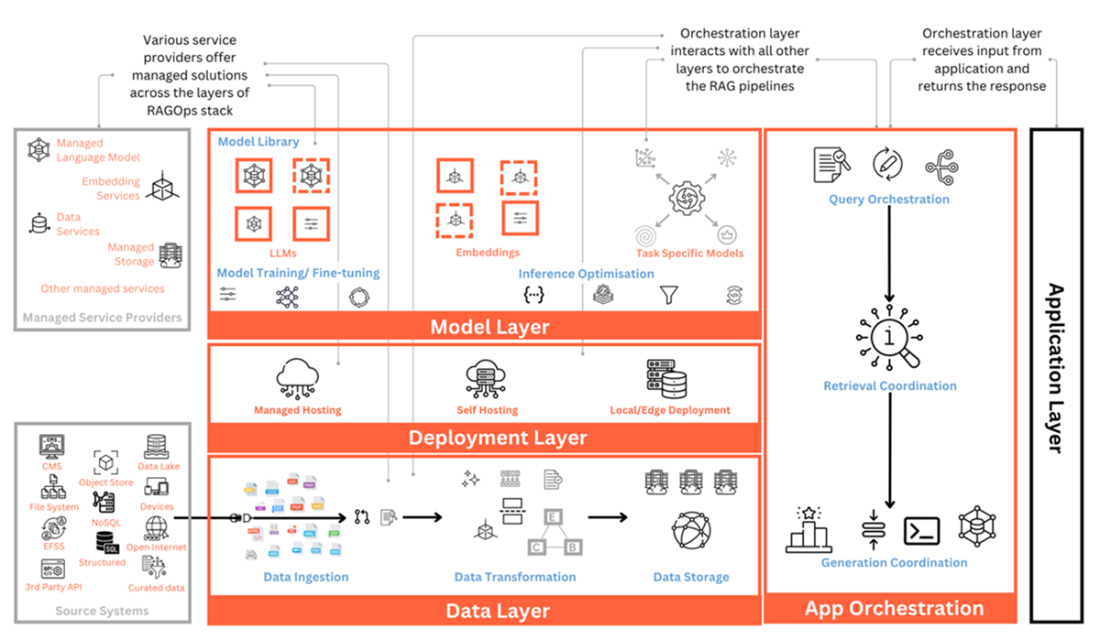
At the core, the critical layers comprise the data layer (ingestion, transformation—such as chunking and metadata enrichment—and storage in vector or graph databases), the model layer (embeddings, LLMs, and task-specific models plus training/fine-tuning and inference optimization), the model deployment layer (managed, self-hosted, or edge/local serving), and the application orchestration layer (coordinating query handling, retrieval strategies, and generation workflows). Essential layers harden the system: prompt design/management, evaluation, monitoring, security and privacy (guardrails, access controls, and protections against prompt injection and data leakage), and caching to contain latency and cost. Enhancement layers—human-in-the-loop oversight, cost optimization, explainability/interpretability, and collaboration/experimentation—are optional accelerators chosen per domain and scale, with both modular tools and managed end-to-end offerings available.
For production, the chapter stresses best practices: control latency through smart routing, hybrid retrieval filtering, inference optimization, and caching; mitigate hallucinations with validation and human review; plan for scale using autoscaling retrieval stores and cloud-native elasticity; tailor to domains by fine-tuning retrieval and generation together; and protect privacy/PII with masking, redaction, encryption, and auditing. Tool selection should weigh scalability and performance, integration with existing stacks, cost efficiency, vendor lock-in risks, and community support. With these layers, practices, and choices, teams can assemble robust RAG systems that are accurate, performant, secure, and maintainable in real-world settings.
FAQ
What is the RAGOps stack and why does it matter?
The RAGOps stack is a layered blueprint for building, deploying, and operating Retrieval-Augmented Generation systems. It groups components into three categories—critical (must-have for basic operation), essential (for performance, reliability, and safety), and enhancement (optional improvements for scale, cost, and usability)—so teams can design robust, production-grade RAG solutions.Which layers are considered critical in a RAG system?
Four layers are critical:
- Data Layer: ingestion, transformation (e.g., chunking, metadata), and storage (vectors/graphs).
- Model Layer: embeddings, LLMs, and task-specific models; plus training/fine-tuning and inference optimization.
- Model Deployment: serving models via managed, self-hosted, or edge setups.
- Application Orchestration: coordinates query handling, retrieval logic, and generation.
What does the Data Layer include and what tools are commonly used?
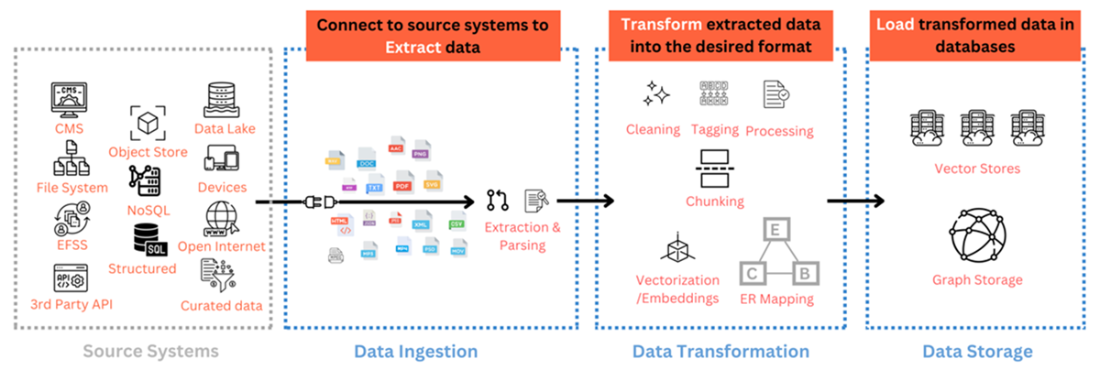
The Data Layer builds the knowledge base:
- Ingestion: batch/stream from DBs, CMS, files, APIs, web (e.g., AWS Glue, Azure Data Factory, Kafka, Airbyte, NiFi).
- Transformation: cleaning, dedup, masking, chunking, embeddings/graph creation (e.g., Spark, dbt, Unstructured.io, GraphRAG).
- Storage: vector and graph stores (e.g., FAISS, Pinecone, Milvus, Qdrant, Chroma, Weaviate; Neo4j for graphs).What models belong to the Model Layer and how are they optimized?
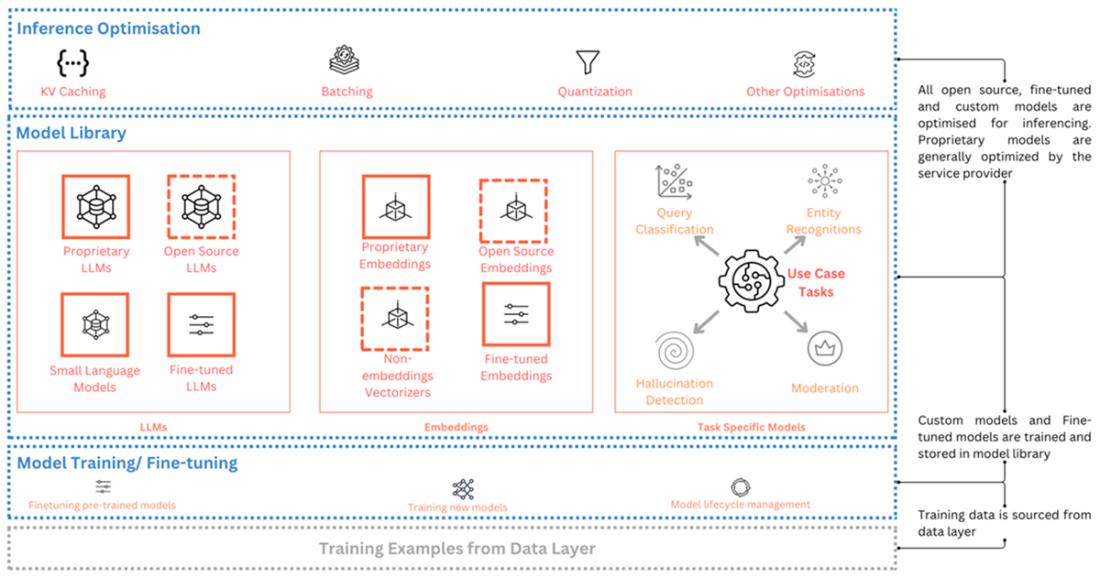
The Model Layer includes:
- Embeddings models for vectorization (OpenAI, Google Gemini, Cohere, open-source via Hugging Face).
- LLMs for generation and evaluation (GPT, Claude, Gemini, Llama, Mistral).
- Task-specific models (query classification, NER, reranking, toxicity/hallucination checks).
- Training/fine-tuning via platforms like SageMaker, Vertex AI, Azure ML, Hugging Face.
- Inference optimization with quantization, batching, KV caching, ONNX, NVIDIA TensorRT-LLM.How can models be deployed for a RAG system?
Three common options:
- Fully managed: fast to start, minimal ops (OpenAI, Anthropic, Cohere; SageMaker, Vertex AI, Azure ML; Amazon Bedrock).
- Self-hosted: more control/compliance; uses VMs/Kubernetes, Docker, NVIDIA Triton.
- Local/edge: privacy/low latency/offline; needs compression (ONNX, TensorFlow Lite, PyTorch Mobile, GGML, TensorRT; GPT4All).What does the Application Orchestration Layer do, and what tools help?
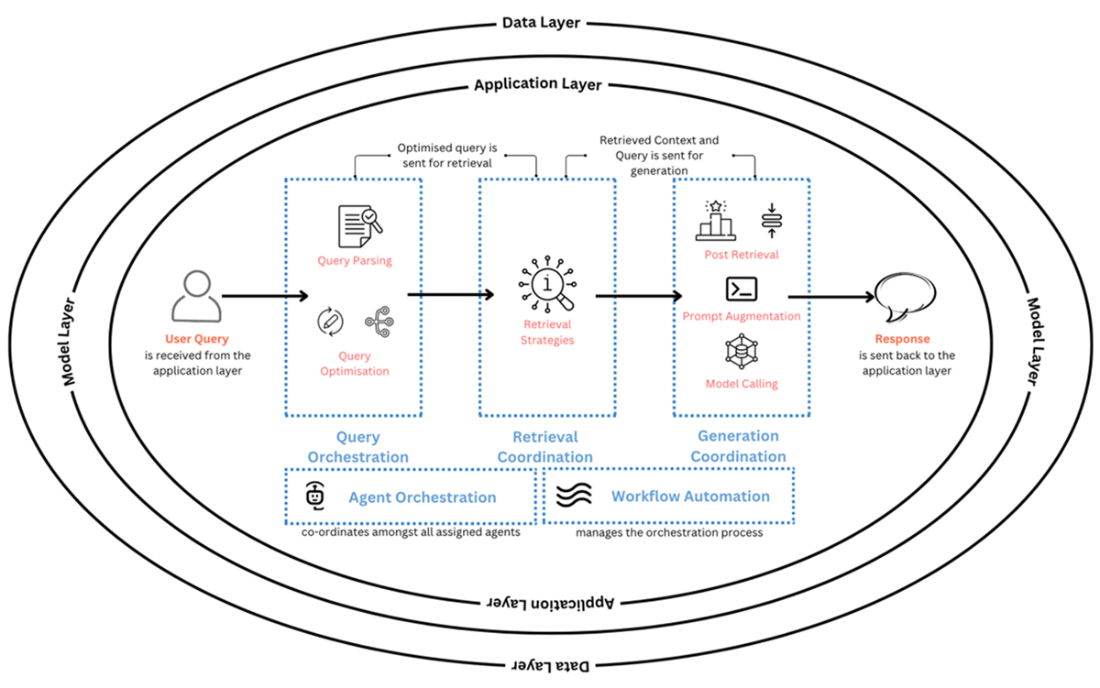
It coordinates end-to-end flow:
- Query orchestration: classification, rewriting/expansion.
- Retrieval coordination: dense/hybrid retrieval, recursive/adaptive strategies.
- Generation coordination: prompting, reranking, contextual compression, post-gen checks.
- Optional: multi-agent orchestration (AutoGen, CrewAI) and workflow automation (Airflow, Dagster).
- Popular frameworks: LangChain, LlamaIndex.Which essential layers improve performance, reliability, and safety?
Key essential layers:
- Prompt Layer: prompt engineering/versioning (Azure Prompt Flow, LangChain/LCEL, W&B Prompts, PromptLayer).
- Evaluation: retrieval accuracy, faithfulness, answer relevance (TruLens, RAGAS, Weights & Biases).
- Monitoring: traces, latency, errors, resource usage (TraceLoop, TruLens, Galileo; Prometheus/Grafana).
- LLM Security & Privacy: guardrails, validation, encryption, PII masking, access controls.
- Caching: response/context caching (e.g., Redis/ElastiCache) to cut cost and latency.What enhancement layers can be added and when should they be used?
Optional layers include:
- Human-in-the-loop: oversight for high-stakes domains and to reduce hallucinations/bias.
- Cost Optimization: infra/model usage tuning, autoscaling, and caching strategies.
- Explainability/Interpretability: transparency for regulated domains (e.g., legal, healthcare).
- Collaboration & Experimentation: experiment tracking and team workflows (Weights & Biases).
Choose based on domain risk, scale, and governance needs.Are there managed end-to-end RAG solutions?
Yes. Examples:
- OpenAI File Search for automatic parsing/chunking, embeddings, and hybrid retrieval.
- Amazon Bedrock Knowledge Bases for managed RAG workflows.
- Azure AI indexing/querying similar to file search.
- Anthropic Claude Projects for document-grounded chats.
These accelerate delivery when time, budget, or expertise is limited.What are common production pitfalls and how do I address them?
Typical issues and remedies:
- Latency: use query routing, hybrid filtering, limit similarity scope, and inference optimizations.
- Hallucinations: strengthen retrieval, add post-gen validation, use recommendation-style outputs with human review.
- Scalability: pick vector DBs with autoscaling; plan for autoscaling services/functions.
- Domain adaptation: fine-tune embeddings and LLMs together for niche domains.
- Privacy/PII: mask/redact in pre/post-processing; encryption, access controls; ensure regulatory compliance.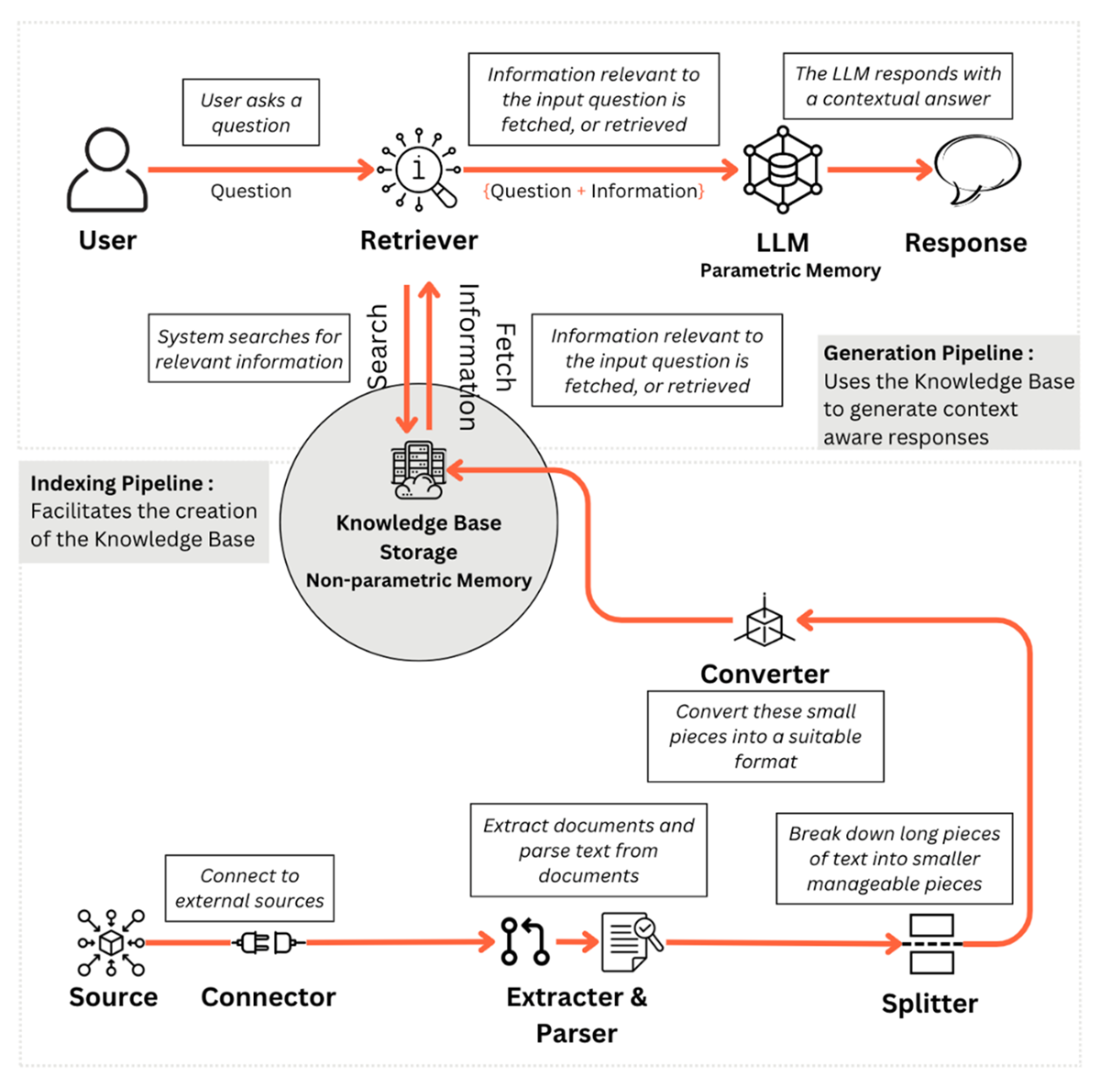



 A Simple Guide to Retrieval Augmented Generation ebook for free
