Socratic Four-Project Series
- prerequisites
- intermediate Python • basic command line • basic Jupyter • basic understanding of APIs, embeddings, and prompting
- skills learned
- building a production-style RAG system end to end • Qdrant vector database • semantic and hybrid retrieval • retrieval and answer evaluation • prompt engineering for grounded Q&A • agentic orchestration with LangGraph • FastAPI deployment
pro $24.99 per month
- access to all Manning books, MEAPs, liveVideos, liveProjects, and audiobooks!
- choose one free eBook per month to keep
- exclusive 50% discount on all purchases
- renews monthly, pause or cancel renewal anytime
lite $19.99 per month
- access to all Manning books, including MEAPs!
team
5, 10 or 20 seats+ for your team - learn more
Socratic liveProjects pair you with an AI tutor to help you learn by doing, in real time.
Step into the role of a developer at a compliance and policy consultancy, where analysts are drowning in dense regulatory documents like the EU AI Act. Keyword search misses the mark, plain LLM chat hallucinates, and your team needs answers grounded in source text with traceable citations. In this series of liveProjects, you’ll build a production-style Retrieval-Augmented Generation (RAG) system from the ground up. You’ll set up a Qdrant vector database with semantically chunked passages, layer in BM25 and hybrid ranking with measurable retrieval metrics, design Pydantic AI prompts that deliver cited answers via OpenRouter’s free Mistral Small 3.1, and orchestrate the whole pipeline as an agentic workflow in LangGraph that decides when to retrieve, self-evaluates, refines its responses, and ships through FastAPI. By the end, you’ll have a modular, agentic RAG system you can adapt to any large document corpus, and the practical skills to tackle real-world knowledge retrieval challenges.
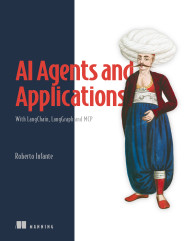
This series accompanies Roberto Infante's AI Agents and Applications .
These projects are designed for learning purposes and are not complete, production-ready applications or solutions.
here's what's included
Project 1 Vector Database and Document Retrieval, Socratic
Socratic liveProjects pair you with an AI tutor to help you learn by doing, in real time.
Step into the role of an AI engineer building a semantic search system for a compliance team drowning in regulatory text. Working with the EU AI Act, a dense, hundred-page policy document, you’ll create a retrieval pipeline that lets analysts ask plain-language questions and instantly surface the most relevant passages by meaning, not just keyword match. You’ll set up a vector database, chunk the text in ways that preserve legal context, generate and store embeddings, and implement metadata-filtered retrieval. Along the way, you’ll validate chunk quality and package your retrieval logic into reusable functions.
learn more
$29.99
$17.99
Project 2 Hybrid Search and Retrieval Evaluation, Socratic
Socratic liveProjects pair you with an AI tutor to help you learn by doing, in real time.
Semantic search understands meaning but fumbles exact terms. Keyword search nails specifics but misses nuance. What if you didn’t have to choose? In this liveProject, you’ll supercharge the retrieval system by fusing both into a smarter hybrid search engine. You’ll implement the battle-tested BM25 algorithm, and fuse their rankings with reciprocal rank fusion (RRF) into a single hybrid ranking. Then you'll prove it works by building a test set and measuring precision, recall, MRR, NDCG, and answer-quality metrics like relevance and groundedness across all three strategies.
learn more
$29.99
$17.99
Project 3 Prompt Engineering for Context-Aware Q&A, Socratic
Socratic liveProjects pair you with an AI tutor to help you learn by doing, in real time.
In this liveProject, you’ll build the generation layer of a document-grounded Q&A system that lets users interrogate the EU AI Act and get back answers with real citations, not hallucinations. Using Pydantic AI with OpenRouter and the free Mistral Small 3.1 model, you’ll craft a system prompt that keeps the LLM strictly on-context, implement smart context injection for top-ranked chunks, and add source attribution so every claim links back to a specific passage.
learn more
$29.99
$17.99
Project 4 Building an Agentic RAG System with LangGraph, Socratic
Socratic liveProjects pair you with an AI tutor to help you learn by doing, in real time.
In this liveProject, you'll step into the shoes of an AI engineer turning a retrieval-and-generation pipeline into an autonomous agent. Building on the retrieval, hybrid search, and grounded-answer components from the earlier projects, you'll design a LangGraph state machine that analyzes each incoming question, routes it, and decides when to retrieve. You'll wrap your hybrid retriever as a tool the agent can call, add a self-evaluation node that scores its own answers, and build an iterative refinement loop with retry and fallback strategies for when the first attempt falls short. Finally, you'll deploy the whole agentic workflow behind a FastAPI endpoint with basic logging and monitoring. By the end, you'll have a modular, agentic RAG system you can adapt to any large document corpus.
learn more
$29.99
$17.99
books resources
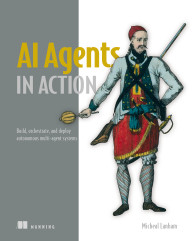
When you start each of the projects in this series, you'll get full access to the following books for 90 days.


choose your plan
pro
monthly
annual
$24.99
$249.99
only $20.83 per month
- access to all Manning books, MEAPs, liveVideos, liveProjects, and audiobooks!
- choose another free product every time you renew
- choose twelve free products per year
- exclusive 50% discount on all purchases
- renews monthly, pause or cancel renewal anytime
- renews annually, pause or cancel renewal anytime
-
![]() Building an Agentic RAG Application project for free
Building an Agentic RAG Application project for free
 Building an Agentic RAG Application project for free
team
monthly
annual
$49.99
$499.99
only $41.67 per month
- five seats for your team
- access to all Manning books, MEAPs, liveVideos, liveProjects, and audiobooks!
- choose another free product every time you renew
- choose twelve free products per year
- exclusive 50% discount on all purchases
- renews monthly, pause or cancel renewal anytime
- renews annually, pause or cancel renewal anytime
-
![]() Building an Agentic RAG Application project for free
Building an Agentic RAG Application project for free

Prerequisites
For Python developers and AI/ML engineers who want to build production-ready, agentic RAG systems. To begin this liveProject you will need to be familiar with:
TOOLS
- Intermediate Python
- Jupyter Notebooks
- Command line
- Basics of machine learning
- Basics of APIs
- Prompting and LLM behavior
 features
- Self-paced
- You choose the schedule and decide how much time to invest as you build your project.
- Project roadmap
- Each project is divided into several achievable steps.
- Get Help
- While within the liveProject platform, get help from fellow participants and even more help with paid sessions with our expert mentors.
- Compare with others
- For each step, compare your deliverable to the solutions by the author and other participants.
- books included as resources
- Get full access to select books for 90 days. Permanent access to excerpts from Manning products are also included, as well as references to other resources.
