From Probability to Causal AI bundle 
Give your next decision a stronger statistical footing. These four ebooks give you a connected path from understanding uncertainty to estimating the effects of taking action. Build your probability skills, learn how evidence should change your beliefs, then tackle the confounding variables that can send an analysis off course. Put those foundations to work with causal models that help you investigate what a proposed change could achieve. With all four books, you can work through the progression and return to the underlying statistics as your projects grow more demanding. Get the complete four-ebook bundle for $99.99.
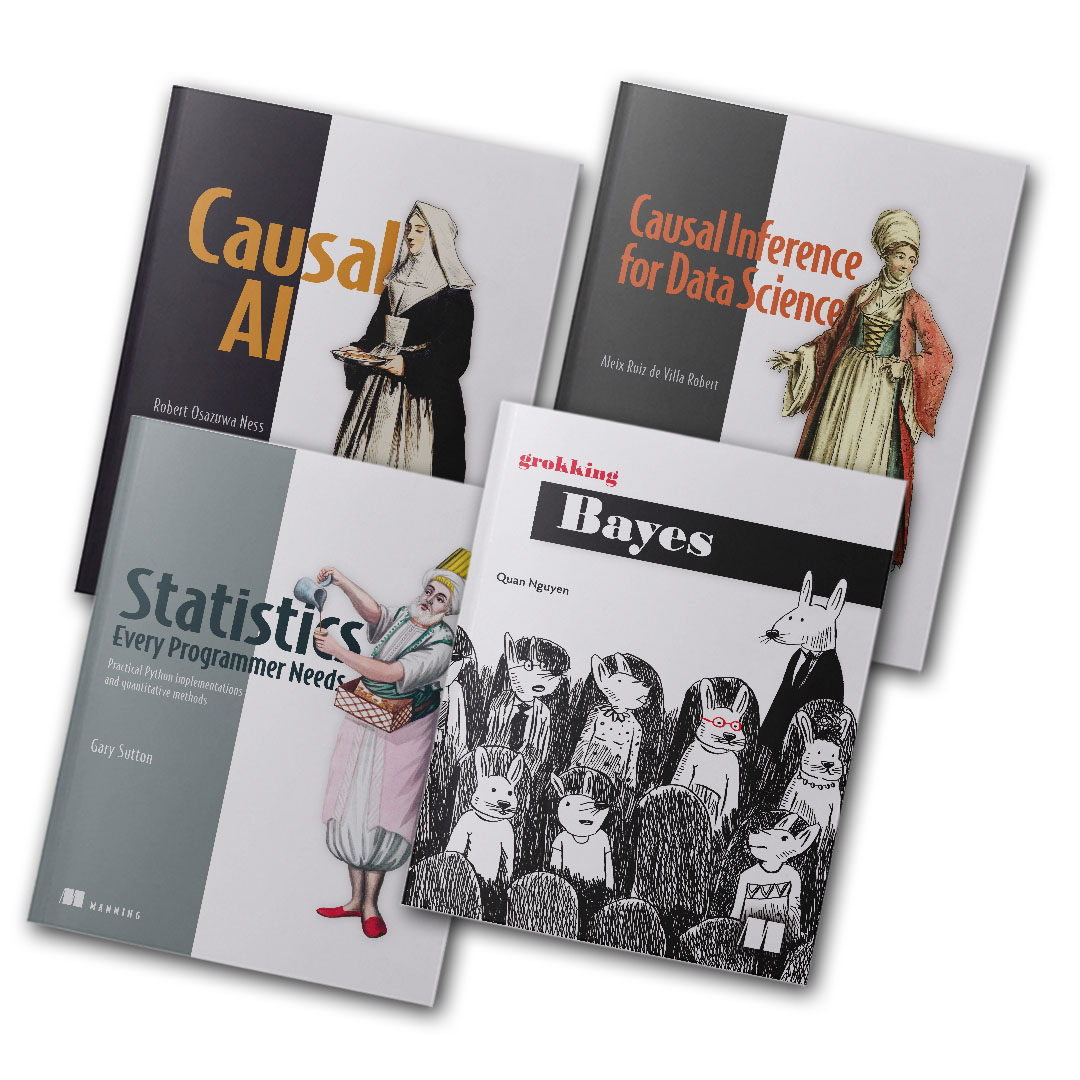

Causal Inference for Data Science
 Causal Inference for Data Science introduces techniques to apply causal reasoning to ordinary business scenarios. And with this clearly-written, practical guide, you won’t need advanced statistics or high-level math to put causal inference into practice! By applying a simple approach based on Directed Acyclic Graphs (DAGs), you’ll learn to assess advertising performance, pick productive health treatments, deliver effective product pricing, and more.

Grokking Bayes 
 Grokking Bayes teaches Bayesianism through clear explanations, rich illustrations, and relatable examples. You’ll first build an intuition, then translate that intuition into working code with Python tools like the PyMC library and ArviZ package. Along the way, you’ll explore how Bayesian ideas connect to modern AI, from uncertainty-aware deep learning to LLM applications.
Throughout, the book focuses on the skills for making better decisions: you’ll go from inference to Bayesian decision theory and even experimental design. Whether you’re a data scientist, AI practitioner, or curious learner, Grokking Bayes will give you the tools to make smarter decisions without needing to rely on long-run frequencies or reams of data, and without drowning you in probability theory and abstract math.
Causal AI
 Causal AI introduces the tools, techniques, and algorithms of causal reasoning for machine learning. This unique book masterfully blends Bayesian and probabilistic approaches to causal inference with practical hands-on examples in Python. Along the way, you’ll learn to integrate causal assumptions into deep learning architectures, including reinforcement learning and large language models. You’ll also use PyTorch, Pyro, and other ML libraries to scale up causal inference.
Statistics Every Programmer Needs
 Statistics Every Programmer Needs teaches you how to apply statistics to the everyday problems you’ll face as a software developer. Each chapter is a new tutorial. You’ll predict ultramarathon times using linear regression, forecast stock prices with time series models, analyze system reliability using Markov chains, and much more. The book emphasizes a balance between theory and hands-on Python implementation, with annotated code and real-world examples to ensure practical understanding and adaptability across industries.
Some bundled books and liveVideos are part of the Manning Early Access Program. You'll get all the available content now, new content as it's created, and the final product when it's ready.
