Better RAG bundle 
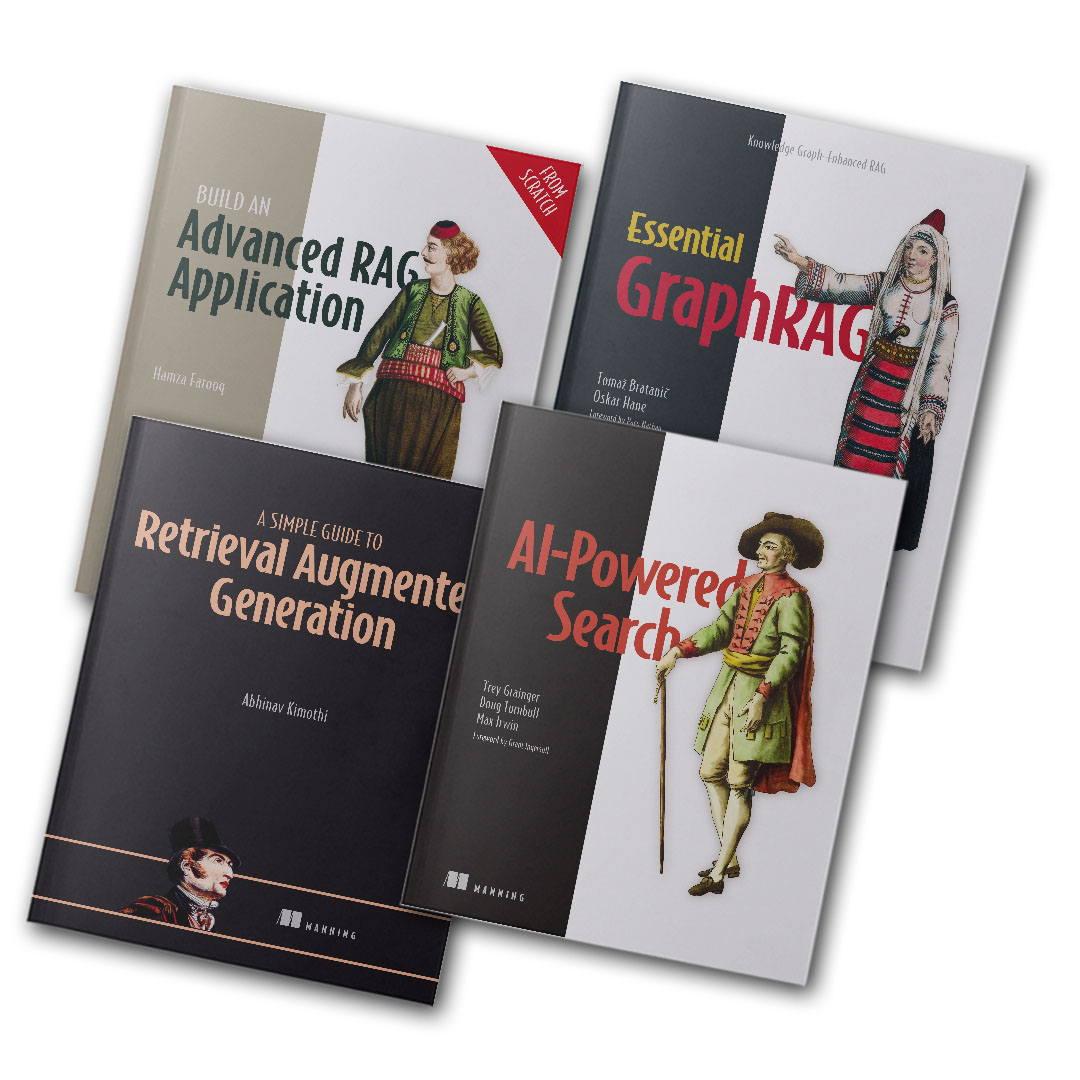
The quality of a RAG system depends on the information it finds—and how it uses that information. This collection of 4 ebooks connects RAG fundamentals with semantic search, advanced retrieval, and enterprise application design. Hands-on examples show you how to retrieve supporting context, rewrite queries, route requests, and reuse results through semantic caching. Reading across the collection gives you several approaches to compare, along with explanations of their tradeoffs in retrieval quality, speed, and cost. Apply those techniques to your own applications and develop the grounding to investigate more advanced RAG methods. Get the entire ebook bundle for $99.99!

AI-Powered Search
 AI-Powered Search teaches you to create a search that understands natural language and improves automatically the more it is used. As you work through dozens of interesting and relevant examples, you’ll learn powerful AI-based techniques like semantic search on embeddings, question answering powered by LLMs, real-time personalization, and Retrieval Augmented Generation (RAG).
Essential GraphRAG
 Essential GraphRAG shows you how to build and deploy a production-quality GraphRAG system. You’ll learn to extract structured knowledge from text and how to combine vector-based and graph-based retrieval methods. The book is rich in practical examples, from building a vector similarity search retrieval tool and an Agentic RAG application, to evaluating performance and accuracy, and more.
A Simple Guide to Retrieval Augmented Generation
 A Simple Guide to Retrieval Augmented Generation is a plain-English guide to RAG. The book is easy to follow and packed with realistic Python code examples. It takes you concept-by-concept from your first steps with RAG to advanced approaches, exploring how tools like LangChain and Python libraries make RAG easy. And to make sure you really understand how RAG works, you’ll build a complete system yourself—even if you’re new to AI!

Build an Advanced RAG Application (From Scratch) 
 Retrieval-augmented generation—RAG—is now the standard way to improve LLM accuracy and relevance. But building production-grade RAG systems requires far more than connecting an LLM to a vector database. In Build an Advanced RAG Application (From Scratch), you’ll learn RAG from first principles by creating a complete portfolio of end-to-end applications. You’ll build each component of the pipeline, ensuring full control over every part of the stack.
Written by former Google research scientist Hamza Farooq, this hands-on guide takes you from LLM and transformer fundamentals through keyword search and semantic retrieval to production RAG systems. You’ll build a hotel search engine with semantic ranking, implement semantic caching for cost-effective production deployments, develop autonomous AI agents powered by RAG context, and deploy optimized open source LLMs. Through under-the-hood experience, you’ll master embeddings, chunking, reranking, vector databases, evaluation frameworks, fine-tuning, and more.
Some bundled books and liveVideos are part of the Manning Early Access Program. You'll get all the available content now, new content as it's created, and the final product when it's ready.
