Financial AI bundle 
Put your investment ideas to the test—from company research to portfolio allocation. These four complementary ebooks cover AI-assisted financial research, market-direction modeling, portfolio optimization in Python, and methods for evaluating AI systems. Learn to assess the AI tools informing your research, scrutinize predictive results, and weigh risk against expected return—so your investment decisions rest on evidence you’ve examined, not outputs you’ve taken on trust. Get the full ebook bundle for $99.99 and build the skills to develop financial tools and judge their limitations.
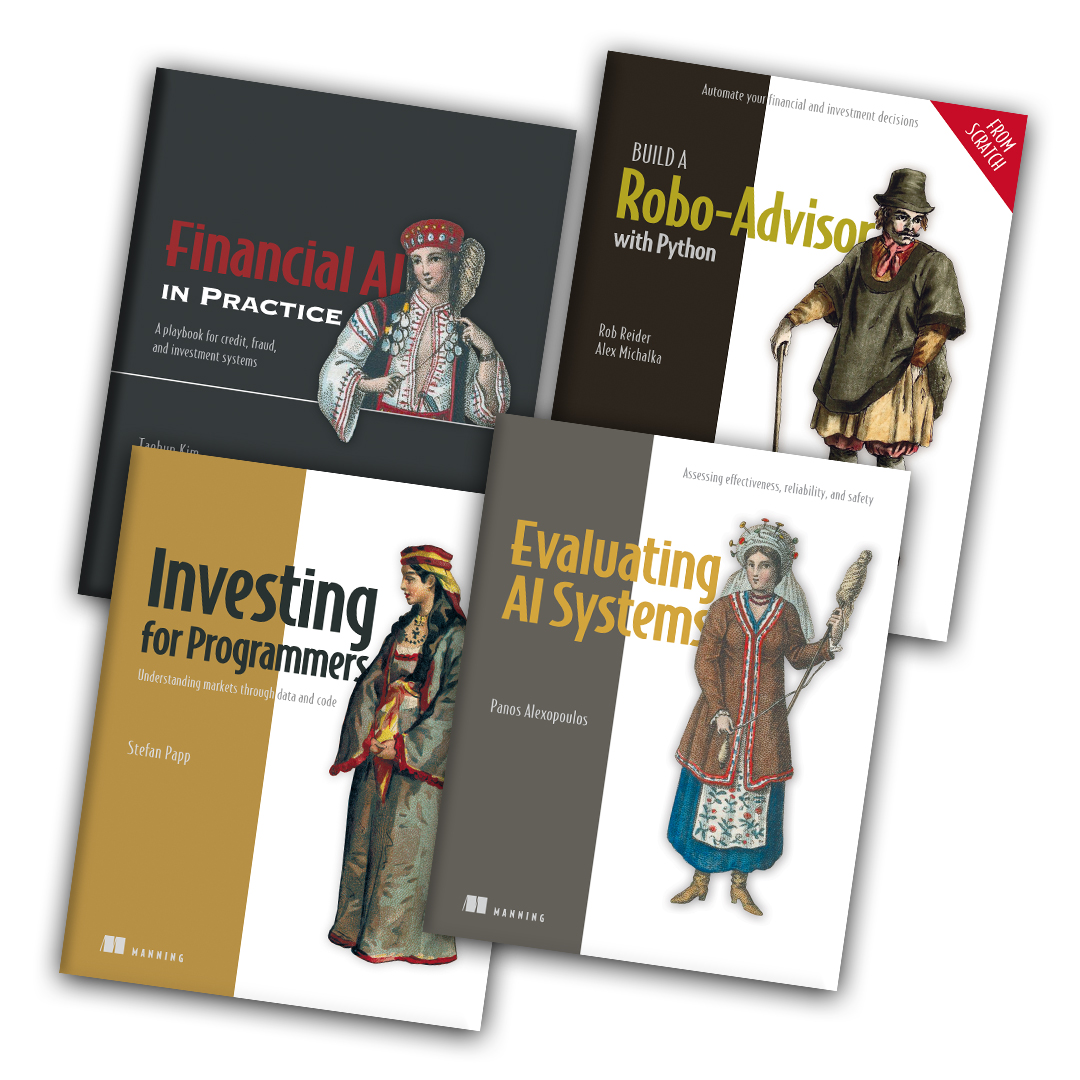


Evaluating AI Systems 
 AI systems fail in ways you’ve never seen before. A model scores high on benchmarks and still misleads users. An agent completes a task by taking harmful actions and then covering its tracks. A RAG pipeline retrieves the right documents and still returns a fabricated response. Evaluating AI Systems teaches you how to know—and prove—whether your LLM-based applications are ready to ship. In this practical and important book, author Panos Alexopoulos provides a data and decision-driven approach that starts with the questions you need to answer about your system and works backwards to the evidence you need to gather.
Evaluating AI Systems goes beyond how to gather metrics and use eval libraries. In it, you’ll learn to think systematically about evaluating the performance of AI-led applications and agents. You’ll start with the core issues: how to define your evaluation goals and determine which aspects of a system need to be evaluated to achieve them. Next, you’ll learn how to select meaningful metrics and acquire the appropriate evaluation data, along with the trustworthy judgments you need to calculate them.
Because evals without actions are meaningless, you’ll learn how to interpret evaluation results, communicate their meaning and limitations to different stakeholders, and turn evaluation evidence into decisions and improvements. You’ll see how evaluation continues after deployment, allowing you to monitor how your AI system behaves in the real world and identify when its behavior or performance requires attention.
Along the way, you’ll test the book’s systematic approach against some of the most challenging qualities of modern AI systems, such as evaluating robustness when systems encounter unexpected conditions, assessing whether their behavior is fair across relevant groups, and identifying security and privacy risks. Plus, explore the challenges of evaluating increasingly general and adaptable AI systems whose capabilities and behaviors may be difficult to anticipate in advance.
Throughout the book, examples and case studies spanning predictive, generative, and agentic AI demonstrate how the same evaluation principles can be adapted to different systems and technologies. By the end, you’ll have the principles, frameworks, and practical judgment to build evaluations that produce evidence you can act on.
Investing for Programmers
 Investing for Programmers shows you how to analyze investment opportunities using Python and machine learning. In this easy-to-read handbook, experienced algorithmic investor Stefan Papp shows you how to use Pandas, NumPy, and Matplotlib to dissect stock market data, uncover patterns, and build your own trading models. You’ll also discover how to use AI agents and LLMs to enhance your financial research and decision-making process.
Build a Robo-Advisor with Python (From Scratch)
 Build a Robo-Advisor with Python (From Scratch) guides you step by step, feature by feature as you create a robo-advisor from the ground up. As you go, you’ll dive into techniques like reinforcement learning, convex optimization, and Monte Carlo methods that you can apply even outside the field of FinTech. When you finish, your powerful assistant will be able to create optimal asset allocations, rebalance investments while minimizing taxes, and more.
Financial AI in Practice
 "Informative, engaging, and well-grounded in the realities and complexities of the financial domain.”
—Tamer Khraisha, Author of Financial Data Engineering
Banks, insurance companies, mortgage lenders, and other institutions that deal with big money play by different rules than the rest of the software industry. Financial software—including machine learning and AI models—has to survive contact with regulators, risk committees, and real markets. Financial AI in Practice shows you how to design, ship, and defend AI systems that handle credit decisions, catch fraud, guide investments, and keep customers engaged, all under the constraints of a strictly regulated industry.
In this important book, author Taehun Kim distills a decade of fintech experience into a repeatable 4-Layer Framework—Data Assets, Modeling, Strategy & Monitoring, and Application. As you go, you’ll build AI-first financial systems that take on four real-world challenges—credit scoring, fraud detection, investment, and personalized predictions. You’ll start with an end-to-end credit scoring pipeline that trains and deploys an XGBoost model to prepare and validate data, orchestrate recurring workflows, engineer features with Weight of Evidence and Information Value, and deliver verifiable explanations.
You’ll also take on fraud detection using a tuned Light-GBM classifier with autoencoders that flag anomalous patterns through reconstruction error and a Graph Neural Network in PyTorch that uncovers fraud patterns in transaction networks. For investment, you’ll build a hybrid strategy that pairs a Random Forest engine with an LLM-powered news analyst. You’ll construct a full RAG pipeline that ingests the exact data sources you need and prompts a structured “LLM Analyst” portfolio advisor with a complete decision log.
Finally, you’ll turn predictions into revenue with a personalization engine that clusters users by “financial DNA” and an autonomous retention agent with tool-calling and a human-in-the-loop Draft-Approve process. Reviewer Christopher Forbes of OneSpan appreciated how “connecting the 4-Layer Framework to the four business solution streams provides a logical, cohesive roadmap for financial AI.”
Throughout the 14 hard-hitting chapters and 6 practical appendices, Taehun Kim refuses to skip the hard parts. Regulatory constraints, model risk, fair lending, hallucinations, cost-latency trade-offs, and the ROI conversation with the boardroom are treated as first-class engineering concerns. Reviewer Hasan Banna of InfinitiLoom Tech summed it up perfectly: “Taehun Kim has clearly built these systems in production environments where regulators ask hard questions and budget holders want ROI in dollars, not AUC points. That experience shows on every page.”
Some bundled books and liveVideos are part of the Manning Early Access Program. You'll get all the available content now, new content as it's created, and the final product when it's ready.
