The Context Engineering Blueprint bundle 
Give your next LLM project a stronger foundation—and a clear standard for success. This thoughtfully curated ebook collection connects prompt patterns and context management with retrieval, knowledge graphs, and systematic evaluation. Learn to guide responses, organize the information behind them, and use test data and custom metrics to assess accuracy and consistency. Reading across the collection helps you consider these choices together, with practical techniques to apply now and fuller explanations to revisit as your projects grow more demanding. Get the entire ebook bundle for $99.99, and build your skills from initial instructions through measurable results.
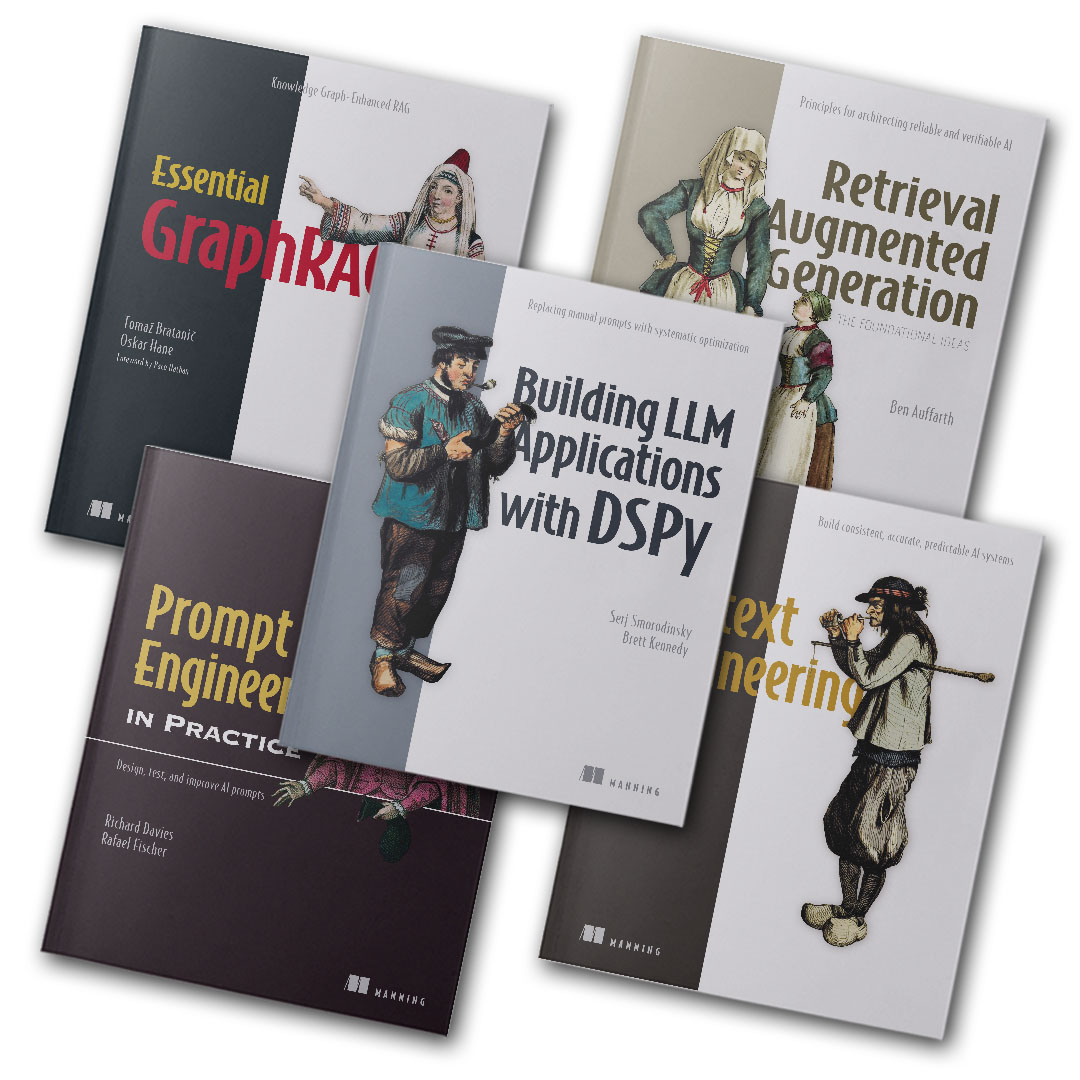


Retrieval Augmented Generation, The Foundational Ideas 
 One of the biggest blockers for AI adoption, and the reason why many AI projects fail to generate promised efficiency gains, is that it's hard to know when AI is right and when it is wrong. Retrieval-augmented generation (RAG) grounds an LLM's answers in your content instead of whatever the model memorized in training, giving you accurate, domain-aware completions. This sophisticated context engineering approach improves the accuracy of responses while giving you tools, including sources, to check easily whether those responses are correct.
RAG emerged in 2020 as a trainable neural architecture that has since developed into a large family of indexing, retrieval, correction, compression, and evaluation techniques, each with its specific use cases, strengths, and weaknesses. Retrieval Augmented Generation: The Foundational Ideas guides you paper-by-paper through the research behind RAG’s family of techniques by exploring the foundational research papers. As you go, you’ll get a systematic view of RAG foundations, what each new innovation fixes, and how to develop your own implementations of these major RAG architectures.
Author Ben Auffarth organizes the book around a taxonomy of seven ways RAG systems fail in production, and then walks through the papers that answer each of those failure modes. You start with the building blocks, including Word2Vec, FAISS, and Sentence-BERT, along with the 2020 originals in REALM and the paper that gave RAG its name. You’ll then follow the line forward as you learn about HyDE and RAG-Fusion, for when retrieval misses the right document, and Self-RAG and CRAG when hallucinations slip past it.
You’ll see how RAPTOR, GraphRAG, and HippoRAG come into play when when the answer isn't in any single chunk or when questions span multiple hops, and LongLLMLingua and AttentionRAG when the prompt blows its budget. Keeping the focus on accurate, reliable responses, you’ll also explore how RAGAS helps you verify whether any of it worked! The closing chapters put the whole progression under measurement and ask which additions earn their cost in production.
In this practical book, you’ll find more than 60 code listings, along with architectural diagrams. Case studies from medicine, e-commerce, fintech, and compliance turn each paper into something you can run. By the end, you’ll know how to build, test, and improve a RAG system, and you'll have a confident intuition for the fundamentals that make a difference in production.
Essential GraphRAG
 Essential GraphRAG shows you how to build and deploy a production-quality GraphRAG system. You’ll learn to extract structured knowledge from text and how to combine vector-based and graph-based retrieval methods. The book is rich in practical examples, from building a vector similarity search retrieval tool and an Agentic RAG application, to evaluating performance and accuracy, and more.
Building LLM Applications with DSPy
 “An essential, forward-looking guide.”
—Dhyey Mavani, Amherst College
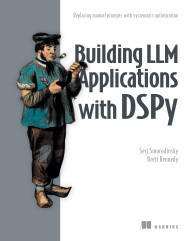
DSPy (Declarative Self-improving Python), an innovative framework for prompt programming, replaces fragile and unpredictable manual prompts with clean, modular Python code that declares what a model should do, defines the inputs and response formats, and establishes clear evaluation metrics. In Building LLM Applications with DSPy, authors Serj Smorodinsky and Brett Kennedy present a systematic approach for treating prompts as programmatic artifacts rather than loose text strings, so you can build, scale, maintain, and improve complex AI applications with the structural integrity of traditional software.
Practical from page one, this book mirrors a professional AI engineering workflow, taking you from simple classifiers to complex summarizers, advanced RAG, and agentic systems. Reviewer Cyrus Nouroozi, a DSPy contributor, notes that the book “frames the whole subject around a single coherent thesis: prompt programming is a data-driven discipline analogous to machine learning.” To support its strong focus on prompt programming as an engineering process, the book introduces the baseline → evaluate → optimize loop that eliminates the guesswork of traditional prompt design.
Production applications require verifiable, consistent metrics, which are difficult to establish with conventional prompts. This book guides you through constructing custom evaluation metrics, setting up multi-threaded test runners, and calibrating LLM-as-a-judge protocols to gather hard data. Instead of deploying prompts on a whim, you compile and optimize them against structured validation sets. The resulting programs are mathematically proven to be more accurate, more cost-effective, and remarkably resilient to underlying model drift.
The final chapters show you how to build DSPy into fully agentic pipelines, integrating conversation memories, and connecting agents to external environments via MCP. This focused 9-chapter book also introduces cutting-edge DSPy v3 features like SIMBA and GEPA optimizers to squeeze maximum performance out of smaller, cheaper open-weight language models. It is an indispensable resource for any modern programmer wanting to build robust, self-improving, and production-ready generative AI systems.
Context Engineering
 The responses from large language models (LLMs) are more accurate, consistent, and explainable when you provide specific relevant information, or context, to support your prompts. Context engineering is the discipline of selecting, organizing, updating, compressing, and prioritizing the precise context a model needs to generate accurate responses. This book shows you how to combine well-designed prompts with smart search, content filtering, and advanced RAG techniques incorporating many types of stored data to create reliable responses in your AI applications.
Because context engineering is typically implemented programmatically, automation is essential as applications evolve from simple prompts to workflows, agents, and agentic systems. Context engineering is particularly critical with the rise of autonomous agents and context windows that can take in a million or more tokens. Irrelevant or poorly selected context raises the chance of hallucinations, brittle agents, and unpredictable outputs. In Context Engineering, author Boni García helps you design an AI’s information environment with the same rigor as your codebase. It unifies every part of the context stack—including RAG, memory, and harness engineering—into one coherent discipline.
The book takes you hands on with the entire context engineering stack. You'll learn how to use tools such as DSPy, LangChain, CrewAI, and LlamaIndex to build context-aware AI applications with frontier models from OpenAI, Anthropic, and Google. Because each chapter builds intuition first and ends with a practical hands-on section grounded in real tools, you’ll come away thinking like a system designer who knows exactly what enters the context window, what stays out, what gets retrieved just in time, and what becomes persistent memory or state.
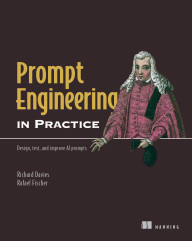
Prompt Engineering in Practice
 "A thoughtful, practical guide to prompt engineering as a real discipline.”
—Che Gamble, Davies Group
Sometimes your LLMs return brilliant responses. Other times, not so much. Do you know why? Prompt Engineering in Practice shows you how to move from accidental AI results to reliable, production-grade systems you can deploy with confidence. Written by AI veterans Richard Davies and Rafael Fischer, this book introduces a unique approach: treat prompts as engineered, self-contained interfaces that you can compose, evaluate, and refine. This shift reframes model interactions as a strict software design discipline rather than a series of fuzzy trial-and-error exercises.
Spanning 11 comprehensive chapters, Prompt Engineering in Practice establishes a logical “design stack” that builds from microscopic syntax to macroscopic system architecture. You’ll start by learning to define the structural elements of a prompt, including delimiters and falsifiable constraints, along with linguistic characteristics like precision, directness, and brevity. These techniques equip you to write well-specified prompts that you can successfully incorporate into reusable production components.
You’ll then explore the foundational patterns that form the core of prompt engineering and enable you to build robust, scalable agentic workflows. Reviewer Dewang Sultania, Senior Machine Learning Engineer at Netflix, noted “The nine-pattern taxonomy provides genuinely useful composable prompt engineering strategies. It’s also a great introduction on how LLM-powered systems actually work!”
Because LLM responses are consistently inconsistent, the book provides a practical framework to diagnose prompt failures systematically by treating prompts as specifications and investigating sources of variance. Throughout the book, you’ll practice a process to systematically analyze and troubleshoot prompt failures as you navigate four distinct phases of the prompt engineering lifecycle—Design, Test, Iterate, Manage. By the time you reach the deployment and operations chapters that conclude the book, you’ll be treating unexpected outputs as valuable debuggable system signals that help you isolate where a prompt is underspecified.
Ultimately, Prompt Engineering in Practice shows you how to treat prompts as first-class, maintainable software artifacts. You will learn to eliminate “prompt debt” by building version-controlled, audited prompt libraries that can be reviewed in pull requests, secured against injection, and managed using role-based access controls. By bridging the gap between prototype experimentation and production operations, this guide provides the exact tools needed to collaborate with cross-functional teams and maintain consistent, safe AI integrations over time.
Some bundled books and liveVideos are part of the Manning Early Access Program. You'll get all the available content now, new content as it's created, and the final product when it's ready.
