LLM Fine-Tuning for Engineers bundle 
Which examples belong in your training data, and which settings are worth another run? This collection takes you from preparing data and fine-tuning a specialized model to choosing experiments, assessing responses with LLM judges, and profiling ONNX models. This specially selected five-book bundle lets you dig deeper at each stage, with practical examples to guide your next steps and detailed explanations to revisit when a project gets complicated. Get the complete ebook collection for $99.99!
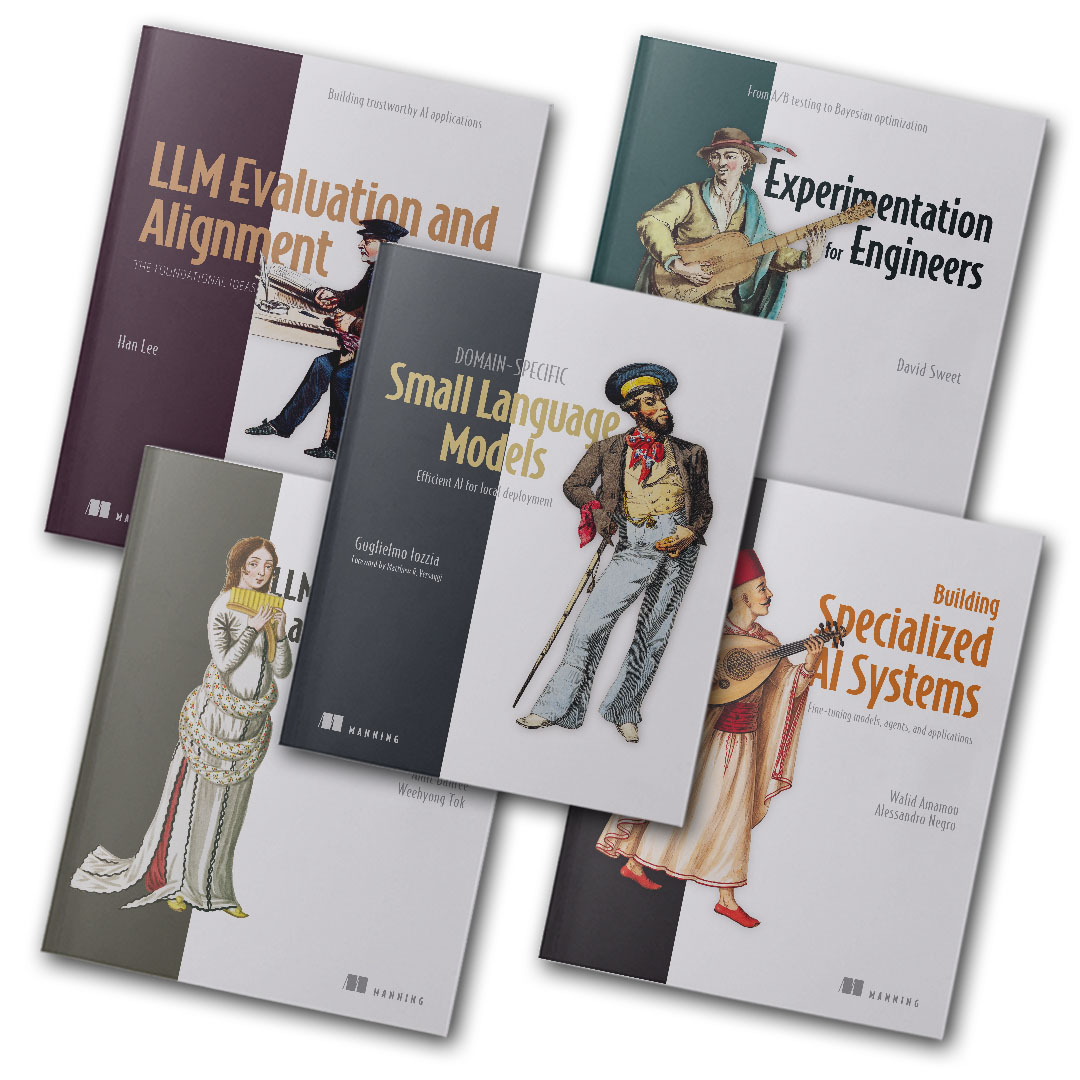


LLM Customization and Fine-Tuning 
 LLM Customization and Fine-Tuning is a hands-on playbook for turning a general-purpose open-weights model into a focused, cost-efficient system that’s tailored to your business. You’ll explore the complete adaptation spectrum, from prompting and RAG, through LoRA and QLoRA, to fully supervised fine-tuning, knowledge distillation, and preference alignment with DPO. One running example, a fictitious enterprise and its IT help desk, carries through every chapter, so you see the same problem solved at each step and can compare the techniques head to head. You’ll soon be swapping generic LLMs for ones that know your business, respect your budget, run on your infrastructure, and stay reliable in production!
Everything you learn is fully reproducible on cost-effective and easy-to-access hardware. You’ll train LoRA and QLoRA adapters on a modest consumer card and perform full fine-tuning on a single 24 GB card such as an A30 or RTX 4090. The published numbers in the book match what you’ll see on your own machine, within run-to-run variance. All with no requirement for a datacenter. The book is also honest about the tradeoffs: it shows you where a technique doesn't win, and it publishes all the code, the trained models, and the training and evaluation logs, including the runs that didn't work, so you can verify every result yourself.
As you go, you’ll build a decision framework that weighs cost, latency, privacy, and ROI to choose the right technique for each problem. You’ll construct a training-data pipeline that curates real data, generates teacher-model outputs, and tracks lineage. You’ll distill a smaller, cheaper student from a stronger teacher, and align a model with DPO while running safety regressions at every step. And because most fine-tuned models fail not at launch but months later, you’ll implement the operational layer that other LLM books skip entirely: a model and data registry, TF-IDF drift detection with canary prompts, rollback procedures, a red-team safety monitor, and an outcome-based retraining cadence.
The methods you learn in this book scale unchanged from Qwen3-4B on your workstation to frontier models on a cluster. You’ll build your own intuition around training AI, own your own pipeline, and make build-versus-buy decisions with real numbers.
Experimentation for Engineers
 Experimentation for Engineers: From A/B testing to Bayesian optimization delivers a toolbox of processes for optimizing software systems. You’ll start by learning the limits of A/B testing, and then graduate to advanced experimentation strategies that take advantage of machine learning and probabilistic methods. The skills you’ll master in this practical guide will help you minimize the costs of experimentation and quickly reveal which approaches and features deliver the best business results.
LLM Evaluation and Alignment, The Foundational Ideas
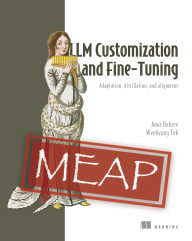
 It’s a fundamental truth that all software—even AI systems—is broken. AI engineers who can diagnose faults and refine systems to align with business needs are in high demand. LLM Evaluation and Alignment, The Foundational Ideas expands the foundational research into judging and adapting AI systems into a collection of practical techniques you can use on the job. As you trace the progression from surface-level text matching to semantic similarity to judgment-based evaluation, you’ll build the mental models necessary to choose the right metrics, detect failure modes, and close the loop from evaluation to alignment.
LLM Evaluation and Alignment, The Foundational Ideas teaches you to think of evaluation as a design constraint. You’ll employ a "working backwards" methodology that begins with what your system must get right, which directs you to the appropriate evaluation approach. As you internalize the define > evaluate > analysis > align cycle, you’ll start making more informed tradeoffs and expertly balancing helpfulness, safety, and brand voice in your models.
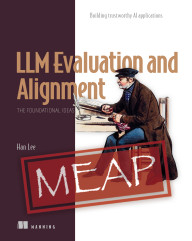
Domain-Specific Small Language Models
 This is a practical book that shows you how to adapt pretrained open source models to your domain using transfer learning and parameter-efficient fine-tuning. You’ll learn to minimize cost through optimization and quantization, develop secure APIs to serve your models, and deploy SLMs on commodity hardware—including small devices. The hands-on examples include integrating SLMs into RAG systems and agentic workflows.
Building Specialized AI Systems
 AI systems using large models like GPT or Gemini can produce impressive results across an astounding range of subjects and domains. In areas like clinical coding, legal contract review, financial due diligence, fraud detection, compliance monitoring, and other specialized business or technical disciplines, however, broad general ability is far less important than efficient output that can be trusted, audited, and controlled. Building Specialized AI Systems: Fine tuning models, agents, and applications teaches you how to adapt pretrained language models to your exact domain, data, and operational constraints.
In this hands-on guide, authors Walid Amamou, CEO of UbiAI.tools and Alessandro Negro, Chief Scientist at GraphAware, walk you through the complete process of building production-grade AI systems around Specialized Language Models. In it, you'll learn how to choose the right pretrained base models, and how to work directly with supervised fine-tuning and modern parameter-efficient techniques including LoRA, QLoRA, DoRA, adapters, and Half Fine-Tuning. You'll also explore reinforcement learning–based approaches such as RLHF and GRPO, along with knowledge distillation for transferring the capabilities of large teacher models into smaller, faster student models.
Building Specialized AI Systems puts working code in front of you and walks through practical implementations step by step. You'll load and quantize models, configure fine-tuning methods, prepare datasets, run reproducible training jobs on accessible hardware, and evaluate whether your specialized model is actually improving on the task that matters.
Complete real-world projects connect these techniques from design to deployment, showing how specialized models can be applied to practical industry problems and giving you reusable patterns for your own AI systems. Along the way, you'll work with the modern fine-tuning ecosystem, including open-source and commercial platforms and tools used to train, evaluate, deploy, and operate specialized language models.
By the end, you'll have a practical framework for deciding when specialization is the right strategy and the technical skills to build, fine-tune, evaluate, and deploy language models tailored to your own domain, tasks, and constraints.
Some bundled books and liveVideos are part of the Manning Early Access Program. You'll get all the available content now, new content as it's created, and the final product when it's ready.
