Local AI and Small Language Models bundle 
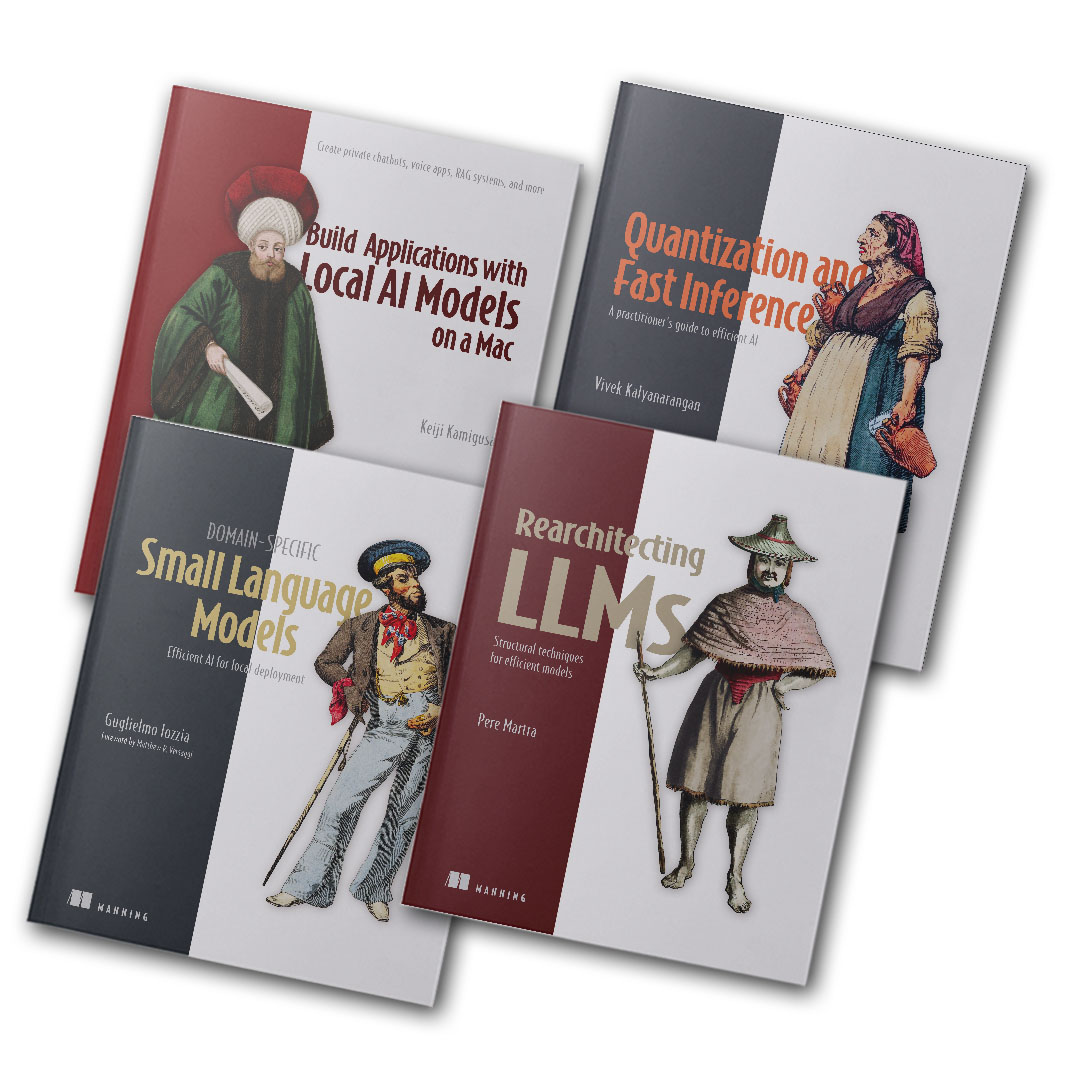
Put small language models to practical use with this collection that connects model selection, specialization, and local AI development. These four Manning books guide you through task-specific fine-tuning, efficient CPU inference with GGUF, and application development with Ollama and Python. Learn to shape model outputs, weigh performance and resource tradeoffs, and build local chatbots with streaming responses and conversation history. The full collection gives you guidance for each stage and a reference to return to as your projects grow. Get the complete eBook bundle for $99.99.


Rearchitecting LLMs 
 By default, general purpose LLMs are not optimized for specific domains and business goals. Using techniques like specialized fine-tuning, pruning unnecessary neural components, and knowledge distillation, you can rearchitect your models to cost less, run faster, and deliver more accurate results.
Rearchitecting LLMs: Structural techniques for efficient models turns research from the latest AI papers into production-ready practices for domain-specific model optimization. As you work through this practical book, you’ll perform hands-on surgery on popular open-source models like Llama-3, Gemma, and Qwen to create cost-effective local small language models (SLMs). Along the way, you’ll learn how to combine behavioral analysis with structural modifications, identifying and removing parts that don’t contribute to your model’s goals, and even use “fair pruning” to reduce model bias at the neuron level.
Domain-Specific Small Language Models
 This is a practical book that shows you how to adapt pretrained open source models to your domain using transfer learning and parameter-efficient fine-tuning. You’ll learn to minimize cost through optimization and quantization, develop secure APIs to serve your models, and deploy SLMs on commodity hardware—including small devices. The hands-on examples include integrating SLMs into RAG systems and agentic workflows.
Quantization and Fast Inference
 Today's AI models demand a lot of memory, compute, and server horsepower—which quickly translates into cost. Quantization and Fast Inference shows you how you can optimize AI models without architectural redesigns or task-specific compression. It reveals practical techniques for quantization, systematically reducing numerical precision to achieve faster inference, lower memory usage, and cheaper deployment—all with minimal accuracy loss.
From quantization fundamentals to runtime packaging, the book gives you a complete and comprehensive overview of the full quantization pipeline. It starts by deriving quantization mapping from first principles and then builds your knowledge and skill through techniques for production-tested PTQ and QAT workflows and a fully compressed deployment. You'll learn to apply post-training quantization to production models, run quantization-aware training using fake quantization and straight-through estimators, and handle subtle tradeoffs like activation outliers in LLMs, KV cache pressure, and sub-8-bit formats like NF4 and FP4.
Build Applications with Local AI Models on a Mac
 "A goldmine of technical advice, with actionable project ideas and learning resources.”
—C. Scott Anderson, Garmin International
Running AI applications on local hardware unlocks architecturally guaranteed privacy, eliminates costly subscriptions and API fees, and gives you the power to tune your models to your exact needs. In Build Applications with Local AI Models on a Mac, author Keiji Kamigusa guides you step-by-step as you build a voice-enabled chatbot that will run on any recent Mac—from a basic Mac mini to a top-of-the-line Mac Studio. As you set up your custom hardware and software stack, you’ll experience a powerful paradigm shift that turns you from a passive consumer into an AI architect.
The book draws you in immediately with a hands-on project that connects three local technologies: audio capture, speech transcription, and language model inference. You’ll start by building the foundation of your chatbot, including command-line navigation and directory management, setting up Homebrew as your package manager, and downloading your first local large language model. Then, you’ll quickly review the features that make local AI on the Mac special, such as Apple Silicon’s unified memory architecture. You’ll also meet a Mac-optimized software suite that includes the Apple-optimized MLX Whisper speech recognition model that offers 100% offline privacy and an integrated voice AI pipeline that runs natively on M-series chips.
As you go, you’ll explore universal concepts that apply to all AI applications—such as temperature configuration, context windows, and system prompts—and learn how they map to the specific needs of your local Mac environment. The book then guides you through expanding your assistant with Retrieval-Augmented Generation (RAG) and autonomous agents. You will store documents locally in ChromaDB to ground your AI’s responses and prevent hallucinations. You’ll also learn how to use the Python-based Streamlit framework to customize your chatbot’s behavior without writing complex callbacks or HTML.
In later chapters, you’ll discover how self-hosting models on your Mac provide absolute control over your workflows while keeping your infrastructure completely private. You’ll explore the Unsloth-to-Ollama pipeline to fine-tune frontier models on your custom data and how to manage stateless LLMs by implementing explicit history tracking. Reviewer Arun Sivakumar of Expedia Group noted, “The context window and token consumption are valuable details that many LLM users ignore, and concepts like how to fine tune models are highly relevant for day-to-day usage.”
Spanning 18 chapters, this book provides a complete local AI roadmap. As reviewer C. Scott Anderson of Garmin International points out, this book gives you exactly what you need to see how “the benefits of open-source models can eclipse the economic realities of proprietary models.”
Some bundled books and liveVideos are part of the Manning Early Access Program. You'll get all the available content now, new content as it's created, and the final product when it's ready.
