AI Agents: From Design to Deployment bundle 
AI agents are transforming how intelligent applications are built, moving beyond simple chatbots to autonomous systems that can reason, plan, use tools, collaborate, and accomplish complex tasks. Whether you're just getting started with agentic AI or looking to build production-ready systems, this bundle gives you the practical knowledge to design, develop, and deploy modern AI agents with confidence.
Start by learning the core principles behind effective agent architecture and decision-making. Then dive into hands-on implementation with real-world examples covering LLM-powered agents, MCP, memory, reasoning, planning, multi-agent systems, evaluation, and deployment. Finally, explore how agentic workflows are reshaping cybersecurity through AI-powered reconnaissance, vulnerability discovery, reporting, and offensive security automation.
.jpg)


AI Agents for Offensive Security 
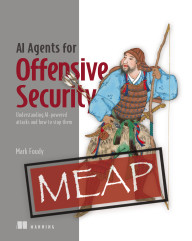 AI is changing how offensive security workflows are designed, executed, and analyzed. AI Agents for Offensive Security: Understanding AI-powered attacks and how to stop them shows you how to build and use AI agents and multi-agent pipelines to support reconnaissance, triage, vulnerability discovery, reporting, agentic penetration testing, and red team/blue team workflows.
In this practical guide for offensive security professionals, you’ll learn how to create intelligent agents that automate parts of security testing while preserving safety, auditability, and human oversight. You’ll build your first security agent, explore how artifacts and pipelines structure agentic workflows, and see how AI can help interpret results, prioritize findings, and reduce manual triage. Along the way, AI security expert Mark Foudy emphasizes governance, authorization controls, resilience, and transparency. You’ll understand where AI adds value, and also where it introduces operational and security risk. The result is a clear framework for integrating AI into day-to-day security work.
AI Agents and Applications
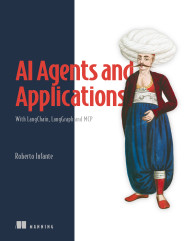 Along the way you’ll build concrete applications—summarization and Q&A engines, context-aware chatbots with memory, and tool-using AI agents that orchestrate multi-step workflows with branching logic. For the examples, the book uses Python, LangChain, LangGraph, and LangSmith, but you’ll be able to generalize to other frameworks. You’ll understand with clarity and confidence how to keep integrations maintainable, manage context limits and cost/latency tradeoffs, and evaluate, debug, and monitor behavior so your systems work in production.
Designing AI Agents
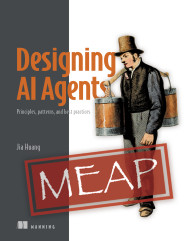 AI agents promise to automate work on an unprecedented scale—even for tasks requiring reasoning and complex multi-step processes. But where do you start? How do you budget your dev time and token spend? What do you do with an agent that “almost works?” How do you scale or improve a multi-agent system? Designing AI Agents answers all these questions and more. In this enlightening book, author Jia Huang, a senior AI researcher at the Singapore-based Agency for Science, Technology and Research (A*STAR), presents an innovative two-axis framework blending seven cognitive functions—perception, memory, reasoning, action, reflection, collaboration, and governance—with six topologies—chain, route, parallel, orchestrate, hierarchy, and loop.
In Designing AI Agents, you’ll learn how to establish agent architectures that manage costs and take governance seriously from day one. This innovative book explores 27 reusable patterns that you can apply to your own agentic systems confidently. Each pattern has been stress-tested at scale, with over 10,000 engineers applying them to ship production agents in banks, manufacturers, and AI startups. You’ll appreciate how this book guides you toward system and harness design that imposes certainty and reliability on the non-deterministic behavior of LLM-driven agents. Once you catch author Jia Huang’s vision, you’ll stop asking “which tools?” and start asking "which patterns?".
Unlike other “agentic patterns” books that dwell on abstract theory, every chapter in this practical guide grows a single running example. You’ll incrementally build Argus, a code-review agent that evolves from a 50-line reasoning-and-action loop all the way to a production-grade system. As you steadily upgrade Argus, you’ll learn both which patterns to use and when and why to apply them. Plus, full case studies exploring agents working as a DevOps incident responder, compliance reviewer, and research synthesis agent show the methodology in action across diverse domains. And, as with all Manning books, you’ll find a clearly defined learning path, thoughtfully edited and readable text, and our promise that everything is accurate and reliable.
AI Agents in Action, Second Edition
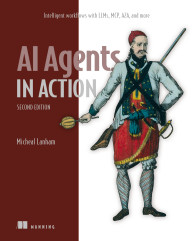 Build AI agents that do more than respond. Give them tools, connect them to knowledge, coordinate their work, and evaluate how well they perform.
AI Agents in Action, Second Edition teaches you how to design, build, evaluate, and deploy AI agents through working Python examples. You’ll progress from a simple agent to tool-using assistants, coordinated multi-agent workflows, and deployable systems. Along the way, you’ll learn how the pieces fit together and where to look when an agent needs improvement.
What’s new and included in the second edition?
- A near-total rewrite with new and extensive coverage of the latest agent innovations
- Agents start to finish—from prompting and planning, to memory and evaluation
- New chapter! Evaluate agents with LLM-as-judge, test-driven-development, and observable behavior
- New chapter! Explore the agentic loop, build task-focused agents, and develop long-horizon, goal focused systems
- New chapter! Metacognition harnesses that structure agent thinking, planning, and learning
- New chapter! Practical tips and techniques for building AI applications, help desks, and deep research agents
- New chapter! Voice-driven AI agents, including real-world deployment patterns for multi-agent systems
- Multi-agent workflows with assembly-flow, orchestration, and collaboration patterns
- Hands-on with the Model Context Protocol (MCP) to connect agents to tools and servers
- Hybrid search for Retrieval Augmented Generation (RAG) and practical ways to use memory in agents
With more than 95% rewritten from the first edition, AI Agents in Action is far more than a refresh! You’ll go right from your agent’s first response, to systems that use tools, work together, draw on knowledge, and incorporate feedback. All illustrated with practical examples throughout.
Some bundled books and liveVideos are part of the Manning Early Access Program. You'll get all the available content now, new content as it's created, and the final product when it's ready.
