

pro $24.99 per month
- access to all Manning books, MEAPs, liveVideos, liveProjects, and audiobooks!
- choose one free eBook per month to keep
- exclusive 50% discount on all purchases
- renews monthly, pause or cancel renewal anytime
lite $19.99 per month
- access to all Manning books, including MEAPs!
team
5, 10 or 20 seats+ for your team - learn more
Look inside
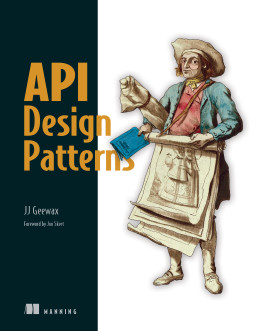
A collection of best practices and design standards for web and internal APIs.
In API Design Patterns you will learn:
API Design Patterns reveals best practices for building stable, user-friendly APIs. These design patterns can be applied to solve common API problems and flexibly altered to fit your specific needs. Hands-on examples and relevant use-cases illustrate patterns for API fundamentals, advanced functionalities, and even uncommon scenarios.
In API Design Patterns you will learn:
- Guiding principles for API patterns
- Fundamentals of resource layout and naming
- Handling data types for any programming language
- Standard methods that ensure predictability
- Field masks for targeted partial updates
- Authentication and validation methods for secure APIs
- Collective operations for moving, managing, and deleting data
- Advanced patterns for special interactions and data transformations
API Design Patterns reveals best practices for building stable, user-friendly APIs. These design patterns can be applied to solve common API problems and flexibly altered to fit your specific needs. Hands-on examples and relevant use-cases illustrate patterns for API fundamentals, advanced functionalities, and even uncommon scenarios.
about the technology
APIs are contracts that define how applications, services, and components communicate. API design patterns provide a shared set of best practices, specifications and standards that ensure APIs are reliable and simple for other developers to use. This book collects and explains the most important patterns from both the API design community and the experts at Google.about the book
API Design Patterns lays out a set of design principles for building internal and public-facing APIs. Google API expert JJ Geewax presents patterns that ensure your APIs are consistent, scalable, and flexible. You’ll improve the design of the most common APIs, plus discover techniques for tricky edge cases. Precise illustrations, relevant examples, and detailed scenarios make every pattern clear and easy to understand.what's inside
- Guiding principles for API patterns
- Fundamentals of resource layout and naming
- Advanced patterns for special interactions and data transformations
- A detailed case-study on building an API and adding features
about the author
JJ Geewax is a software engineer at Google, focusing on Google Cloud Platform, API design, and real-time payment systems. He is also the author of Manning’s Google Cloud Platform in Action.concepts explained in this book
- Filtering is the selection or exclusion of data or items according to specified criteria.
- A unique identifier is a value or name that distinguishes an entity or record from others within a defined scope or namespace.
- An HTTP method is a standardized token in an HTTP request that indicates the operation the client intends to perform on a resource.
- A reference is an indirect value, binding, or relationship that identifies or provides access to another object, value, resource, or source.
- soft delete: Soft deletion is a technique that marks data as deleted while retaining it in storage rather than immediately removing it physically.
- Backward compatibility is the property of a newer or changed system remaining usable by existing clients, code, data, or integrations that depend on earlier interfaces or behavior.
- A move method is an operation that relocates an existing resource or item to a different location or parent while preserving its identity.
- A list method is an API operation that retrieves the resources belonging to a specified collection.
A concept-rich book on API design patterns. Deeply engrossing and fun to read.
Excellent companion for API design!
The right way to build APIs.
If API design or refactoring is in your future, this book is a great investment!
Makes the complex puzzle of designing APIs into a delightful learning experience.
related titles
related titles





choose your plan
pro
monthly
annual
$24.99
$249.99
only $20.83 per month
- access to all Manning books, MEAPs, liveVideos, liveProjects, and audiobooks!
- choose another free product every time you renew
- choose twelve free products per year
- exclusive 50% discount on all purchases
- renews monthly, pause or cancel renewal anytime
- renews annually, pause or cancel renewal anytime
-
![API Design Patterns]() API Design Patterns ebook for free
 API Design Patterns ebook for free
team
monthly
annual
$49.99
$499.99
only $41.67 per month
- five seats for your team
- access to all Manning books, MEAPs, liveVideos, liveProjects, and audiobooks!
- choose another free product every time you renew
- choose twelve free products per year
- exclusive 50% discount on all purchases
- renews monthly, pause or cancel renewal anytime
- renews annually, pause or cancel renewal anytime
-
![API Design Patterns]() API Design Patterns ebook for free
choose your plan
pro
monthly
annual
$24.99
$249.99
only $20.83 per month
- access to all Manning books, MEAPs, liveVideos, liveProjects, and audiobooks!
- choose another free product every time you renew
- choose twelve free products per year
- exclusive 50% discount on all purchases
- renews monthly, pause or cancel renewal anytime
- renews annually, pause or cancel renewal anytime
-
![API Design Patterns]() API Design Patterns ebook for free
team
monthly
annual
$49.99
$499.99
only $41.67 per month
- five seats for your team
- access to all Manning books, MEAPs, liveVideos, liveProjects, and audiobooks!
- choose another free product every time you renew
- choose twelve free products per year
- exclusive 50% discount on all purchases
- renews monthly, pause or cancel renewal anytime
- renews annually, pause or cancel renewal anytime
-
![API Design Patterns]() API Design Patterns ebook for free
