books by Taehun Kim
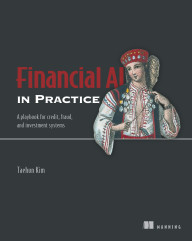
Financial AI in Practice
"Informative, engaging, and well-grounded in the realities and complexities of the financial domain.”
—Tamer Khraisha, Author of Financial Data Engineering
Banks, insurance companies, mortgage lenders, and other institutions that deal with big money play by different rules than the rest of the software industry. Financial software—including machine learning and AI models—has to survive contact with regulators, risk committees, and real markets. Financial AI in Practice shows you how to design, ship, and defend AI systems that handle credit decisions, catch fraud, guide investments, and keep customers engaged, all under the constraints of a strictly regulated industry.
In this important book, author Taehun Kim distills a decade of fintech experience into a repeatable 4-Layer Framework—Data Assets, Modeling, Strategy & Monitoring, and Application. As you go, you’ll build AI-first financial systems that take on four real-world challenges—credit scoring, fraud detection, investment, and personalized predictions. You’ll start with an end-to-end credit scoring pipeline that trains and deploys an XGBoost model to prepare and validate data, orchestrate recurring workflows, engineer features with Weight of Evidence and Information Value, and deliver verifiable explanations.
You’ll also take on fraud detection using a tuned Light-GBM classifier with autoencoders that flag anomalous patterns through reconstruction error and a Graph Neural Network in PyTorch that uncovers fraud patterns in transaction networks. For investment, you’ll build a hybrid strategy that pairs a Random Forest engine with an LLM-powered news analyst. You’ll construct a full RAG pipeline that ingests the exact data sources you need and prompts a structured “LLM Analyst” portfolio advisor with a complete decision log.
Finally, you’ll turn predictions into revenue with a personalization engine that clusters users by “financial DNA” and an autonomous retention agent with tool-calling and a human-in-the-loop Draft-Approve process. Reviewer Christopher Forbes of OneSpan appreciated how “connecting the 4-Layer Framework to the four business solution streams provides a logical, cohesive roadmap for financial AI.”
Throughout the 14 hard-hitting chapters and 6 practical appendices, Taehun Kim refuses to skip the hard parts. Regulatory constraints, model risk, fair lending, hallucinations, cost-latency trade-offs, and the ROI conversation with the boardroom are treated as first-class engineering concerns. Reviewer Hasan Banna of InfinitiLoom Tech summed it up perfectly: “Taehun Kim has clearly built these systems in production environments where regulators ask hard questions and budget holders want ROI in dollars, not AUC points. That experience shows on every page.”