
books by Richard Davies
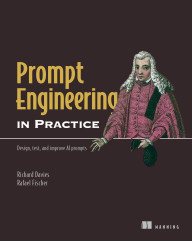
Prompt Engineering in Practice
"A thoughtful, practical guide to prompt engineering as a real discipline.”
—Che Gamble, Davies Group
Sometimes your LLMs return brilliant responses. Other times, not so much. Do you know why? Prompt Engineering in Practice shows you how to move from accidental AI results to reliable, production-grade systems you can deploy with confidence. Written by AI veterans Richard Davies and Rafael Fischer, this book introduces a unique approach: treat prompts as engineered, self-contained interfaces that you can compose, evaluate, and refine. This shift reframes model interactions as a strict software design discipline rather than a series of fuzzy trial-and-error exercises.
Spanning 11 comprehensive chapters, Prompt Engineering in Practice establishes a logical “design stack” that builds from microscopic syntax to macroscopic system architecture. You’ll start by learning to define the structural elements of a prompt, including delimiters and falsifiable constraints, along with linguistic characteristics like precision, directness, and brevity. These techniques equip you to write well-specified prompts that you can successfully incorporate into reusable production components.
You’ll then explore the foundational patterns that form the core of prompt engineering and enable you to build robust, scalable agentic workflows. Reviewer Dewang Sultania, Senior Machine Learning Engineer at Netflix, noted “The nine-pattern taxonomy provides genuinely useful composable prompt engineering strategies. It’s also a great introduction on how LLM-powered systems actually work!”
Because LLM responses are consistently inconsistent, the book provides a practical framework to diagnose prompt failures systematically by treating prompts as specifications and investigating sources of variance. Throughout the book, you’ll practice a process to systematically analyze and troubleshoot prompt failures as you navigate four distinct phases of the prompt engineering lifecycle—Design, Test, Iterate, Manage. By the time you reach the deployment and operations chapters that conclude the book, you’ll be treating unexpected outputs as valuable debuggable system signals that help you isolate where a prompt is underspecified.
Ultimately, Prompt Engineering in Practice shows you how to treat prompts as first-class, maintainable software artifacts. You will learn to eliminate “prompt debt” by building version-controlled, audited prompt libraries that can be reviewed in pull requests, secured against injection, and managed using role-based access controls. By bridging the gap between prototype experimentation and production operations, this guide provides the exact tools needed to collaborate with cross-functional teams and maintain consistent, safe AI integrations over time.
