
books by Ben Auffarth
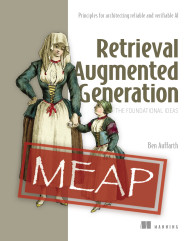
Retrieval Augmented Generation, The Foundational Ideas
One of the biggest blockers for AI adoption, and the reason why many AI projects fail to generate promised efficiency gains, is that it's hard to know when AI is right and when it is wrong. Retrieval-augmented generation (RAG) grounds an LLM's answers in your content instead of whatever the model memorized in training, giving you accurate, domain-aware completions. This sophisticated context engineering approach improves the accuracy of responses while giving you tools, including sources, to check easily whether those responses are correct.
RAG emerged in 2020 as a trainable neural architecture that has since developed into a large family of indexing, retrieval, correction, compression, and evaluation techniques, each with its specific use cases, strengths, and weaknesses. Retrieval Augmented Generation: The Foundational Ideas guides you paper-by-paper through the research behind RAG’s family of techniques by exploring the foundational research papers. As you go, you’ll get a systematic view of RAG foundations, what each new innovation fixes, and how to develop your own implementations of these major RAG architectures.
Author Ben Auffarth organizes the book around a taxonomy of seven ways RAG systems fail in production, and then walks through the papers that answer each of those failure modes. You start with the building blocks, including Word2Vec, FAISS, and Sentence-BERT, along with the 2020 originals in REALM and the paper that gave RAG its name. You’ll then follow the line forward as you learn about HyDE and RAG-Fusion, for when retrieval misses the right document, and Self-RAG and CRAG when hallucinations slip past it.
You’ll see how RAPTOR, GraphRAG, and HippoRAG come into play when when the answer isn't in any single chunk or when questions span multiple hops, and LongLLMLingua and AttentionRAG when the prompt blows its budget. Keeping the focus on accurate, reliable responses, you’ll also explore how RAGAS helps you verify whether any of it worked! The closing chapters put the whole progression under measurement and ask which additions earn their cost in production.
In this practical book, you’ll find more than 60 code listings, along with architectural diagrams. Case studies from medicine, e-commerce, fintech, and compliance turn each paper into something you can run. By the end, you’ll know how to build, test, and improve a RAG system, and you'll have a confident intuition for the fundamentals that make a difference in production.
