Overview

Chapter 9. Cloud 9: the future of the cloud

In this chapter, the authors look ahead to a future in which cloud computing becomes the dominant model for IT, much as electricity became a utility. They argue that the shift is already far along in consumer technology, where browsers, mobile devices, and cloud-backed services are widely used, while enterprises are moving more slowly because of legacy systems, security concerns, and organizational inertia. Over time, they expect cloud computing to reshape both personal and corporate technology in a way that feels revolutionary but will unfold gradually over a generation.

The chapter’s main forecast is that cloud services will become cheaper, more reliable, more secure, and easier to use than traditional data centers, thanks to economies of scale, automation, open source, and stronger standards. It predicts that public cloud providers will operate massive mega-data centers with extreme efficiency, that open-source software will dominate cloud infrastructure, and that major vendors’ APIs will effectively set practical standards before formal ones arrive. Governments are also expected to move aggressively into cloud adoption, helping normalize the model for enterprises, while SaaS continues to grow by building on basic web technologies.

On the application side, the authors foresee development shifting toward browser-centered, cloud-hosted, and highly modular systems. Application frameworks, cloud-based middle tiers, scalable storage, stronger security services, and mashups will make it easier for both professional developers and end users to create software, with PaaS and Framework as a Service becoming increasingly important. In the long run, they envision a world where most organizations rely on utility-like computing resources, where application creation is inexpensive and widely accessible, and where the cloud underpins a broad ecosystem of interconnected services, devices, and users.

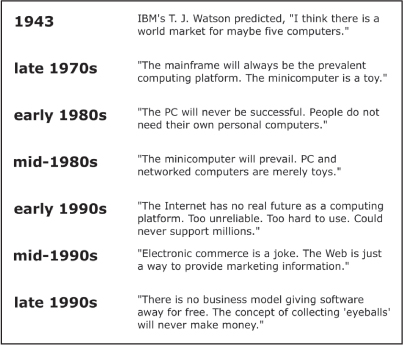
This list of predictions made about computing over the decades is now amusing.
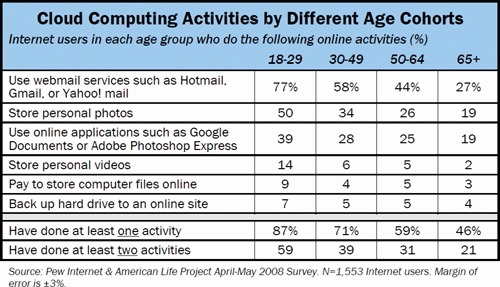
Cloud computing activities by different age cohorts from the Pew Internet & American Life Project of 2008. The survey shows that the younger age groups are using the cloud heavily and will continue to do so. The greatest usage is in the millennial group (87%), which does at least one activity (email, photos, online applications, video, storage, or backups) using the cloud.
Major browsers and their initial release dates: the original Mozilla browser, Netscape’s Navigator, Microsoft’s Internet Explorer, Opera Software ASA’s browser, Apple’s Safari, Mozilla’s Firefox, and Google’s Chrome.

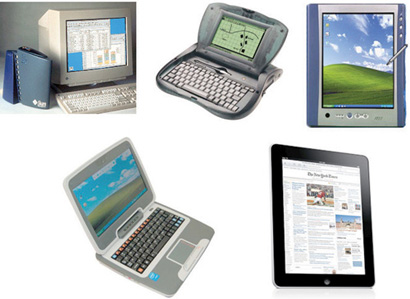
The evolution of network computers, clockwise from upper left: Sun’s Network Computer, Apple’s eMate, Microsoft’s Tablet PC, Apple’s iPad, and the current generation of netbook
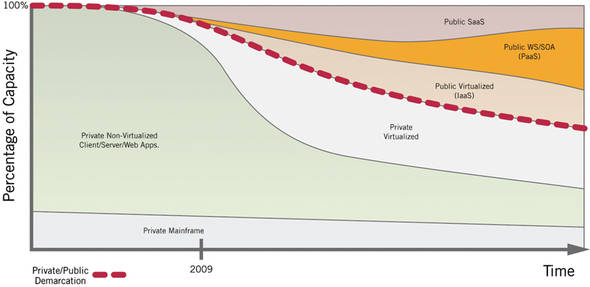
The projected mix of computing done via mainframe, client-server, and various types of clouds in enterprises over the next few years. Source: Compuware.
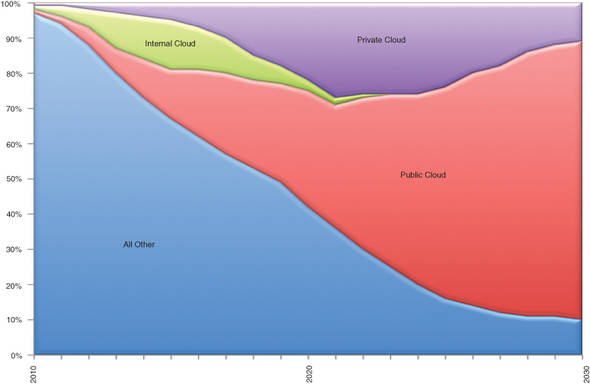
The author’s predictions for the role of clouds vs. non-cloud-based computing over the next 20 years. Today, less than 3% of computing is done via clouds. Twenty years from now, public clouds will be the dominant approach for corporate IT services. Private clouds, which will initially grow to more than 35% of all IT, will shrink back to under 25%; internal clouds will all but disappear; and the remaining percentage of do-it-yourself IT (such as corporations with their own data centers) will be only 10%.
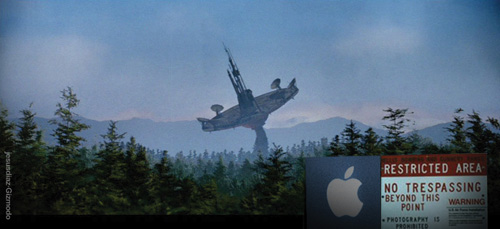
A rare photo of Apple’s new 500,000 sq. ft. North Carolina cloud data center site
A mashup using Google Maps combined with data about collapsed civilizations. Google Maps merge together all kinds of data, creating a simple but useful kind of mashup. Source: University of Florida.

FAQ

What is the chapter’s overall prediction about the future of cloud computing?The chapter predicts that cloud computing will become a pervasive, game-changing reconstruction of IT over the next generation, eventually evolving into utility computing, where computing resources are consumed much like electricity or water.
Why does the chapter say consumer internet use is leading enterprise cloud adoption?Consumer-facing cloud use is already widespread, while enterprise adoption is slower. The chapter argues that consumer habits, especially around web apps and mobile devices, will push businesses to adopt the cloud more broadly over time.
What three trends are driving cloud adoption in the near future?The chapter identifies three drivers: application standardization on the browser platform, miniaturization and standardization of device-based computing, and the mobile revolution.
How will browsers influence the future of cloud computing?Browsers are becoming rich application platforms that can run interactive web apps without needing heavy local software. As browsers evolve, they make thin-client access to cloud applications practical and widely usable.
What role will mobile devices play in the future of the cloud?Tablets and smartphones will increasingly replace the PC as the main personal computing device. These lightweight devices will rely on cloud storage and cloud applications for much of their functionality.
What are the main phases of enterprise cloud adoption described in the chapter?The chapter outlines four phases: startups doing it hard and manually, internal cloud migration, ascendancy of the private cloud, and eventual transition to utility computing.
Why does the chapter believe the private cloud will be important for years?Private clouds are seen as a practical bridge for enterprises because they lower adoption barriers, preserve a sense of control, and help organizations transition toward broader cloud use without abandoning existing concerns.
What does the chapter predict about cloud costs and reliability?The chapter predicts that cloud services will become cheaper, more reliable, more secure, and easier to use than corporate data centers because of economies of scale, competition, automation, and strong service-level commitments.
How will application development change in the cloud era?Development will shift toward frameworks, cloud-hosted middle and storage tiers, mashups, and platform services like PaaS and FaaS. The chapter also predicts that development costs will drop so much that more people will build applications.
What is the chapter’s long-term vision for IT and software creation?The long-term vision is that cloud computing will become the default utility for computing, while application creation becomes more modular and accessible through APIs, reusable components, and mashups. In that future, many users will create or assemble the applications they need directly.

pro $24.99 per month

  • access to all Manning books, MEAPs, liveVideos, liveProjects, and audiobooks!
  • choose one free eBook per month to keep
  • exclusive 50% discount on all purchases
  • renews monthly, pause or cancel renewal anytime

lite $19.99 per month

  • access to all Manning books, including MEAPs!

team

5, 10 or 20 seats+ for your team - learn more


Close
choose your plan

team

monthly
annual
$49.99
$499.99
only $41.67 per month
  • five seats for your team
  • access to all Manning books, MEAPs, liveVideos, liveProjects, and audiobooks!
  • choose another free product every time you renew
  • choose twelve free products per year
  • exclusive 50% discount on all purchases
  • renews monthly, pause or cancel renewal anytime
  • renews annually, pause or cancel renewal anytime
  • The Cloud at Your Service The Cloud at Your Service ebook for free

Close
choose your plan

team

monthly
annual
$49.99
$499.99
only $41.67 per month
  • five seats for your team
  • access to all Manning books, MEAPs, liveVideos, liveProjects, and audiobooks!
  • choose another free product every time you renew
  • choose twelve free products per year
  • exclusive 50% discount on all purchases
  • renews monthly, pause or cancel renewal anytime
  • renews annually, pause or cancel renewal anytime
  • The Cloud at Your Service The Cloud at Your Service ebook for free