Chapter 3. The business case for cloud computing
Cloud computing is presented as a business decision as much as a technical one. The chapter explains how the cloud shifts IT spending from large up-front capital costs to flexible operating expenses, and it compares four deployment approaches: internal IT, colocation, managed service, and public cloud. Using a sample e-commerce application, the text shows that the cheapest option depends on assumptions about existing infrastructure, depreciation, bandwidth, storage, and management overhead.
The core lesson is that cloud economics become especially attractive when workloads are temporary, variable, or nonstrategic. Short-lived projects avoid large hardware investments, elastic demand can be handled by adding or removing capacity as needed, and commodity functions like backup storage can be moved off internal systems to free resources for higher-value work. At the same time, the chapter cautions that cloud is not always the best fit: fixed workloads on already available internal resources may cost less outside the cloud.
The chapter also highlights who benefits most from cloud adoption. Startups can launch with little or no capital, test ideas quickly, and scale only if demand appears, while small and medium businesses can use the cloud for websites, backups, storage, and development environments with greater flexibility. Large enterprises may be slower to adopt, but examples such as pharmaceutical computing, deadline-driven document processing, and public-facing travel services show that the cloud can deliver speed, agility, and cost-effective scale even for major organizations.
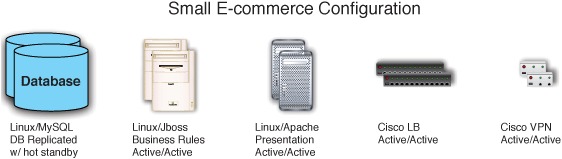
For redundancy, the e-commerce example configuration consists of a pair of each functional component required to operate the application. The hardware chosen for the configuration is rack mountable, commodity servers, and network gear. Except for the database, each component is active; the DB is replicated with a hot standby. We chose a LAMP open source stack to simplify the treatment of software costs.
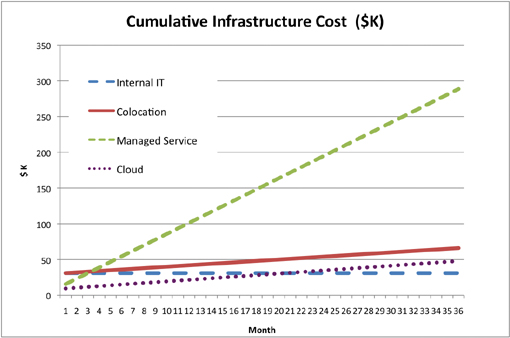
The total cumulative infrastructure cost for the example e-commerce application deployed in four different models. The internal IT model depicts a fixed initial cost due to capital equipment purchase and the implicit assumption that the organization is able to use existing operational resources allocated elsewhere, including the human resources to manage the infrastructure.
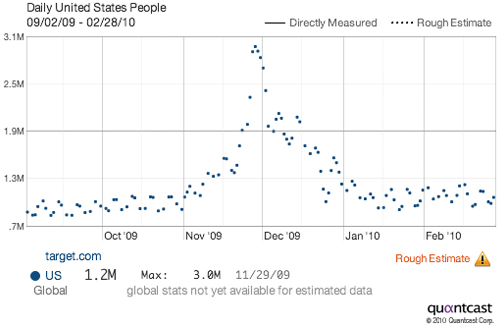
This chart shows the estimated daily number of U.S. visitors to Target.com as determined by Quantcast (www.quantcast.com/target.com) over a one-year interval. As it does for many e-commerce sites, peak utilization occurs predictably at the end of November, at the start of the Christmas shopping season.
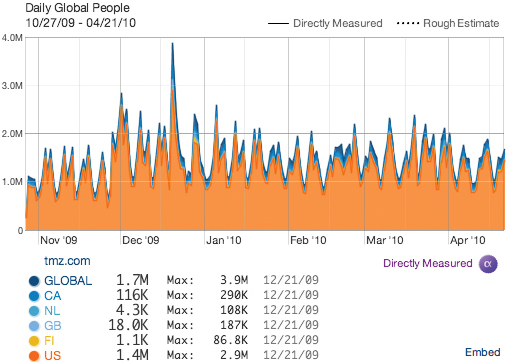
This chart shows the estimated daily number of U.S. visitors to TMZ.com as determined by Quantcast (www.quantcast.com/tmz.com) between 6/03/09 and 8/31/09. This is an example of an event-driven spike in demand on 6/25/09, when TMZ.com was the first to report the death of Michael Jackson.

 The Cloud at Your Service ebook for free
