This chapter introduces the basics of building a Rust web service with Warp by first setting up the project structure, required dependencies, and the runtime stack that powers the server. It explains why Warp is a practical choice for the book’s Q&A application, emphasizing its active community, strong documentation, and the fact that it builds on Tokio for async execution and Hyper for HTTP handling.
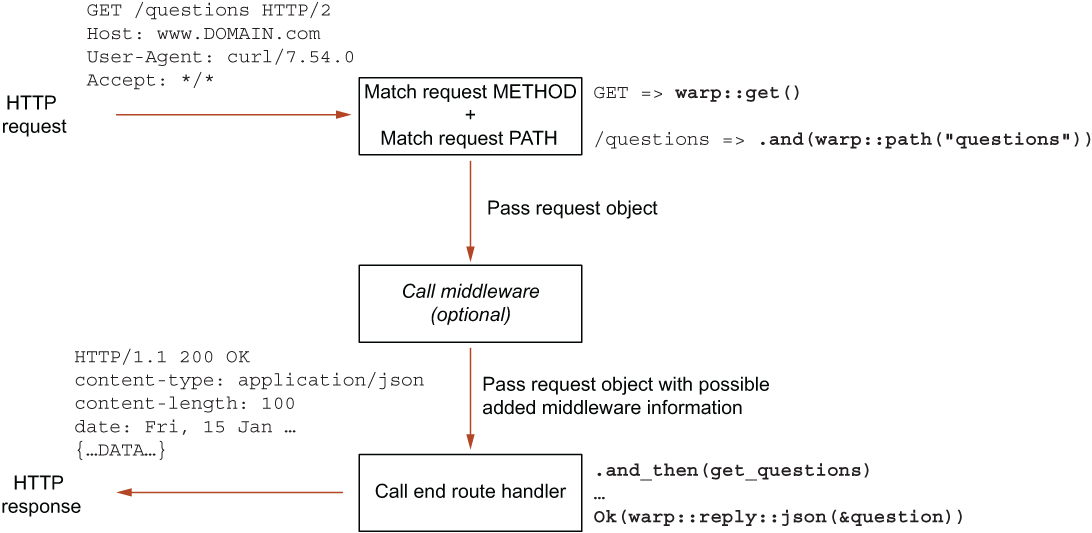
The core lesson is how Warp processes requests through chained filters, which together form routes. A simple first handler is created for a GET request that matches a specific path, calls a route-handling function, and returns JSON. To make that work, the book shows how to structure the handler’s return type, how to use Serde’s serialization support to turn custom Rust data into JSON, and how Warp’s rejection system lets you handle failures cleanly instead of crashing or returning vague responses.
The chapter closes by showing how to customize error handling and prepare the service for browser use with CORS. It demonstrates creating custom rejection types, mapping them to meaningful HTTP status codes, and using Warp’s built-in CORS filter to allow selected origins, headers, and methods. By the end, the reader has a working route, JSON output, graceful error responses, and a server configured to interact safely with browsers across origins.
The web framework Warp includes Tokio as its runtime and Hyper as a HTTP server library.
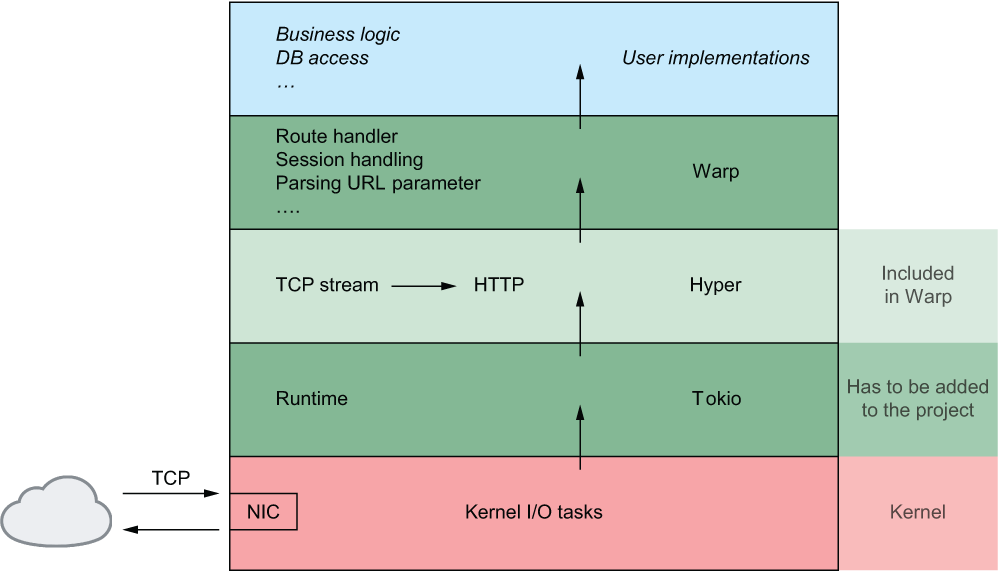
Workflow of sending, parsing, and answering HTTP GET requests with Warp
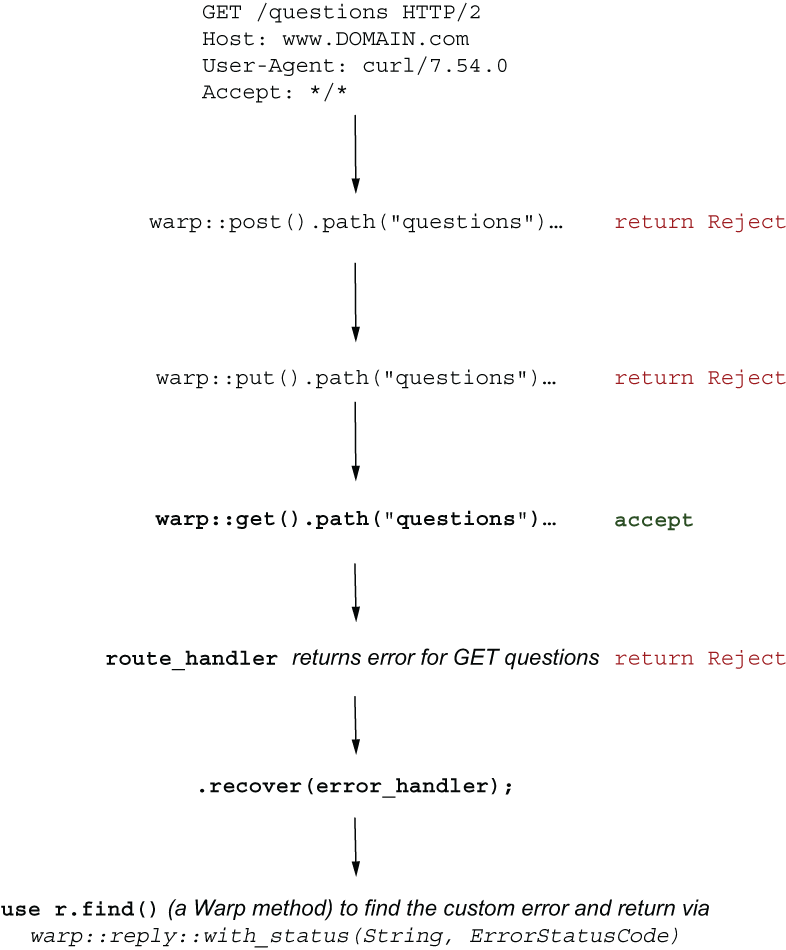
As an HTTP request passes through each filter, facing possible rejections along the way, those rejections can be picked up by Warp’s recover method to send out custom HTTP responses.
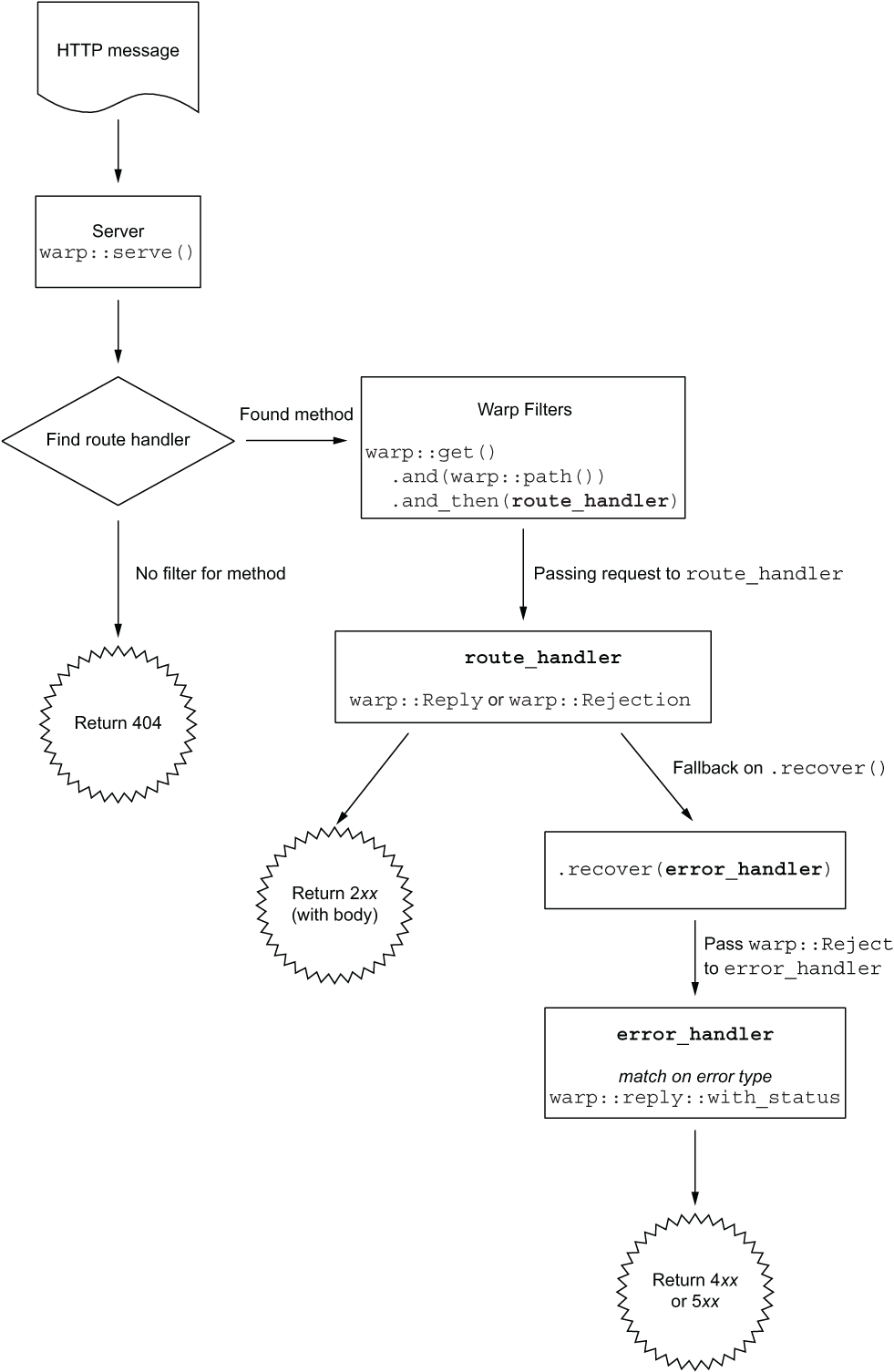
Getting an HTTP request, sending it through Warp filters and the route handler, and then returning a proper HTTP message
In a CORS workflow, a user initiates a POST request inside a browser, and the browser first does a preflight HTTP OPTIONS request to the server, which has to respond with allowed domains (origins), methods, and headers.

Summary
- It is important to understand which stack is covered by the library you are choosing.
- Usually, you have to include a runtime to support your chosen web framework’s asynchronous way of working.
- Every web framework already comes with a web server and types to return proper HTTP messages.
- Try to understand the mindset behind the framework you are choosing and think through a few use cases and how they would be implemented with this mindset.
- Start small and with the happy path, which is the GET route for one particular resource, in most cases.
- Use the Serde library to serialize and deserialize structs you create.
- Immediately start thinking about unsuccessful paths and implement custom error handling afterward.
- When HTTP requests come from a browser and originate from a different domain than the one our server is deployed under, we have to handle OPTION requests, which are part of the CORS workflow.
- The Warp framework has a built-in cors filter that can answer the requests appropriately.

 Rust Web Development ebook for free
