The chapter closes the book with three practical human-in-the-loop product examples that show how to turn the earlier concepts into workable prototypes. Rather than starting from algorithms alone, it emphasizes defining the real human problem first, then designing the interface, annotation flow, model behavior, and evaluation around that problem. The three examples are intentionally lightweight first-pass systems: exploratory analysis of news headlines, extraction of food-safety information from text, and bicycle detection in images.
A central theme is that product decisions depend on how the system will actually be used. The news-headline tool prioritizes analyst agency, transparency, dense information display, and iterative improvement through active learning and stratified sampling. The food-safety system supports an existing expert workflow, so it values speed, compactness, and minimal disruption more than perfect model autonomy; it uses autocomplete-like assistance and straightforward confidence-based uncertainty. The bicycle-counting system, by contrast, is mainly about maximizing model accuracy, so it leans more heavily on strong pretrained vision models, broad visual diversity, and careful monitoring of performance across varied conditions.
The chapter also shows how these systems can be built with simple web-based prototypes by connecting Python and HTML, and how the architecture can evolve through small, targeted extensions. Across all three cases, the book encourages readers to treat the prototypes as starting points rather than final systems, and to think critically about the next most valuable improvement—whether that means better sampling, richer annotation tools, quality control, or stronger model adaptation. The overall message is that effective human-in-the-loop products come from aligning machine learning choices with user goals, workflow constraints, and the type of value the system is meant to deliver.
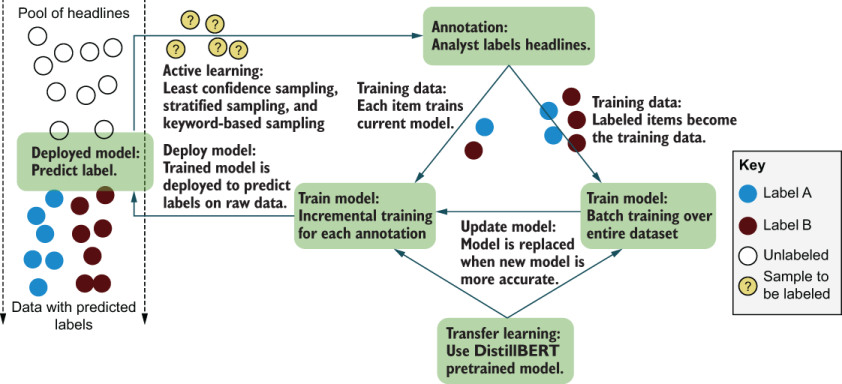
Architecture for the example system to classify news headlines
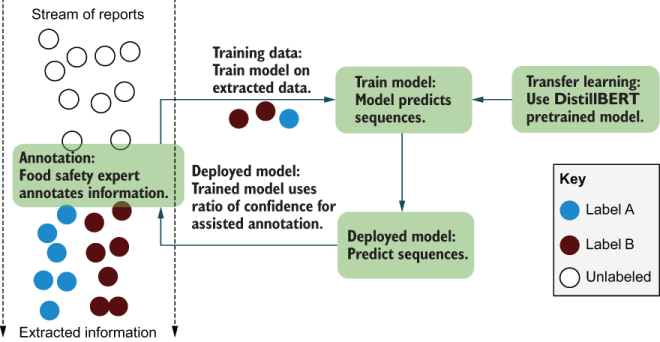
Architecture for the example system to extract information about food safety events from text
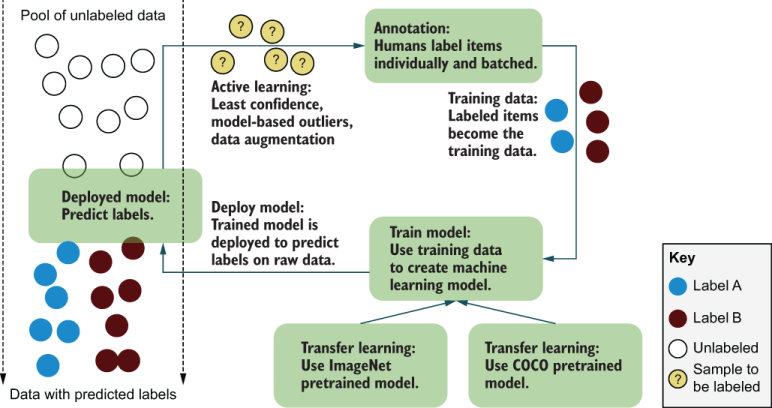
Architecture for the example system to label bicycles
Summary
When defining products for human-in-the-loop machine learning applications, it helps to start with the problem that you are trying to solve and work backward. This approach helps frame everything from the technical design to the interface design and the guidelines for annotation.
We created a system for exploratory data analysis for short text, giving an analyst the ability to filter news headlines quickly according to different labels so that they can see the changes over time.
We created a system to extract information from text, helping a food safety expert track information about pathogens and foreign bodies found in food from plain reports.
We created a system to maximize the accuracy of an image labeling task, assisting a data scientist who is making a bicycle identification model as accurate as possible.
FAQ
What is the best way to define a human-in-the-loop machine learning product?Start by defining the real human problem you are solving, not the technology you plan to use. A clear problem statement helps guide interface design, annotation choices, model architecture, and future product decisions.Why is it important to focus on the user’s daily task when designing these systems?Because human-in-the-loop products are meant to support an actual workflow. Understanding the user’s daily task helps ensure the system improves their work rather than disrupting it, and it shapes what success should look like.What are the three example human-in-the-loop machine learning products in chapter 12?The chapter presents three worked examples: exploratory data analysis for news headlines, information extraction for food safety reports, and image labeling for bicycles.How does the chapter decide between optimizing agency, model accuracy, and annotation accuracy?It depends on the use case. For exploratory data analysis, agency and transparency matter a lot. For food safety, preserving the expert’s workflow and maintaining high annotation accuracy are crucial. For bicycle detection, model accuracy is the main priority.Why does the chapter use eel to connect Python and HTML?eel is a lightweight way to build local HTML interfaces for Python applications. It keeps most of the implementation in Python, which is helpful if the developer is more familiar with Python than JavaScript.What is the role of active learning in the news headline example?Active learning helps choose which headlines to annotate next, using uncertainty sampling and stratified sampling by year. This supports both efficient model improvement and exploration of real-world diversity in the dataset.Why does the food safety example use autocomplete suggestions from matching text?When the model has no prediction, matching strings from the report provide a useful fallback. This preserves a smooth user experience and supports the expert’s workflow without forcing them to wait for model output.Why is maintaining the expert’s agency especially important in the food safety system?Because the system is meant to assist a human process that already exists. The expert should not feel slowed down by machine learning integration; instead, the tool should fit naturally into their current job.Why does the bicycle detection example emphasize model accuracy over annotation or user agency?The task is primarily about producing the most accurate and robust counting model possible. Since the user mainly wants reliable estimates, the design focuses on accuracy, diversity of examples, and effective model training.What kinds of extensions does the chapter suggest for these prototype systems?The chapter suggests many small next steps, such as batch annotation, predictive annotations, better filtering, adjudication interfaces, synthetic data, ensemble sampling, diversity sampling, and other model or interface improvements.
pro $24.99 per month
access to all Manning books, MEAPs, liveVideos, liveProjects, and audiobooks!

 Human-in-the-Loop Machine Learning ebook for free
