Overview

13 Finite field extension curves described

The chapter introduces elliptic curves over finite field extensions as the setting needed for pairing-based cryptography. It explains that an irreducible polynomial plays the role of a modulus, just as a prime does in a base field, and that this lets one build an extension field of size \(p^k\). The key cryptographic idea is the embedding degree: for a curve with a large prime factor \(r\) in its group order, the extension field must be chosen so that the extended curve’s cardinality is also divisible by \(r\), which is captured by the condition \(p^k \equiv 1 \pmod r\).

Building on that algebraic foundation, the chapter adapts the standard elliptic-curve routines to work with polynomial coordinates. It defines polynomial point and curve structures, shows how to initialize, clear, copy, print, and test them, and then extends point embedding, random point generation, addition, and scalar multiplication to the polynomial setting. The implementation repeatedly mirrors the prime-field versions, but every operation must also respect the irreducible polynomial, making the arithmetic more involved while following the same basic elliptic-curve formulas.

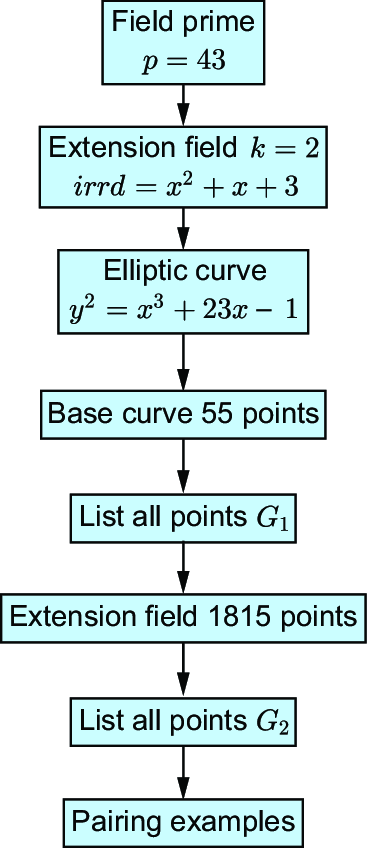
To make the ideas concrete, the chapter uses a small worked example over \(p=43\), with a curve chosen to have manageable cardinality and a very small embedding degree of 2. It demonstrates how to find an irreducible polynomial, enumerate points on the base curve, and then construct and list many more points over the extension curve, where \(x\) and \(y\) become polynomials rather than simple field elements. The example emphasizes that the extension contains all the original points plus many additional ones, illustrating why field extensions are essential for pairing computations and why the structure is more abstract but still governed by the same curve equations.

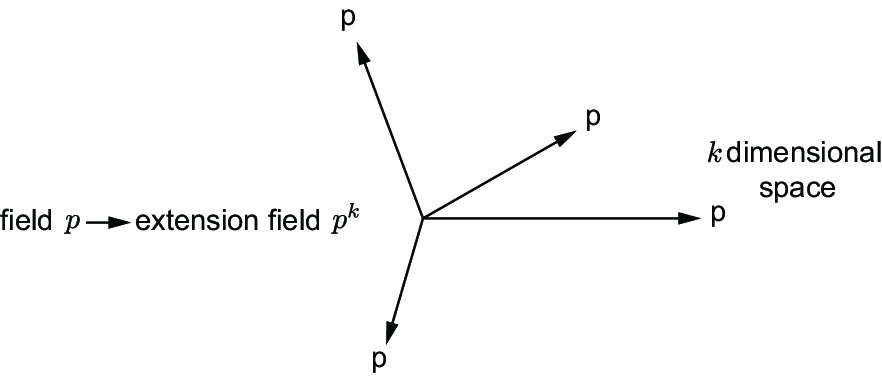
Expanding a prime base field \(p\) to an extension field \(p^k\). Extension fields are required to compute pairings.
figure
Tiny example overall description
figure
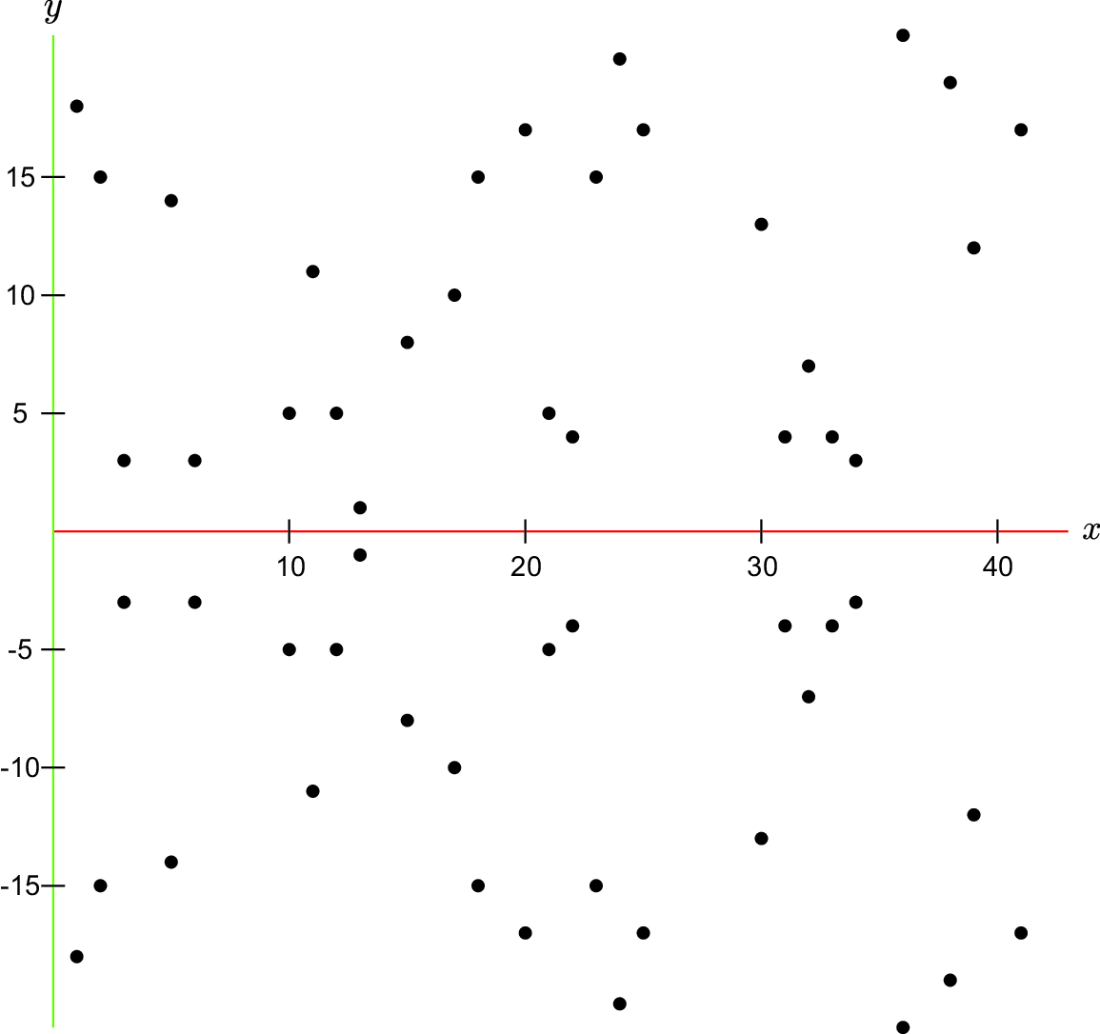
All points on tiny elliptic curve \(y^2=x^3+23x-1\) mod \(43\)
figure
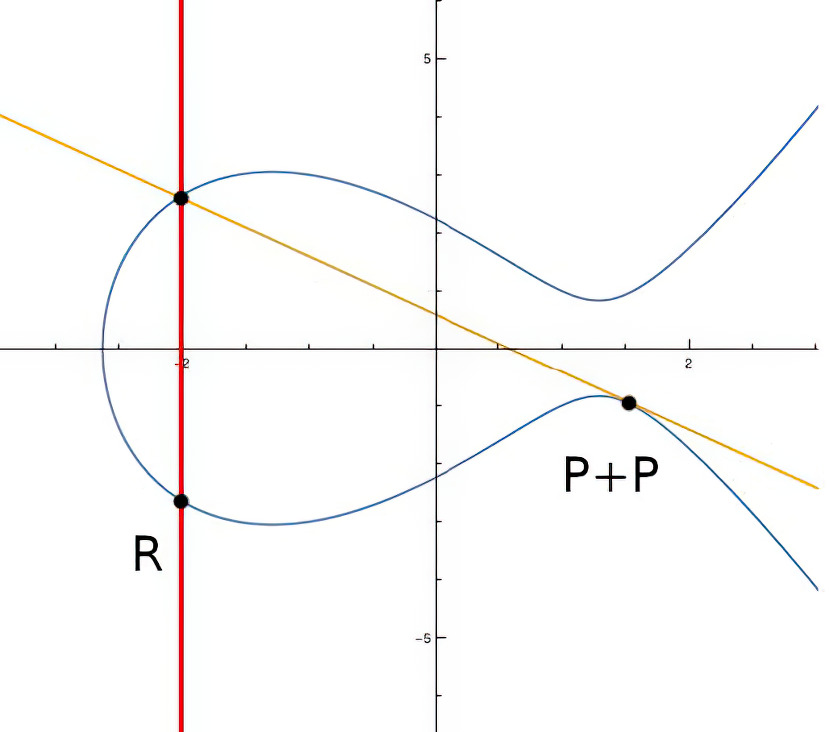
General shape of an elliptic curve to help with field extension abstraction
figure

Summary

  • An elliptic curve over a finite field has cardinality \(\#E=h\cdot r\) with \(r\) a large prime. That curve has field extension \(k\) when \[p^k\cong 1\text{ mod }r\]For elliptic curve pairings, we want \(k\) to be small.
  • The cardinality of a field extension curve is \[\#E_k=p^k+1-t_k\]with \(t_k\) found from the recurrence relation\[t_{n+2}=t_1 t_{n+1} - p t_n\]This is used to find cofactors of field extension curves.
  • Points on a field prime curve are labeled \(G_1\). Points on an extension curve are labeled \(G_2\). A field extension curve has the same coefficients as a field prime curve, but they are constructed as zero-degree polynomials.
  • Testing for a polynomial point at infinity uses the degree of the polynomials as well as the lowest coefficient to determine whether both \(x\) and \(y\) are zero. This is used to determine the order of a point on a field extension curve.
  • Embedding a polynomial point on a polynomial curve requires a "bump" routine that increments the next coefficient. It is only used for small test cases since large coefficients will never roll over.
  • The polynomial random point function embeds a random polynomial on a polynomial curve. This is used to find reference points for pairing calculations.
  • Polynomial elliptic curve addition uses the same formulas as field prime elliptic curve point addition. It just calls polynomial functions to process the math. These routines are used in aggregated signature and zero-knowledge algorithms.
  • Polynomial elliptic curve multiplication is also the same as field prime elliptic curve multiplication. The double and add formula is exactly identical. These routines are used in aggregated signature and zero-knowledge algorithms.
  • A tiny example shows how \(G_1\) and \(G_2\) points are on the same curve. A field extension has both \(G_1\) and \(G_2\) points. A prime field curve can only see \(G_1\) points.

FAQ

What is a finite field extension curve in elliptic curve cryptography?A finite field extension curve is an elliptic curve defined over an extended field \(p^k\) instead of just a prime field \(p\). In this chapter, the curve is used to support pairing computations, and its point coordinates become polynomials modulo an irreducible polynomial.
Why are field extension curves needed for pairings?Pairings require working with points over an extension field so that the curve’s group structure contains the large prime factor needed for the pairing algorithm. The extension curve must have a cardinality divisible by the same large prime \(r\) as the base curve subgroup.
What is the embedding degree of a curve?The embedding degree is the smallest positive integer \(k\) such that \(r\) divides \(p^k - 1\), or equivalently \(p^k \equiv 1 \pmod r\). It tells you the minimum extension field size needed for pairing-based cryptography.
How is the number of points on an extension curve computed?The extension-curve cardinality is written as \(\#E_k = p^k + 1 - t_k\). The values \(t_k\) are found using a recurrence relation starting from \(t_0 = 2\) and \(t_1 = p + 1 - \#E\).
What is the recurrence relation for \(t_k\) in this chapter?The recurrence used is \(t_{n+2} = t_1 t_{n+1} - p t_n\). This lets you compute the trace terms needed to determine the cardinality of the field extension curve.
What are \(G_1\) and \(G_2\) curves?\(G_1\) curves are curves over the base prime field \(p\), while \(G_2\) curves are curves over the extension field \(p^k\). The same curve coefficients are used, but on \(G_2\) the coordinates become polynomials.
How does point embedding work on a field extension curve?To embed a point, the code computes the curve right-hand side \(x^3 + a_4x + a_6\) for a polynomial \(x\), checks whether the result is a quadratic residue, and if not, increments \(x\) until a valid point is found. Then it computes the corresponding \(y\) values.
Why does the chapter use the FF_bump() routine?FF_bump() increments a polynomial \(x\) value through the finite field extension space. It is used when a chosen \(x\) does not produce a quadratic residue, so the routine can move to the next candidate until a valid point is found.
How is point addition performed on extension curve points?Point addition uses the same elliptic curve formulas as in the prime field case, but all arithmetic is done with polynomials modulo the irreducible polynomial. The slope \(\lambda\), new \(x_3\), and new \(y_3\) are computed using polynomial operations.
What does the tiny example in this chapter demonstrate?The tiny example shows how a very small base curve and its extension curve produce actual \(G_1\) and \(G_2\) points. It illustrates that the extension curve includes all base-field points plus many additional points, making the structure useful for pairings.

pro $24.99 per month

  • access to all Manning books, MEAPs, liveVideos, liveProjects, and audiobooks!
  • choose one free eBook per month to keep
  • exclusive 50% discount on all purchases
  • renews monthly, pause or cancel renewal anytime

lite $19.99 per month

  • access to all Manning books, including MEAPs!

team

5, 10 or 20 seats+ for your team - learn more


Close
choose your plan

team

monthly
annual
$49.99
$499.99
only $41.67 per month
  • five seats for your team
  • access to all Manning books, MEAPs, liveVideos, liveProjects, and audiobooks!
  • choose another free product every time you renew
  • choose twelve free products per year
  • exclusive 50% discount on all purchases
  • renews monthly, pause or cancel renewal anytime
  • renews annually, pause or cancel renewal anytime
  • Elliptic Curve Cryptography for Developers Elliptic Curve Cryptography for Developers ebook for free

Close
choose your plan

team

monthly
annual
$49.99
$499.99
only $41.67 per month
  • five seats for your team
  • access to all Manning books, MEAPs, liveVideos, liveProjects, and audiobooks!
  • choose another free product every time you renew
  • choose twelve free products per year
  • exclusive 50% discount on all purchases
  • renews monthly, pause or cancel renewal anytime
  • renews annually, pause or cancel renewal anytime
  • Elliptic Curve Cryptography for Developers Elliptic Curve Cryptography for Developers ebook for free